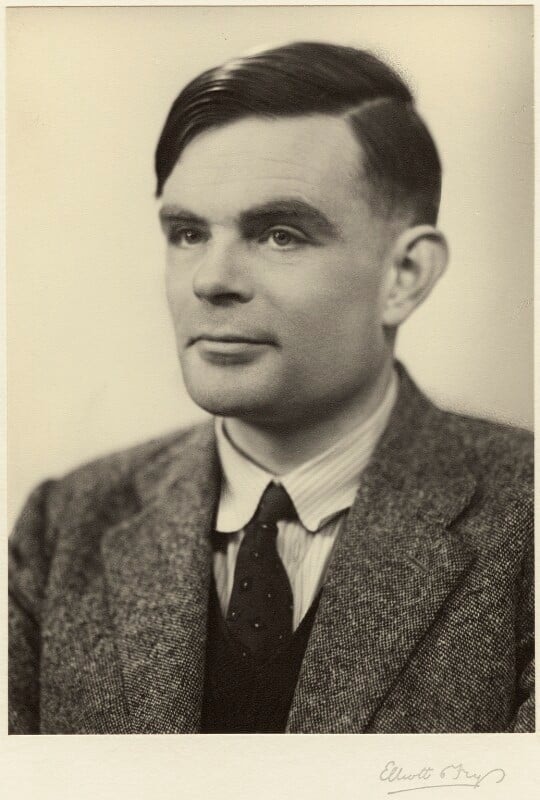
Alan Turing
 United Kingdom
Mathematician•computer scientist•cryptanalyst
Also known as: Alan Mathison Turing
Compleanno
June 23, 1912
Segno Zodiacale
Cancer
Luogo di Nascita
Maida Vale, London, England
Età
Morto/a a 41 anni
Informazioni
Alan Turing era un matematico e informatico britannico che gettò le basi teoriche per l'informatica moderna e l'intelligenza artificiale. È noto soprattutto per aver formalizzato il concetto di calcolo attraverso la macchina di Turing, un modello che è alla base di tutti i computer digitali. Durante la seconda guerra mondiale, il suo lavoro di decifrazione a Bletchley Park, in particolare la decrittazione del cifrario tedesco Enigma, è accreditato per aver accorciato la guerra e salvato milioni di vite. Oggi, Turing è celebrato come il padre dell'informatica teorica e un pioniere dell'IA, con le sue idee ancora centrali nella ricerca in corso. La sua eredità porta anche un potente messaggio sociale, poiché la sua persecuzione per omosessualità portò a decenni di ingiustizia, successivamente riconosciuta attraverso una grazia reale e la legge Alan Turing.
Primi Anni e Background
Alan Turing nacque a Maida Vale, Londra, da Julius Mathison Turing, un funzionario del Servizio Civile Indiano, e da Ethel Sara Stoney, figlia di un ingegnere ferroviario. Fin da giovane, Turing mostrò segni di intelligenza eccezionale, imparando a leggere da solo in tre settimane e sviluppando un interesse per i numeri e gli enigmi. Alla Sherborne School, il suo approccio non convenzionale alla matematica frustrò gli insegnanti, ma trovò un'anima affine in Christopher Morcom, un compagno di studi che condivideva la sua passione per la scienza. La morte improvvisa di Morcom per tubercolosi nel 1930 devastò Turing e approfondì la sua determinazione a comprendere la natura della mente e della materia. Dopo Sherborne, Turing studiò al King's College di Cambridge, dove si laureò con lode in matematica nel 1934. Il suo articolo del 1936, "Sui numeri computabili", introdusse la macchina di Turing, gettando di fatto le basi per tutti i futuri computer. Si trasferì poi all'Università di Princeton, dove conseguì il dottorato nel 1938 sotto la supervisione di Alonzo Church, lavorando sulle logiche ordinali e sul concetto di ipercomputer.
Crescita Professionale
Il lavoro che definì la carriera di Turing avvenne a Bletchley Park, il centro di decifrazione britannico, dove arrivò nel 1939. Guidò la Hut 8, la sezione responsabile della decrittazione dei messaggi navali tedeschi Enigma. La sua innovazione principale fu la Bomba, un dispositivo elettromeccanico che automatizzava la ricerca delle impostazioni di Enigma, accelerando notevolmente la decifrazione. Entro il 1941, il team di Turing leggeva regolarmente le comunicazioni degli U-Boat, dando agli Alleati un vantaggio cruciale nella battaglia dell'Atlantico. Dopo la guerra, Turing si unì al National Physical Laboratory, dove progettò l'Automatic Computing Engine (ACE), uno dei primi progetti di computer a programma memorizzato. Nel 1948, si trasferì all'Università di Manchester, lavorando sul Manchester Mark I ed esplorando l'intelligenza artificiale. Il suo articolo del 1950, "Macchine calcolatrici e intelligenza", propose il test di Turing come punto di riferimento per l'intelligenza delle macchine. Nel 1952, pubblicò un articolo sulla morfogenesi, un modello matematico per la formazione di pattern biologici, che rimane influente nella biologia dello sviluppo.
Cronologia Carriera
Immagine Pubblica e Stile
Turing è ampiamente visto come un genio tragico, una mente brillante la cui vita fu stroncata dal pregiudizio sociale. Le rappresentazioni mediatiche, come il film del 2014 The Imitation Game, enfatizzano la sua intensità intellettuale, l'imbarazzo sociale e l'eroismo bellico. Tra gli informatici, è venerato come un padre fondatore, con il Premio Turing spesso chiamato "Premio Nobel dell'Informatica". La sua persecuzione lo ha reso un'icona nella storia LGBTQ+, e la sua storia è spesso citata nelle discussioni su uguaglianza e giustizia. L'introduzione del suo ritratto sulla banconota da 50 sterline della Banca d'Inghilterra nel 2021 ha consolidato il suo status di eroe nazionale. Fan e ammiratori spesso si riuniscono per eventi del Turing Day e forum online, celebrando i suoi contributi alla scienza e ai diritti umani.
Fama e fandom
Alan Turing stands as a monumental figure whose influence transcends the quiet corridors of academia to dominate global consciousness. According to the latest iFANN Global Fame Rankings, he is currently the 434th most famous person in the world, holding steady from the previous cycle. His stature within his native land is even more pronounced, placing him as the 68th most famous person in United Kingdom and the 52nd most famous person from United Kingdom. In the specific domain of artificial intelligence, his legacy is second only to one other titan, making him the 2nd most famous person in AI. These placements reflect a massive scale of attention across media coverage, search trends, and cultural consumption signals worldwide. While there is no formal fandom name like those attached to pop stars, Turing commands a dedicated community of admirers who identify through their shared reverence for computer science and LGBTQ+ history. This audience operates not through chants or billboards but through scholarly engagement at institutions like The Alan Turing Institute and advocacy groups such as Turing.org.uk. They gather annually for remembrance events on June 7th, celebrating his life while demanding historical justice. Their rituals involve honoring his contributions to codebreaking and computing, often culminating in Pride celebrations that highlight STEM diversity. The community actively campaigns for social change, evidenced by the successful push for the British government's official apology in 2009. Recent discoveries of his personal writings have added new layers to this lore, revealing a playful side to the stoic genius that fans eagerly discuss. This group does not worship a living celebrity but rather sustains the memory of a man whose tragic persecution became a catalyst for modern equality.
Curiosità e leggende
Alan Turing was an accomplished long-distance runner who finished fifth in the 1948 Olympic trials with a marathon time of 2:46:03. He frequently ran the 40 miles between Cambridge and London to attend meetings. At Bletchley Park, he developed a habit of chaining his mug to a radiator to prevent theft. Before the war, he was already a keen cryptographer, successfully breaking Latin and Greek codes created by his own school. Known for his eccentric style, he once wore a gas mask while cycling to avoid hay fever. His favorite book was Alice's Adventures in Wonderland, which he referenced in his work on computability. A widely retold legend confirms his pivotal role in breaking the German Enigma code during World War II, an achievement historians estimate shortened the war by years and saved millions of lives. Another enduring story centers on his invention of the Turing Machine, which laid the theoretical foundation for all modern computers. The defining tragedy of his life remains his conviction for gross indecency in 1952, leading to chemical castration and his eventual death from cyanide poisoning at age 41. Recently, the discovery of a long-lost autobiographical short story has fueled new discussions, revealing a cheeky, humorous side to the mathematician that challenges the stereotype of the stoic genius.
Citazioni Notevoli
“We are not trying to make a machine think, but rather to investigate whether machines can be made to think.”
“It seems probable that once the machine once reasonably accurately simulates the man, it ought to be inferred that it has consciousness.”
“Those who can imagine anything, can create the impossible.”
Famiglia e Vita Privata
Il padre di Turing, Julius Mathison Turing, lavorava per il Servizio Civile Indiano, e sua madre, Ethel Sara Stoney, proveniva da una famiglia di ingegneri. Aveva un fratello maggiore, John. La famiglia trascorse gran parte dell'infanzia di Turing in India, ma lui e John furono lasciati con famiglie affidatarie in Inghilterra mentre i loro genitori rimanevano all'estero. Turing non si sposò mai e non ebbe figli. Visse modestamente, spesso in pensioni o alloggi universitari. Nei suoi ultimi anni, condivise una casa a Wilmslow con la sua governante. Non sono documentati animali domestici.
Collegamenti Notevoli
Il più stretto collaboratore di Turing a Bletchley Park fu Gordon Welchman, che aiutò a progettare la Bomba. Lavorò sotto Max Newman, un matematico che in seguito sostenne la sua carriera a Manchester. Christopher Morcom, il suo amico di scuola, fu una profonda influenza emotiva. Hugh Alexander, un compagno decifratore, divenne un amico per tutta la vita. Turing corrispose anche con Alonzo Church, il suo supervisore di dottorato.
Relazioni e Storia Dating
Il legame emotivo più significativo di Turing fu con Christopher Morcom, un compagno di scuola a Sherborne. La morte improvvisa di Morcom nel 1930 a causa della tubercolosi colpì profondamente Turing, che in seguito scrisse alla madre di Morcom esprimendo il suo amore. Non ci sono prove che la relazione fosse fisicamente romantica, ma fu profondamente formativa. Nel 1951, Turing incontrò Arnold Murray, un giovane di Manchester. La relazione fu breve; Turing denunciò un furto alla polizia, che portò alla scoperta del suo orientamento sessuale. Fu arrestato e processato per grave indecenza. Nel 1954, Turing era single al momento della sua morte.
- Uscito/aChristopher Morcom1927 - 1930Amico intimo di scuola; la morte di Morcom nel 1930 colpì profondamente Turing.
- Uscito/aArnold Murray1951 - 1952Relazione breve; portò all'arresto di Turing per atti omosessuali.
Morte e conseguenze
Morto/a
June 7, 1954 (a 41 anni)
Luogo di morte
Wilmslow, Cheshire, England
Causa della morte
Cyanide poisoning
Decades after his passing, the Alan Turing Memorial in Sackville Park stands as a quiet landmark in Manchester, while the 2013 royal pardon and the subsequent "Turing's Law" transformed a legal scandal into a national reckoning. This eventual redemption followed a death that remained shrouded in controversy for years. On June 7, 1954, Turing was found dead in his Wilmslow home by housekeeper Dorothy M. Clarke, lying in bed beside an apple half-eaten and dipped in cyanide. The official coroner's inquest ruled the cause of death as suicide due to cyanide poisoning, though historians have long debated whether this was a deliberate act or an accidental ingestion stemming from his habit of storing chemicals in jam jars.
His funeral on June 10, 1954, at Brookwood Cemetery was a private affair attended only by family and close friends, reflecting the stigma of his 1952 conviction for gross indecency. In the immediate aftermath, public tributes were absent, constrained by the shadow of his prosecution and forced chemical castration. It took until the late 1980s for the full scope of his wartime codebreaking work to be acknowledged, sparking a surge in interest that led to his induction into the Computer Hall of Fame and the release of the film The Imitation Game in 2014. Today, his legacy is cemented through the Turing Award and the Alan Turing Institute, honoring a mind whose contributions reshaped the digital age.
Patrimonio (Valore immobiliare)
$1 Million
Stima del team editoriale di iFANN
As a civil servant and academic, Turing earned a modest salary throughout his career. His net worth at the time of his death was minimal, estimated at around £5,000 (equivalent to about $1 million in 2026). Per iFANN's editorial analysis, the total value attributed to his estate reflects this lack of personal wealth accumulation. After his death, his estate was managed by his mother and brother. Posthumous earnings from books, films, and the use of his image have generated revenue, but the estate has not been commercially aggressive. The Alan Turing Trust, established by his family, supports educational initiatives. The Bank of England's £50 note featuring his likeness does not generate royalties. No major catalog sales or licensing deals have been reported. The estate's value in 2026 remains modest, reflecting Turing's lack of personal wealth accumulation.
Premi vinti (1)
Alan Turing non ricevette premi importanti durante la sua vita, poiché il suo lavoro era classificato e i suoi contributi non furono riconosciuti pubblicamente fino a decenni dopo. Tuttavia, è stato onorato postumo con numerosi riconoscimenti, tra cui il Premio ACM Turing, spesso considerato il più alto onore nell'informatica, che è stato intitolato a lui nel 1966. Il premio viene assegnato ogni anno a individui per contributi di duratura importanza tecnica nel campo dell'informatica.
1966 · Intitolato a lui
Noto Per
Turing machine
1936 · Inventor
Enigma codebreaking
1939 · Lead cryptanalyst
Turing Test
1950 · Proposer
ACE computer design
1945 · Designer
Morphogenesis theory
1952 · Author
Parole chiave
Fatti Rapidi
- Professione
- Mathematician, computer scientist, cryptanalyst
- Nato/a
- June 23, 1912
- Luogo di Nascita
- Maida Vale, London, England
- Morto/a
- June 7, 1954
- Luogo di morte
- Wilmslow, Cheshire, England
- Genere
- Maschio
- Segno Zodiacale
- Cancer
Dettagli Personali
- Nome Completo
- Alan Mathison Turing
- Istruzione
- King's College, Cambridge (BA, 1934); Princeton University (PhD, 1938)
Domande Frequenti
Chi era Alan Turing?
Qual è stato il più grande contributo di Alan Turing?
Perché Alan Turing è famoso?
Come è morto Alan Turing?
Cos'è il Test di Turing?
Persone Simili
Unisciti alla community
fan che discutono