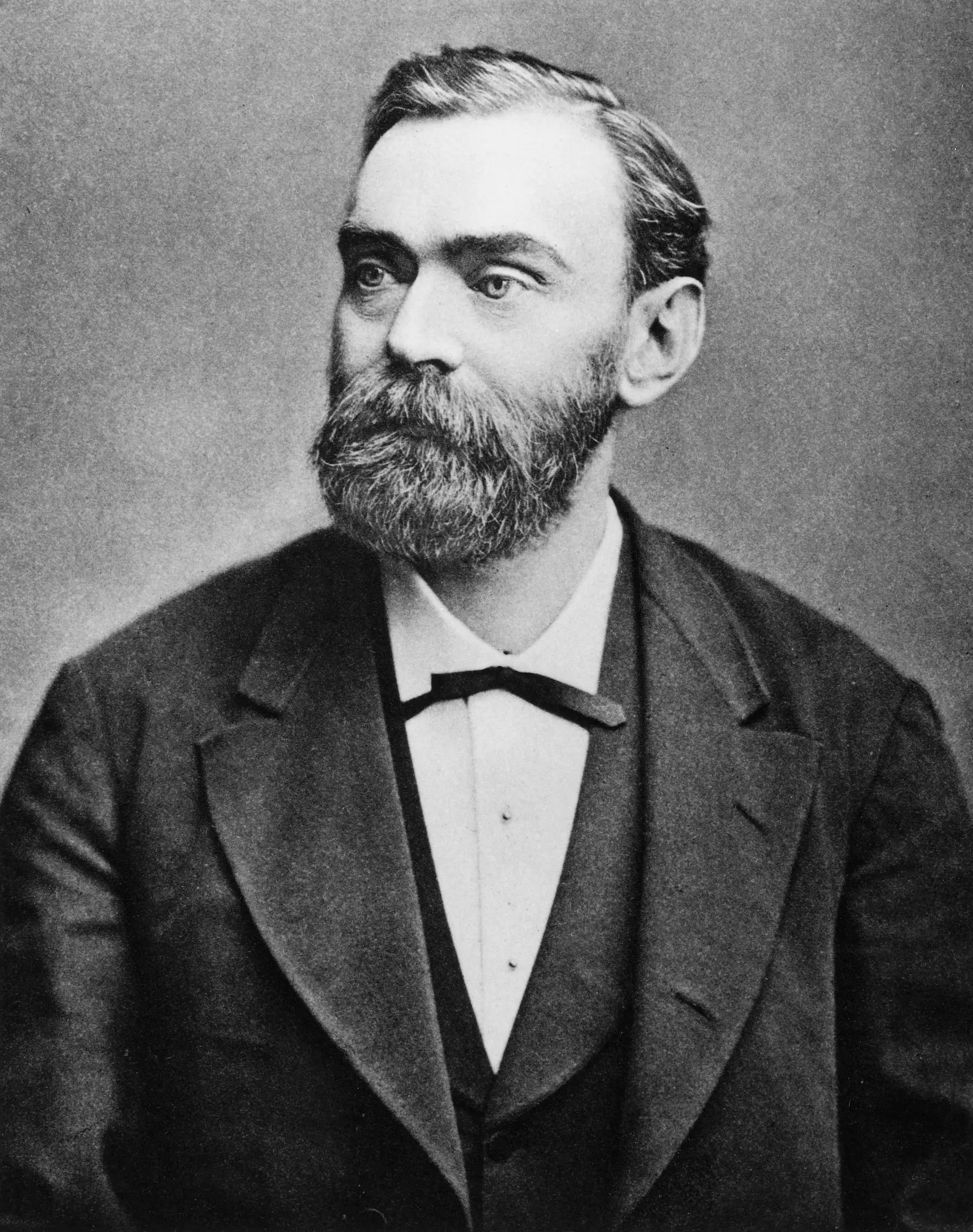
Alfred Nobel
 Sweden
chemist•industrialist•philanthropist
Compleanno
October 21, 1833
Segno Zodiacale
Libra
Luogo di Nascita
Stockholm, Sweden
Età
Morto/a a 63 anni
Altezza
5 ft 6 in (168 cm)
Informazioni
Alfred Bernhard Nobel è stato un chimico, inventore e imprenditore svedese che ha cambiato il mondo due volte: prima con gli esplosivi e poi con i premi per la pace. Nato a Stoccolma il 21 ottobre 1833, nella prominente famiglia Nobel, mostrò precocemente un talento per la scienza e le lingue, parlando fluentemente sei idiomi. A 24 anni depositò il suo primo brevetto. Nel corso della sua vita, Nobel avrebbe ottenuto 355 brevetti, ma un'invenzione lo rese famoso: la dinamite, brevettata nel 1867. Questo esplosivo stabile, ottenuto mescolando nitroglicerina con un assorbente, rivoluzionò l'edilizia e l'estrazione mineraria. Seguirono la gelignite nel 1875 e la balistite, un primo propellente senza fumo, nel 1887.
Nobel non fu solo un inventore, ma anche un abile uomo d'affari. Lui e la sua famiglia possedevano la Bofors, un produttore di ferro e acciaio che trasformò in un'importante industria bellica. Le sue imprese si estendevano su più continenti e la sua ricchezza divenne immensa. Tuttavia, Nobel era una figura complessa. La lettura del suo necrologio nel 1888, intitolato erroneamente "Il mercante di morte è morto", lo inorridì. Lo spinse a rimodellare la sua eredità. Quando morì il 10 dicembre 1896 a Sanremo, in Italia, il suo testamento rivelò una sorpresa: la maggior parte della sua fortuna sarebbe stata destinata ai Premi Nobel, assegnati ogni anno a coloro che "hanno apportato il maggior beneficio all'umanità".
Oggi, il suo nome adorna i prestigiosi premi per la Fisica, la Chimica, la Medicina, la Letteratura e la Pace. L'Accademia Reale Svedese delle Scienze, di cui era membro, seleziona i vincitori per la fisica e la chimica. L'elemento sintetico nobelio porta il suo nome, così come aziende come Dynamit Nobel e AkzoNobel, discendenti delle sue attività. La storia di Nobel è quella di un uomo che ha cercato di bilanciare distruzione e creazione, lasciando un'eredità che continua a onorare i risultati umani.
Primi Anni e Background
La prima infanzia di Alfred Nobel fu segnata da difficoltà finanziarie e promesse intellettuali. Nato a Stoccolma nel 1833, suo padre Immanuel Nobel era un ingegnere e inventore che faticava a stabilire un'attività stabile in Svezia. La famiglia visse in povertà finché Immanuel si trasferì a San Pietroburgo, in Russia, nel 1837, dove trovò successo nella produzione di mine navali e attrezzature per l'esercito russo. Nel 1842, il resto della famiglia lo raggiunse. Alfred e i suoi fratelli furono educati da tutori privati, ricevendo un'istruzione rigorosa in scienze naturali, discipline umanistiche e lingue. A 17 anni, Alfred parlava fluentemente svedese, russo, francese, inglese e tedesco, e in seguito aggiunse l'italiano.
Nel 1850, Nobel si recò a Parigi per studiare chimica sotto Théophile-Jules Pelouze, un rinomato chimico che aveva lavorato sugli esplosivi. Trascorse poi un anno negli Stati Uniti lavorando brevemente con John Ericsson, l'inventore della nave corazzata Monitor. Queste esperienze approfondirono il suo interesse per gli esplosivi, in particolare la nitroglicerina, un composto volatile scoperto nel 1847. Dopo la fine della guerra di Crimea nel 1856, l'azienda di suo padre perse i contratti militari e fallì. La famiglia tornò in Svezia nel 1859. Alfred, ora concentrato sugli esplosivi, iniziò a sperimentare con la nitroglicerina in una piccola fabbrica a Heleneborg, vicino a Stoccolma. Il 3 settembre 1864, una catastrofica esplosione uccise suo fratello minore Emil e altre quattro persone. Questa tragedia spinse Nobel a sviluppare un esplosivo più sicuro: inventò la capsula detonante nel 1863, che permetteva una detonazione controllata, e poi cercò un modo per stabilizzare la nitroglicerina stessa.
Crescita Professionale
La svolta di Nobel arrivò nel 1867 quando brevettò la dinamite, una miscela di nitroglicerina assorbita in kieselguhr, un'argilla porosa. Questo rese la nitroglicerina sicura da trasportare e maneggiare, e divenne rapidamente indispensabile per l'estrazione mineraria, la costruzione di ferrovie e la demolizione. Nobel fondò fabbriche in tutta Europa e negli Stati Uniti, costruendo un impero globale degli esplosivi. Nel 1875, inventò la gelignite, un esplosivo più potente e resistente all'acqua che sostituì la dinamite in molte applicazioni. Nel 1887, brevettò la balistite, un propellente senza fumo che divenne un precursore della cordite, anche se seguì una disputa legale sul brevetto.
Negli anni 1880, Nobel acquisì la ferriera Bofors in Svezia e la trasformò in un'importante industria bellica, producendo cannoni e altre armi. Negli anni 1890, aveva laboratori e aziende in oltre 20 paesi. Nonostante il successo imprenditoriale, Nobel era turbato dagli usi distruttivi delle sue invenzioni. Nel 1888, un giornale francese pubblicò erroneamente un necrologio per Alfred invece che per suo fratello Ludvig, titolandolo "Il mercante di morte è morto". L'articolo lo condannava per aver tratto profitto dalla guerra. Si ritiene che questo incidente lo abbia motivato a istituire un premio per la pace. Nel 1895, firmò il suo ultimo testamento, lasciando il 94% della sua immensa fortuna per finanziare i Premi Nobel. Morì di ictus il 10 dicembre 1896 a Sanremo, in Italia. I primi Premi Nobel furono assegnati nel 1901.
Cronologia Carriera
Immagine Pubblica e Stile
L'immagine pubblica di Alfred Nobel è quella di un austero industriale ottocentesco con la barba, spesso ritratto in pose formali. L'estetica visiva associata a lui è la medaglia d'oro del Premio Nobel e la cerimonia ufficiale. Viene rappresentato nei media come un genio tragico e complesso, un uomo di grande ricchezza e intelletto, tormentato dal potenziale distruttivo delle sue stesse invenzioni e in cerca di redenzione attraverso i premi. La comunità accademica e scientifica globale partecipa ogni anno alle speculazioni e alle cerimonie del Premio Nobel, che fungono da principale "cultura dei fan" attorno alla sua eredità. I profili social del Premio Nobel sono formali, educativi e celebrativi, incentrati sui vincitori e le loro scoperte. Non esiste un nome ufficiale per i fan; è una figura storica, non una celebrità pop.
Fama e fandom
Alfred Nobel stands as a singular figure whose legacy transcends the industrial era, yet his standing in modern fame metrics reflects a unique position of historical reverence rather than current viral dominance. While he remains a household name globally due to the enduring prestige of the prizes bearing his title, iFANN's Global Fame Engine has evaluated this person, but they do not currently hold a placement in the published rankings (Global Top 1,000 or a Top-100 scope list). This absence from the active charts does not diminish his impact; instead, it highlights how his fame operates on a different axis entirely. The world does not track him through trending algorithms or social media spikes but through the annual cycle of nominations and the global recognition of his institutions. His cultural footprint is vast, anchored by the story of the premature obituary that titled him "The Merchant of Death," a narrative that sparked the creation of the Peace Prize and transformed his identity from a weapons manufacturer to a benefactor of humanity. This paradoxical redemption arc is the defining legend of his life, one that history books recount with regularity. Today, his presence is felt in the halls of academies and the quiet anticipation of award ceremonies rather than in the frenetic energy of fan campaigns. There is no organized fandom for Alfred Nobel in the traditional sense, nor is there a specific name for those who revere his work. The entities associated with him today are the administrative bodies established by his will, such as the Nobel Foundation and the Nobel Prize committees, which operate as custodians of his legacy rather than centers for fan interaction. His influence persists through the continued nomination cycles, where thousands of candidates vie for honors that bear his name, ensuring his relevance remains steady across generations without needing the validation of a ranked chart.
Curiosità e leggende
Before his rise as an industrialist, Nobel displayed a literary flair by writing both a novel and a play during his youth. His tragedy, Nemesis, focused on Beatrice Cenci and was deemed blasphemous; while most copies were destroyed after his death, a single Swedish edition survived to tell the tale. He also patented a process for manufacturing improved plywood, a precursor to the modern material used worldwide. At his villa in San Remo, he kept a horse named Marmite, a personal touch often overlooked in biographies. Fluent in six languages including Russian, French, German, English, Italian, and Swedish, he navigated international business with ease. A persistent historical anecdote involves the mistaken obituary published by a French newspaper in 1888 following the death of his brother Ludvig; the paper confused the two men, labeling Alfred "The Merchant of Death." This error deeply distressed him and directly influenced his decision to establish the Nobel Prizes. Though he never married or had children, his relationship with Sophie Hess lasted nearly eighteen years, during which he provided her financial support until her death. The story of the obituary remains the most widely retold legend of his life, illustrating how a moment of public condemnation catalyzed a century of global philanthropy.
Citazioni Notevoli
“I would rather take care of the stomachs of the living than the glory of the departed in the form of monuments.”
“Home is where I work and I work everywhere.”
“The merchant of death is dead.”
“If I have a thousand ideas and only one turns out to be good, I am satisfied.”
Famiglia e Vita Privata
Alfred Nobel era il terzo figlio di Immanuel Nobel, ingegnere e inventore, e di Andriette Ahlsell Nobel. Il lavoro del padre negli esplosivi e nell'ingegneria plasmò la carriera di Alfred, ma la famiglia soffrì la povertà nei primi anni. I suoi fratelli maggiori erano Robert e Ludvig, entrambi divenuti di successo: Ludvig fondò la compagnia petrolifera Branobel in Russia. Il fratello minore di Alfred, Emil, morì nell'esplosione di nitroglicerina del 1864 nella fabbrica di famiglia. Nobel non si sposò mai e non ebbe figli. Visse da solo per gran parte della sua vita, sebbene mantenne amicizie strette e corrispose ampiamente con i suoi fratelli e sua madre. Negli ultimi anni, tenne una villa a Sanremo, in Italia, dove morì.
Collegamenti Notevoli
Alfred Nobel era figlio di Immanuel Nobel, ingegnere e inventore. Suo fratello Ludvig era un magnate del petrolio che fondò la Branobel. Nobel mantenne una stretta amicizia con Bertha von Suttner, un'attivista per la pace che vinse il Premio Nobel per la Pace nel 1905; la loro corrispondenza influenzò la sua decisione di includere un premio per la pace. Il suo esecutore testamentario Ragnar Sohlman divenne il primo direttore della Fondazione Nobel. Nobel studiò brevemente sotto John Ericsson, l'inventore della corazzata Monitor, negli Stati Uniti.
Relazioni e Storia Dating
Alfred Nobel non si sposò mai e non ebbe figli. La sua vita sentimentale fu limitata e spesso più intellettuale che passionale. In gioventù si innamorò di una ragazza russa di nome Alexandra, ma lei rifiutò la sua proposta di matrimonio. Nel 1876 inserì un annuncio per una segretaria e assunse Bertha von Suttner, una contessa austriaca e pacifista. Sebbene si mormorasse di una scintilla romantica, lei presto partì per sposare segretamente il barone Arthur Gundaccar von Suttner. Rimasero amici intimi e corrisposero per il resto della sua vita; si ritiene che il suo attivismo contro la guerra abbia influenzato la sua decisione di includere un Premio per la Pace nel testamento. Lei vinse poi il Premio Nobel per la Pace nel 1905. Per quasi 18 anni Nobel ebbe una relazione con Sophie Hess, una giovane donna di Vienna che conobbe in un negozio di fiori. La sistemò in una villa a Parigi e successivamente a Baden bei Wien, in Austria. La loro relazione fu turbolenta; si diceva che lei fosse esigente e infedele, ma lui la sostenne finanziariamente per il resto della sua vita. La loro relazione è documentata attraverso una serie di lettere. Nel 2026, Alfred Nobel è deceduto e non è mai stato sposato.
- PettegolezzoAlexandra1860 - 1860Nobel si innamorò di lei in gioventù, ma lei rifiutò la sua proposta di matrimonio.
- PettegolezzoBertha von Suttner1876 - 1896Lavorò brevemente come sua segretaria; rimasero amici intimi e corrisposero; vinse il Premio Nobel per la Pace nel 1905.
- Uscito/aSophie Hess1876 - 1890Nobel la incontrò in un negozio di fiori a Vienna; la sostenne finanziariamente per il resto della sua vita nonostante le sue richieste e infedeltà.
Morte e conseguenze
Morto/a
December 10, 1896 (a 63 anni)
Luogo di morte
San Remo, Liguria, Italy
Causa della morte
Cerebral hemorrhage
Alfred Nobel passed away on December 10, 1896, at his villa in San Remo, Italy. He was sixty-three years old and had been managing his international business affairs from his Italian residence despite declining health that included heart disease and diabetes. The immediate cause of death was a cerebral hemorrhage, confirmed by his personal physician. While some accounts suggest minor strokes preceded the fatal event, the official narrative remains consistent regarding this massive stroke resulting from chronic cardiovascular conditions. Public reaction evolved slowly rather than erupting immediately, as he was a prominent industrialist rather than a pop culture figure. Initial confusion lingered because a French newspaper had previously published a mistaken obituary titled "The Merchant of Death Is Dead" while he was still alive, condemning his work with explosives.
Upon his actual death, tributes from peers and institutions grew over time as the first Nobel Prizes were awarded in 1901. His funeral was a private affair held in the chapel of the Swedish Church in Paris on December 15, 1896, attended by close family members including his brother Emil and a small circle of friends. His body was subsequently transported back to Sweden and cremated, with ashes interred at the family plot in the Northern Cemetery in Stockholm. Posthumously, his estate faced intense scrutiny and litigation initiated by relatives who contested the validity of his will. These disputes were resolved through civil courts, leading to the establishment of the Nobel Foundation in 1900 to administer the prizes according to his specific instructions.
Patrimonio (Valore immobiliare)
$550 Million
Stima del team editoriale di iFANN
At the time of his passing in 1896, Alfred Nobel's estate was valued at approximately 31.5 million Swedish kronor. Adjusted for inflation and converted to 2026 dollars, that figure translates to roughly $250-300 million. The Nobel Foundation, established in 1900 to manage the estate's assets and administer the prizes, now holds a diversified portfolio of stocks, bonds, real estate, and hedge funds. As of 2026, the foundation's total assets are estimated between 5.5 and 6 billion SEK, approximately $500-550 million USD. This fund generates annual returns that finance the prize amounts, currently 11 million SEK per prize. Additional revenue comes from donations and licensing of the Nobel name for merchandise and official events. The foundation's investment strategy has grown the original capital significantly over the decades, ensuring the prizes remain substantial. Per iFANN's editorial analysis, the total net worth attributed to Alfred Nobel's enduring legacy and estate management is $550 Million.
Premi vinti (3)
Alfred Nobel non vinse premi competitivi; fu il fondatore dei Premi Nobel. Ricevette ordini cavallereschi tra cui l'Ordine della Stella Polare (Svezia) e l'Ordine della Rosa (Brasile). Fu eletto membro dell'Accademia Reale Svedese delle Scienze nel 1884. Postumo, fu inserito nella National Inventors Hall of Fame nel 1998, e l'elemento sintetico nobelio fu chiamato in suo onore.
1880 · Ordine Cavalleresco
1880 · Ordine Cavalleresco
Noto Per
Dynamite
1867 · Inventor
Nobel Prizes
1901 · Founder
Gelignite
1875 · Inventor
Ballistite
1887 · Inventor
Parole chiave
Fatti Rapidi
- Professione
- chemist, industrialist, philanthropist
- Nato/a
- October 21, 1833
- Luogo di Nascita
- Stockholm, Sweden
- Morto/a
- December 10, 1896
- Luogo di morte
- San Remo, Italy
- Genere
- Maschio
- Segno Zodiacale
- Libra
- Altezza
- 5 ft 6 in (168 cm)
Dettagli Personali
- Nome Completo
- Alfred Bernhard Nobel
- Altezza
- 5 ft 6 in (168 cm)
- Istruzione
- Private tutors in St. Petersburg; studied chemistry in Paris under Théophile-Jules Pelouze and in the United States with John Ericsson
Domande Frequenti
Perché Alfred Nobel creò i Premi Nobel?
Alfred Nobel aveva una moglie o dei figli?
Quanti brevetti aveva Alfred Nobel?
Qual era il patrimonio di Alfred Nobel?
Quanti anni aveva Alfred Nobel quando morì?
Unisciti alla community
fan che discutono