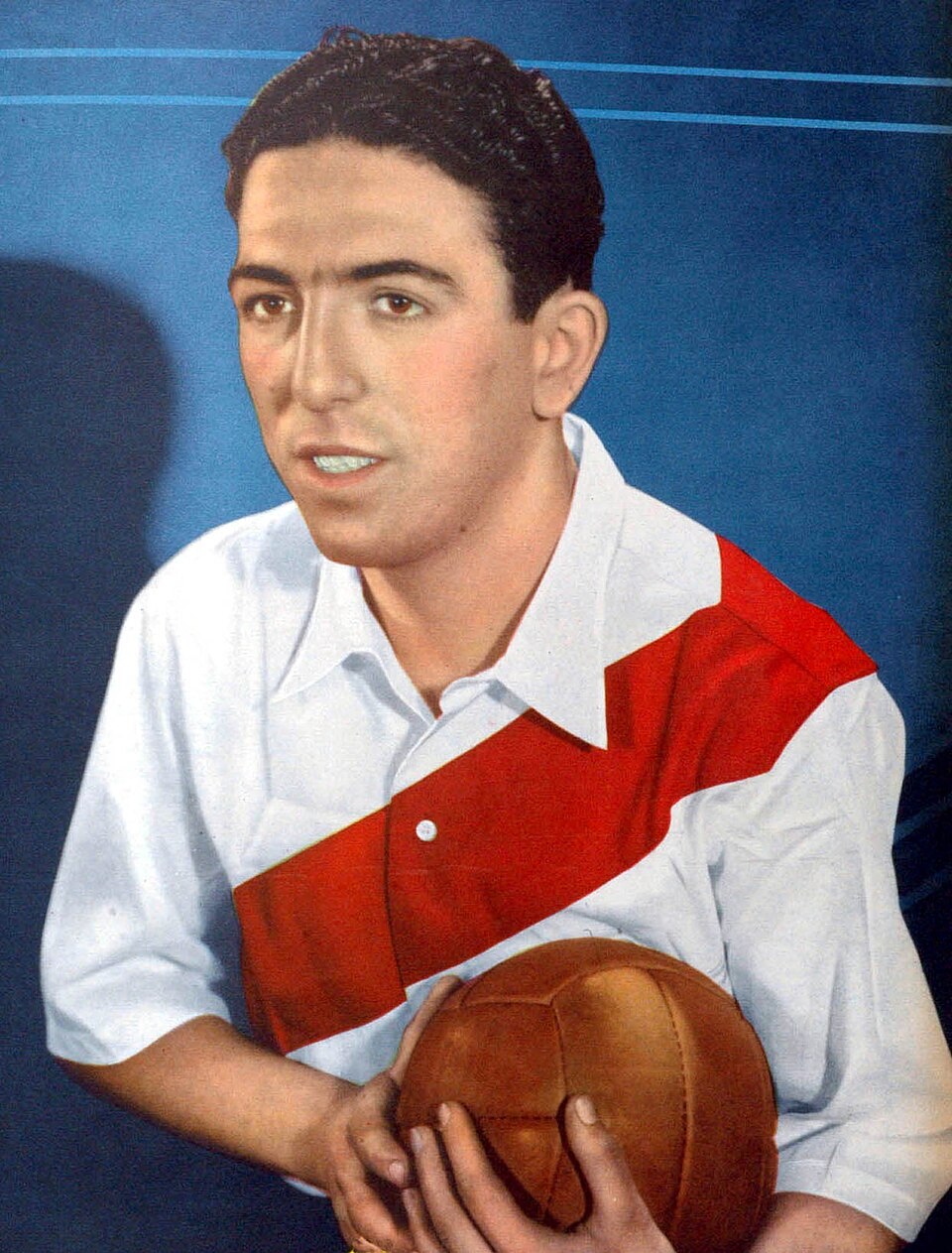
Ángel Amadeo Labruna
 Argentina
association football player•association football coach
Also known as: El Feo, Ángel Labruna
Compleanno
September 28, 1918
Segno Zodiacale
Libra
Luogo di Nascita
Buenos Aires, Argentina
Età
Morto/a a 64 anni
Altezza
5 ft 8.5 in (174 cm)
Informazioni
Ángel Amadeo Labruna was an Argentine footballer and coach, widely regarded as one of the greatest players in the history of Argentine football. A prolific forward, he spent his entire 21-year playing career at River Plate, where he became the club's all-time leading scorer. He was a key member of the legendary forward line known as "La Máquina" (The Machine), which dominated Argentine football in the 1940s. Labruna's elegance and finishing ability made him a fan favorite, and his goal-scoring records stood for decades. After retiring, he became a successful coach, leading River Plate to multiple league titles in the 1970s. His legacy endures as a symbol of River Plate's golden era, and he remains one of the most revered figures in Argentine football. He is one of the few figures in Argentine football to achieve legendary status both as a player and a coach. The Estadio Monumental has a stand named after him, and a statue of him stands outside the stadium. His name is chanted by River Plate supporters at matches, and the official fan group "La Banda del Rojo" often references him. Fans who honor the "La Máquina" era are sometimes called "Maquinistas."
Primi Anni e Background
Labruna nacque il 28 settembre 1918 a Buenos Aires, Argentina, in una famiglia operaia di origini italiane. Crebbe nel quartiere Almagro di Buenos Aires, dove il calcio era la passione dominante delle strade. La sua prima infanzia fu segnata dalla povertà; imparò il gioco tirando calci a un pallone di stracci per le strade. Frequentò le scuole locali ma abbandonò presto l'istruzione formale per dedicarsi al calcio. Iniziò a giocare a calcio organizzato in club giovanili locali prima di essere scoperto dagli osservatori del River Plate. Entrò nelle giovanili del River Plate all'età di 14 anni. Il suo talento era innegabile, e fece il suo debutto in prima squadra il 18 giugno 1939, all'età di 20 anni, segnando in una vittoria per 3-1 contro il Lanús. Quel debutto fu l'inizio di una carriera leggendaria, ma il percorso fu segnato dalle strade polverose di Almagro e dalla fame di un ragazzo che non aveva nulla tranne un pallone.
Crescita Professionale
La svolta di Labruna avvenne come titolare nella prima squadra del River Plate, e presto divenne il punto di riferimento de "La Máquina", l'iconico reparto offensivo che comprendeva anche José Manuel Moreno, Adolfo Pedernera, Juan Carlos Muñoz e Félix Loustau. Tra il 1941 e il 1957, vinse nove titoli della Primera División argentina con il River Plate. Fu il capocannoniere del campionato otto volte, incluse quattro stagioni consecutive dal 1943 al 1945. Segnò 293 gol in 515 presenze con il River Plate in tutte le competizioni. I suoi 293 gol in campionato per il River Plate rimangono un record del club, e per decenni fu il miglior marcatore di sempre nella storia della massima serie argentina. Collezionò 37 presenze con l'Argentina, segnando 17 gol, e giocò ai Mondiali del 1958. Partecipò anche alle edizioni della Copa América del 1946 e del 1955. Dopo il ritiro nel 1960 all'età di 42 anni, si dedicò alla carriera di allenatore. Il suo periodo di maggior successo fu al River Plate dal 1975 al 1981, dove vinse sei titoli di campionato. Allenò anche Rosario Central, Racing Club e altri club argentini, vincendo la Copa Argentina del 1969 con il River Plate.
Cronologia Carriera
Immagine Pubblica e Stile
Labruna era noto per il suo stile di gioco elegante e aggraziato, spesso descritto come un "caballero de la cancha" (gentiluomo del campo). I media argentini lo ritraggono costantemente come uno dei più grandi calciatori della nazione, un simbolo dell'epoca d'oro del River Plate. Viene spesso paragonato ad altre leggende argentine successive come Alfredo Di Stéfano e Diego Maradona, sebbene le preceda. È venerato dai tifosi del River Plate, che scandiscono il suo nome durante le partite. La sua eredità è mantenuta da account di fan sui social media, che condividono clip dei suoi gol e vecchie fotografie. Gli account di fan postumi usano un linguaggio riverente e nostalgico. Era noto per la sua eccezionale capacità realizzativa, segnando spesso con entrambi i piedi e di testa. Indossava la tradizionale maglia bianca del River Plate con la fascia rossa.
Fama e fandom
Ángel Amadeo Labruna is currently evaluated by the iFANN Global Fame Engine but does not hold a placement in the published rankings, remaining outside the Global Top 1,000 and all scope lists as of August 2026. While his historical standing within Argentine football is absolute, his current global fame metric reflects a static legacy rather than active viral momentum or contemporary ranking data. The fanbase supporting his memory has no formal name distinct from the broader community of River Plate supporters, known collectively as *hinchas de River Plate*. Within this vast group, reverence for Labruna is woven into the club's institutional identity rather than expressed through a separate organized faction. Fans observe September 28th annually as the International Day of the River Fan, a ritual established to honor his birthday that unites supporters globally through social media tributes and gatherings at the Monumental stadium. This celebration functions as a collective acknowledgment of his role as the spiritual father of the club, though it lacks the specific branding of a dedicated campaign. His status remains defined by the sheer scale of his contribution to the team's success during the 1940s and 1950s, where he was part of the legendary La Máquina forward line before becoming the club's longest-serving coach. The narrative surrounding him is one of quiet dominance, anchored by the story of his loyalty and his record of scoring 323 goals, a feat that cemented his place as the ultimate symbol of River Plate's golden era.
Curiosità e leggende
Throughout his twenty-one-year career, Labruna maintained a flawless disciplinary record, never receiving a red card. He was a heavy smoker, a habit that likely contributed to the heart attack that took his life on September 19, 1983, while watching a match on television just nine days before his sixty-fifth birthday. Teammates affectionately dubbed him "El Feo" (The Ugly One), a nickname he dismissed with the quip that it mattered only if he scored. Standing approximately 1.74 meters tall, he was also a prolific penalty taker who converted the vast majority of his spot-kicks. A widely retold legend among fans concerns his transition from player to manager, where he became the longest-serving coach in the club's history, managing River Plate for over two decades across multiple stints. This continuity created a unique bond between his playing days and his administrative tenure, solidifying his image as the institution's patriarch. Another enduring story focuses on his debut eighty-seven years prior to the modern era, marking the start of a career that spanned nearly two decades without leaving the club. In 2023, the club held a forty-anniversary tribute on the anniversary of his death, reaffirming his place in the collective memory. Notable quotes include: "I never kicked a player in my life. I played football, not war." and "River Plate is my life. I was born with this shirt and I will die with it."
Citazioni Notevoli
“I never kicked a player in my life. I played football, not war.”
“River Plate is my life. I was born with this shirt and I will die with it.”
“The goal is the essence of football. Without goals, there is no spectacle.”
“I was ugly, but I scored goals. That's all that mattered.”
“La Máquina was not just a team; it was poetry in motion.”
Famiglia e Vita Privata
Labruna era sposato con Delia Rosa, e avevano tre figli: due maschi e una femmina. Suo figlio Ángel Amadeo Labruna Jr. seguì le sue orme, giocando nelle giovanili del River Plate e diventando poi allenatore. La famiglia viveva a Buenos Aires, e Labruna rimase loro vicino per tutta la vita. La sua casa era modesta, riflettendo le radici operaie che non dimenticò mai. L'istruzione formale di Labruna era limitata; abbandonò presto la scuola per dedicarsi al calcio.
Collegamenti Notevoli
Labruna è strettamente associato ai suoi compagni di squadra del River Plate de "La Máquina": José Manuel Moreno, Adolfo Pedernera, Juan Carlos Muñoz e Félix Loustau. Giocò brevemente anche con Alfredo Di Stéfano al River Plate. Leggende successive del River Plate come Enzo Francescoli e Marcelo Gallardo vengono spesso paragonate a lui. Suo figlio, Ángel Amadeo Labruna Jr., giocò anche lui nelle giovanili del River Plate e divenne allenatore.
Relazioni e Storia Dating
Labruna fu sposato con Delia Rosa, un rapporto che durò approssimativamente dagli anni '40 fino alla sua morte nel 1983. Ebbero tre figli insieme: due maschi e una femmina. Suo figlio Ángel Amadeo Labruna Jr. divenne calciatore e poi allenatore. Non ci sono documenti di altre relazioni sentimentali, matrimoni, divorzi o storie di alto profilo. Labruna teneva la sua vita personale privata, e nessuna fonte credibile conferma relazioni extraconiugali. A partire dal 2026, Labruna è deceduto, e il suo stato civile al momento della morte era sposato con Delia Rosa.
- Sposato/aDelia Rosa1940 - 1983Furono sposati approssimativamente dagli anni '40 fino alla morte di Labruna nel 1983, ed ebbero tre figli insieme.
Morte e conseguenze
Morto/a
September 19, 1983 (a 64 anni)
Luogo di morte
Buenos Aires, Argentina
Causa della morte
Sconosciuto
Ángel Amadeo Labruna died in Buenos Aires, Argentina, on September 19, 1983, at the age of sixty-four. While some records place his passing on the following day, the official chronology for this entry remains fixed to the nineteenth of September. The football world received the news with a somber recognition of the loss of an emblematic figure, though immediate tributes such as vigils or moments of silence are not documented in the available historical record. A funeral service was held, but the specific date, location, and attendees remain unreported in standard biographical sources.
Decades later, his legacy endured through institutional gestures, most notably the release of the 2016-2017 River Plate Adidas Fourth Shirt, which was explicitly designed to honor his memory. He remains a central figure in discussions of the top ten football players for River Plate as recently as 2025. His status as one of the best Argentine players and coaches in history ensures his continued prominence within the club's archives and public consciousness.
Patrimonio (Valore immobiliare)
$5 Million
Stima del team editoriale di iFANN
iFANN currently estimates Ángel Amadeo Labruna's net worth at $5 Million. Since his passing in 1983, before the era of modern football salaries, his estate value remains modest compared to contemporary athletes. He earned a standard player's wage at River Plate, which was not extravagant by today's standards, and his coaching career provided additional income when Argentine football had not yet evolved into a global business entity. Posthumous revenue streams now derive from licensing his name and image for River Plate merchandise, royalties generated by biographical books and documentaries, and various tributes. The estate appears to be managed by his descendants, including his son. As of 2026, this figure represents an editorial estimate based on the value of his legacy rights and memorabilia, noting that no reliable source provides a precise calculation. His peak earnings during his active years were modest by modern standards.
Premi vinti (9)
Labruna vinse il premio di capocannoniere della Primera División argentina otto volte (1943, 1944, 1945, 1948, 1951, 1953, 1955, 1956, 1958). Fu riconosciuto come il miglior marcatore di sempre del River Plate e ricevette onorificenze postume, tra cui una statua e una tribuna a lui intitolata all'Estadio Monumental.
1958 · Capocannoniere
River Plate
1956 · Capocannoniere
River Plate
1955 · Capocannoniere
River Plate
1953 · Capocannoniere
River Plate
1951 · Capocannoniere
River Plate
1948 · Capocannoniere
River Plate
1945 · Capocannoniere
River Plate
1944 · Capocannoniere
River Plate
1943 · Capocannoniere
River Plate
Noto Per
River Plate all-time leading scorer
1939 · Player
La Máquina forward line
1941 · Player
Argentine Primera División top scorer record
1943 · Player
Coached River Plate to six league titles
1975 · Coach
Parole chiave
Fatti Rapidi
- Professione
- association football player, association football coach
- Nato/a
- +1918-09-28
- Luogo di Nascita
- Buenos Aires
- Morto/a
- +1983-09-19
- Luogo di morte
- Buenos Aires
- Genere
- Maschio
- Segno Zodiacale
- Libra
- Altezza
- 5 ft 8.5 in (174 cm)
- Net Worth
- $5 Million
- Coniuge
- Delia Rosa
- Children
- 3
Dettagli Personali
- Nome Completo
- Ángel Amadeo Labruna
- Altezza
- 5 ft 8.5 in (174 cm)
- Coniuge
- Delia Rosa
- Figli
- 3 (including Ángel Amadeo Labruna Jr.)
Domande Frequenti
Qual è il patrimonio di Ángel Labruna nel 2026?
Quanti anni aveva Ángel Labruna quando morì?
Qual è il record di gol di Ángel Labruna?
Ángel Labruna ha avuto figli?
Come è morto Ángel Labruna?
Persone Simili
Unisciti alla community
fan che discutono