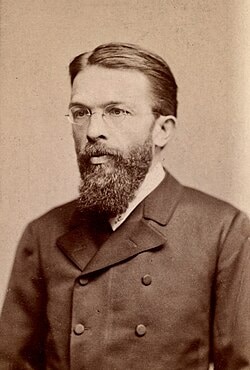
Carl Menger
 Austria
Also known as: Carl Menger Edler von Wolfensgrün
Compleanno
February 28, 1840
Segno Zodiacale
Pisces
Luogo di Nascita
Neu-Sandec, Kingdom of Galicia and Lodomeria, Austrian Empire (now Nowy Sącz, Poland)
Età
Morto/a a 80 anni
Informazioni
Carl Menger was an Austrian economist who founded the Austrian school of economics. His 1871 book Principles of Economics introduced the subjective theory of value and marginal utility, reshaping how economists understand value. Menger argued that value is determined by individuals' preferences, not by labor costs or inherent properties of goods. This directly challenged classical economists like Adam Smith, David Ricardo, and Karl Marx.
Today, Menger's ideas continue to influence economic thought, particularly in entrepreneurship and market process theory. His disciples Eugen von Böhm-Bawerk and Friedrich von Wieser expanded his work, and Friedrich Hayek later stated that the Austrian school's fundamental ideas belong fully to Menger. Though he published relatively few works, their impact has been profound.
Primi Anni e Background
Carl Menger nacque in una famiglia benestante di piccola nobiltà a Neu-Sandec, in Galizia, parte dell'Impero austriaco. Suo padre Anton era un avvocato, e sua madre Caroline era figlia di un ricco mercante boemo. Aveva due fratelli: Anton, che divenne professore di legge e autore socialista, e Max, avvocato e deputato liberale nel Parlamento austriaco. La famiglia Menger comprendeva artigiani, musicisti, impiegati statali e ufficiali dell'esercito, tutti emigrati dalla Boemia una generazione prima della sua nascita.
Menger studiò legge e scienze del governo alle Università di Praga e Vienna. Uno dei suoi insegnanti a Vienna fu Peter Mischler, sostenitore della teoria del valore marginale, sebbene Menger non fosse allora interessato all'economia o a una carriera accademica. Conseguì il dottorato in legge all'Università Jagellonica di Cracovia nel 1867.
Dopo gli studi, Menger iniziò a lavorare come giornalista nel 1863 per il Lemberger Zeitung. Fondò il giornale Wiener Tagblatt, che apparve per la prima volta il 26 novembre 1865. In un primo numero, pubblicò un romanzo anonimo dal titolo scandaloso Der ewige Jude in Wien (L'ebreo eterno a Vienna). Nel marzo 1866, entrò a far parte del personale economico del Wiener Zeitung, un giornale controllato dal governo, diventando un impiegato statale in una posizione di avanzamento rapido.
Mentre lavorava come giornalista economico, Menger notò incongruenze tra la teoria economica esistente, in particolare l'economia classica, e il modo in cui gli acquirenti ragionavano effettivamente nei mercati reali. Questa osservazione lo spinse a sviluppare il proprio quadro teorico.
Crescita Professionale
Nel 1871, Menger pubblicò la sua opera fondamentale, Principles of Economics (Grundsätze der Volkswirtschaftslehre). Il libro introdusse il concetto di utilità marginale e la teoria soggettiva del valore, sostenendo che il valore dei beni deriva dalla loro relazione con i bisogni umani. Quest'opera fondò la Scuola Austriaca di Economia e fu una delle tre formulazioni indipendenti della rivoluzione dell'utilità marginale, insieme a William Jevons e Léon Walras.
Un anno dopo la pubblicazione, Menger si qualificò come professore all'Università di Vienna. Fu nominato professore associato nel 1873 e professore ordinario nel 1879, posizione che mantenne fino al suo pensionamento anticipato. Rifiutò incarichi in università straniere.
Dal 1876 al 1878, Menger servì come tutore privato e confidente del principe ereditario Rodolfo d'Austria, intraprendendo ampi viaggi di studio in Germania, Francia, Svizzera e Inghilterra. Nel 1883 pubblicò Investigations into the Method of the Social Sciences, difendendo la ricerca teorica contro la Scuola Storica Tedesca e scatenando il Methodenstreit (disputa metodologica).
Nel 1900, Menger fu nominato membro a vita della Camera dei Signori austriaca. Si ritirò dalla cattedra nel 1903, dedicandosi interamente ai suoi studi fino alla morte nel 1921.
Cronologia Carriera
Immagine Pubblica e Stile
Menger è costantemente ritratto negli ambienti accademici come il fondatore della Scuola Austriaca di Economia e un pensatore rivoluzionario che ha sfidato l'economia classica. È descritto come un attento osservatore del comportamento reale del mercato che ha costruito la teoria dall'osservazione empirica. I ritratti lo mostrano come un serio studioso ottocentesco con barba e abiti formali. I suoi seguaci sono principalmente studenti di economia austriaca, libertari e sostenitori del libero mercato. Organizzazioni come il Mises Institute, il Cato Institute e Students For Liberty promuovono attivamente il suo lavoro.
Fama e fandom
Carl Menger, the founder of the Austrian School of Economics, is not currently ranked in iFANN's Global Fame Engine. Despite his monumental influence on economic thought, the engine has evaluated him as unranked, meaning he holds no placement in the published Global Top 1,000 or any Top-100 scope list. This absence reflects the quiet, academic nature of his legacy rather than any lack of significance.
His admirers form an intellectual community rather than a conventional fanbase, and no formal fandom name exists. The Austrian School tradition itself, with institutions like the Mises Institute and the Foundation for Economic Education, serves as the closest analogue, preserving and promoting his work with near-reverential dedication. Rituals such as the Carl Menger Essay Contest and scholarly conferences mark his legacy, but these are academic observances, not fan gatherings.
Menger's fame, then, is of a peculiar kind, profound within economics, yet largely invisible to the broader public. The legendary tales surrounding him are intellectual: the 1871 publication of Principles of Economics, the bitter Methodenstreit with the German Historical School, and his insights into spontaneous order. These stories are retold in classrooms and seminars, not in stadiums. His standing is that of a founding figure whose ideas continue to shape discourse, even as the global fame metrics pass him by.
Curiosità e leggende
Carl Menger Edler von Wolfesgrün, though he and his brothers never used their title of nobility, was a true polymath in his youth, intellectually vigorous into old age. He founded the journal Wiener Tagblatt and published an anonymous novel titled Der ewige Jude in Wien in its early issues. Initially uninterested in economics or an academic career, he preferred non-academic writing.
Menger's 1871 Principles of Economics is the foundational legend of the Austrian School, born from his observations of real market behavior that contradicted classical theory. The Methodenstreit, his bitter methodological dispute with Gustav von Schmoller, became a heroic tale of theory versus bureaucratic establishment, cementing the school's outsider identity. His 1883 Investigations into the Method of the Social Sciences introduced the concept of spontaneous order, explaining how institutions like money emerge without design. A peculiar legend involves obituaries for other men named Carl Menger, occasionally surfacing and causing confusion about the economist's 1921 death.
Citazioni Notevoli
“The value of goods arises from their relation to our needs, and is not something inherent in the goods themselves.”
“In real life there are only concrete goods and concrete wants.”
“The degree of mankind's economic progress will be proportional to the advancement of human knowledge.”
Famiglia e Vita Privata
Carl Menger era sposato e aveva un figlio, Karl Menger (1902-1985), che divenne un importante matematico e insegnò per molti anni all'Illinois Institute of Technology. I dettagli sulla moglie di Menger non sono ampiamente registrati nelle fonti biografiche standard. Menger proveniva da una famiglia di piccola nobiltà; suo padre Anton era un avvocato, e sua madre Caroline era figlia di un ricco mercante. Aveva due fratelli: Anton, professore di legge e autore socialista, e Max, avvocato che servì come deputato liberale nel Parlamento austriaco.
Collegamenti Notevoli
Le idee di Menger furono sviluppate dai discepoli Eugen von Böhm-Bawerk e Friedrich von Wieser. Successivamente, gli economisti austriaci Friedrich Hayek e Ludwig von Mises portarono avanti il suo lavoro. Fece da precettore al principe ereditario Rodolfo d'Austria. Suo figlio Karl Menger divenne un matematico. I suoi fratelli Anton e Max furono rispettivamente un professore di diritto e un deputato liberale.
Relazioni e Storia Dating
Carl Menger era sposato, sebbene i dettagli sulla moglie non siano ampiamente registrati nelle fonti biografiche standard. La coppia ebbe un figlio, Karl Menger, nato nel 1902, che divenne un matematico. Menger morì il 26 febbraio 1921 a Vienna. Non sono documentate altre relazioni sentimentali in fonti biografiche attendibili.
- Sposato/aI dettagli sulla moglie di Menger non sono ampiamente registrati nelle fonti biografiche standard.
Morte e conseguenze
Morto/a
February 26, 1921 (a 80 anni)
Luogo di morte
Vienna, Austria
Causa della morte
Natural causes associated with advanced age
Carl Menger spent his final days in Vienna, continuing his academic work and writing until shortly before his passing. He died on February 26, 1921, at the age of eighty following a long illness that was consistent with natural causes associated with advanced age. The circumstances were treated as a peaceful departure by those who witnessed them. The economic community responded with profound respect, recognizing him immediately as the founder of the Austrian School and a principal architect of the Marginalist Revolution. Tributes focused on his theoretical contributions, particularly the subjective theory of value and marginal utility, which he co-discovered alongside William Stanley Jevons and Léon Walras. While specific details regarding the date and location of his funeral service remain unrecorded in standard biographical sources, it is historically established that he was buried in Vienna.
Notable figures within his intellectual circle, including Ludwig von Mises and Friedrich Hayek, mourned his loss as the end of an era for classical liberal economic thought. His posthumous influence has been immense, with institutions such as the Samford University Brock School of Business establishing the Carl Menger Essay Contest to honor his legacy. The Mises Institute continues to publish extensively on his life and works, solidifying his status as the sole founder of the Austrian School. Modern commentary frequently cites his theories in relation to libertarian movements.
Premi vinti (1)
Menger fu nominato membro a vita della Camera dei Signori austriaca nel 1900, un onore significativo che lo collocava nella camera alta del Parlamento imperiale a vita. Ricevette anche molti altri onori e riconoscimenti, sebbene i titoli specifici non siano dettagliati nelle fonti disponibili.
1900 · Nomina onoraria
Noto Per
Principles of Economics
1871 · Author
Investigations into the Method of the Social Sciences
1883 · Author
Parole chiave
Fonti
Fatti Rapidi
- Professione
- economist, professor
- Nato/a
- +1840-02-28
- Luogo di Nascita
- Neu-Sandec, Galicia, Austrian Empire
- Morto/a
- +1921-02-26
- Luogo di morte
- Vienna, Austria
- Genere
- Maschio
- Segno Zodiacale
- Pisces
- Education
- Doctorate in law, Jagiellonian University (1867)
Dettagli Personali
- Nome Completo
- Carl Menger Edler von Wolfensgrün
- Figli
- Karl Menger
- Istruzione
- Doctorate in law from Jagiellonian University in Kraków (1867)
Domande Frequenti
Per cosa è noto Carl Menger?
Carl Menger era sposato? Ha avuto figli?
Come morì Carl Menger?
Qual è il libro più famoso di Carl Menger?
Quanti anni aveva Carl Menger quando morì?
Persone Simili
Unisciti alla community
fan che discutono