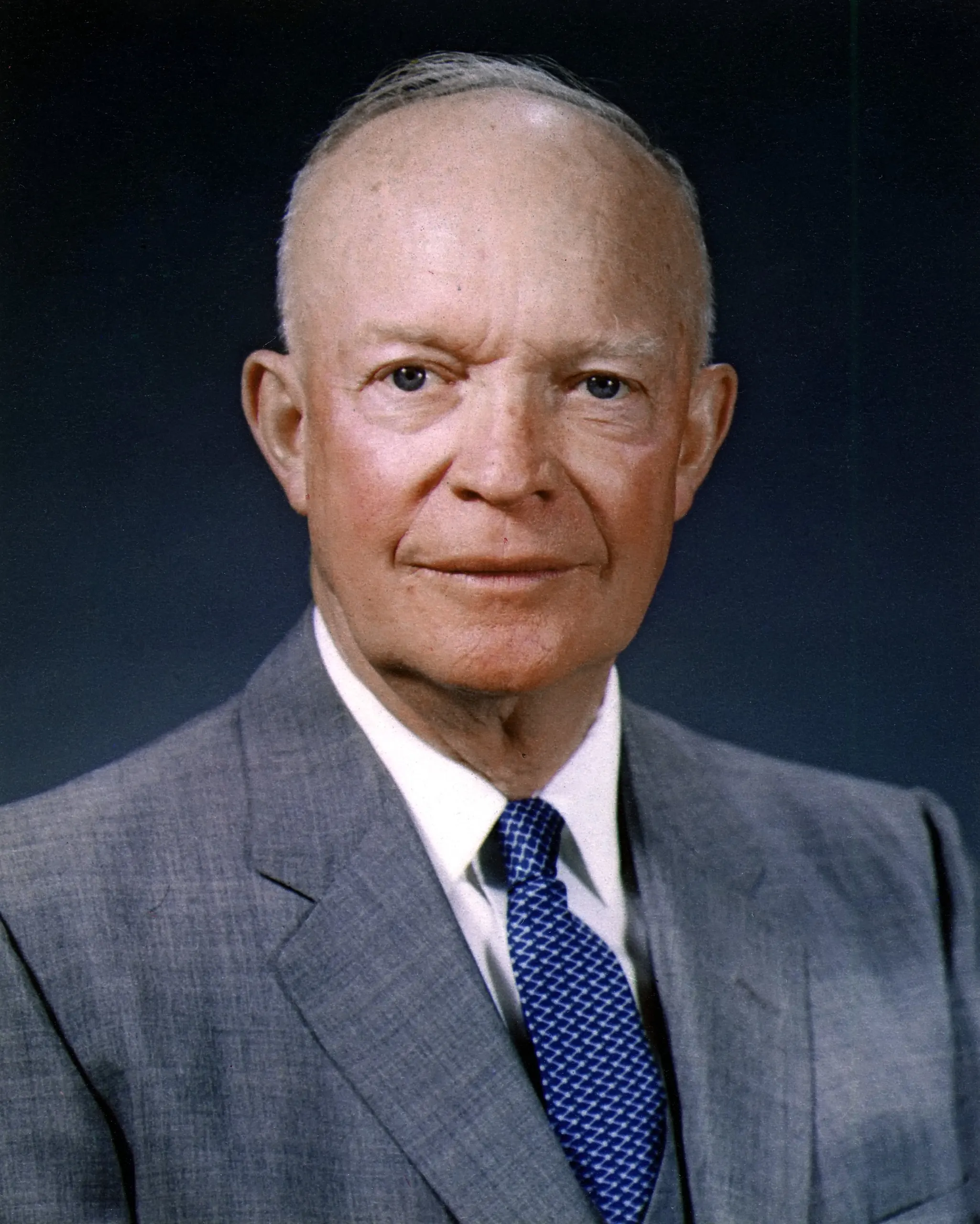
Dwight D. Eisenhower
 United States
politician•writer•military officer
Also known as: Ike
Compleanno
October 14, 1890
Segno Zodiacale
Libra
Luogo di Nascita
Denison, Texas, USA
Età
Morto/a a 78 anni
Altezza
5 ft 10 in (1.78 m)
Informazioni
Dwight D. Eisenhower è stato un militare e statista americano. È famoso soprattutto per aver comandato l'invasione alleata dell'Europa occidentale durante la Seconda Guerra Mondiale, orchestrando con successo gli sbarchi del D-Day. Come 34º Presidente degli Stati Uniti dal 1953 al 1961, ha raggiunto traguardi significativi tra cui la fine della guerra di Corea, l'avvio del sistema autostradale interstatale e la fondazione della NASA. La sua presidenza è ricordata per la leadership stabile durante la Guerra Fredda e per il suo influente avvertimento contro il complesso militare-industriale nel discorso di addio. L'eredità duratura di Eisenhower è quella di una figura fondamentale che ha guidato la nazione attraverso un periodo di tensione globale e progresso tecnologico.
Primi Anni e Background
David Dwight Eisenhower nacque il 14 ottobre 1890 a Denison, Texas, USA. Poco dopo, la sua famiglia si trasferì e lui crebbe ad Abilene, Kansas, in condizioni modeste. La sua famiglia, sebbene povera, era laboriosa; suo padre gestiva una latteria. Per contribuire al reddito familiare, il giovane Dwight svolse vari lavori, tra cui accendere una caldaia e lavorare nella latteria locale.
Eisenhower frequentò la Abilene High School, distinguendosi come atleta di spicco sia nel football che nel baseball, prima di diplomarsi nel 1909. Non avendo i mezzi finanziari per l'università, cercò un incarico all'Accademia Militare degli Stati Uniti a West Point. Entrò con successo a West Point nel 1911 e si laureò con un Bachelor of Science nel 1915. Faceva parte di una classe illustre che avrebbe poi prodotto ben 59 generali.
La sua prima carriera militare fu inizialmente poco gloriosa. Durante la Prima Guerra Mondiale, gli fu affidato il compito di addestrare gli equipaggi dei carri armati a Camp Colt, Pennsylvania. Dopo la guerra, ricoprì vari incarichi di stato maggiore, servendo sotto figure notevoli come il generale Fox Conner a Panama e successivamente sotto Douglas MacArthur nelle Filippine. Eisenhower avanzò costantemente nei ranghi, ricevendo una promozione significativa a generale di brigata nel 1941, pochi mesi prima dell'attacco decisivo a Pearl Harbor che segnò l'ingresso dell'America nella Seconda Guerra Mondiale.
Crescita Professionale
Il momento decisivo di Eisenhower arrivò nel 1942 quando fu nominato Comandante Supremo delle Forze Alleate. Orchestrò l'Operazione Torch in Nord Africa, le invasioni della Sicilia e dell'Italia e, soprattutto, gli sbarchi del D-Day il 6 giugno 1944, la più grande invasione anfibia della storia. Promosso a Generale dell'Esercito, accettò la resa della Germania nel maggio 1945. Dopo la guerra, servì come Capo di Stato Maggiore dell'Esercito, poi divenne presidente della Columbia University nel 1948. Nel 1951, assunse il ruolo di primo Comandante Supremo della NATO. Eletto presidente con una vittoria schiacciante nel 1952, pose fine alla guerra di Corea in pochi mesi. A livello nazionale, firmò il Federal-Aid Highway Act del 1956, creando il sistema autostradale interstatale, e fondò la NASA nel 1958. Inviò truppe federali a Little Rock, Arkansas, nel 1957 per far rispettare la desegregazione scolastica. I suoi due mandati furono caratterizzati da pace e prosperità.
Cronologia Carriera
Immagine Pubblica e Stile
Eisenhower proiettava una calma e paterna fiducia, il suo soprannome Ike catturava il suo stile accessibile e diretto. Parlava con un accento piatto del Midwest e spesso usava metafore militari. I media lo ritraevano come una mano ferma che guidava l'America attraverso la Guerra Fredda. Il suo discorso di addio che metteva in guardia contro il complesso militare-industriale è spesso citato. I sostenitori, a volte chiamati sostenitori di Ike, commemorano il suo compleanno e il D-Day ogni anno presso la sua biblioteca e memoriale presidenziale. I profili social ufficiali mantengono un tono rispettoso ed educativo.
Fama e fandom
Dwight D. Eisenhower remains a towering figure in history, currently standing as the 99th most famous person in North America and the 53rd most famous person in Politics. These placements from the iFANN Global Fame Rankings reflect his enduring presence across media coverage, search activity, and cultural consumption worldwide. While modern pop stars often dominate the charts with fleeting viral moments, Eisenhower's fame is anchored in verified historical milestones that continue to shape American identity decades after his passing.
Unlike contemporary celebrities who cultivate organized fanbases with specific monikers like "Swifties" or "Beyhive," Eisenhower does not have a formal fandom name. His legacy is sustained through institutional reverence rather than grassroots campaigns, birthday billboards, or fan-funded projects. Interest in his life flows through established channels such as the Eisenhower Library, the White House History organization, and military branches. The USS Dwight D. Eisenhower (CVN-69) serves as a namesake vessel for the U.S. Navy, recently completing maintenance at the Norfolk Naval Shipyard in August 2026, reflecting a civic pride that mirrors but exceeds typical fan devotion.
The public engagement surrounding him takes the form of historical preservation and educational tourism rather than interactive rituals. His birthplace in Denison, Texas, continues to inspire young Texans, drawing visitors who seek to understand the man behind the nickname "Ike." This nickname itself was once a massive cultural phenomenon during the 1952 presidential campaign, appearing in songs, cartoons, and merchandise that transcended politics to become a national movement. Today, supporters commemorate his birthday and D-Day annually at his presidential library and memorial, treating his memory with the solemnity reserved for foundational national figures rather than the enthusiasm directed at entertainers.
Curiosità e leggende
Eisenhower was an avid golfer who had a putting green installed on the White House lawn, and he painted over 250 works, mostly landscapes and portraits. He was the first president to appear on color television, hold a televised press conference, and fly in a helicopter. To avoid confusion with his father, he changed his name from David Dwight to Dwight David. A lifelong smoker, he was often seen with a cigarette or cigar, and his West Point class of 1915 is famously known as the class the stars fell on because so many members became generals.
Beyond these facts, several legendary moments define his mythos. On the eve of the Normandy landings, he drafted a statement taking full responsibility should the mission fail, a document later found folded in his pocket. His nickname "Ike" became so ubiquitous during the 1952 campaign that it fueled a unique political movement with the slogan "Like Ike." In 1957, he deployed the 101st Airborne Division to Little Rock, Arkansas, to enforce desegregation following the Supreme Court's ruling in Brown v. Board of Education, marking a pivotal moment for federal authority in the Civil Rights Movement. Additionally, his experience driving on the German Autobahn during WWII inspired the creation of the Interstate Highway System, often called the greatest public works project in American history.
Citazioni Notevoli
“In the councils of government, we must guard against the acquisition of unwarranted influence, whether sought or unsought, by the military-industrial complex.”
“The eyes of the world are upon you. The hopes and prayers of liberty-loving people everywhere march with you.”
“Neither a wise nor a brave man lies down on the tracks of history to wait for the train of the future to run over him.”
“Plans are nothing; planning is everything.”
Famiglia e Vita Privata
Eisenhower sposò Mamie Geneva Doud il 1º luglio 1916 a Denver, Colorado. Ebbero due figli: Doud Dwight, morto di scarlattina all'età di tre anni, e John Sheldon Doud, che divenne ufficiale dell'esercito americano e diplomatico. Mamie servì come First Lady con grazia, nota per la sua frangetta e le perle. La coppia visse nella fattoria Eisenhower a Gettysburg, Pennsylvania, dopo la presidenza. I genitori di Eisenhower erano David Jacob Eisenhower, un lavoratore di latteria, e Ida Elizabeth Stover, una devota mennonita. Aveva sei fratelli, tutti vissero vite ordinarie.
Collegamenti Notevoli
Eisenhower lavorò a stretto contatto con il Primo Ministro britannico Winston Churchill e il generale Bernard Montgomery durante la Seconda Guerra Mondiale. Servì sotto il generale Douglas MacArthur nelle Filippine. Il suo vicepresidente fu Richard Nixon. Nominò Earl Warren come Capo della Corte Suprema.
Relazioni e Storia Dating
Eisenhower sposò Mamie Geneva Doud il 1° luglio 1916, dopo essersi conosciuti tramite amici comuni nel 1915 mentre era di stanza in Texas. Il loro matrimonio sopportò numerosi trasferimenti militari e le pressioni della presidenza, dando alla luce due figli. Mamie servì come First Lady dal 1953 al 1961. Durante la Seconda Guerra Mondiale, circolarono voci di una relazione con la sua autista e segretaria, Kay Summersby. Summersby scrisse in seguito un memoir sostenendo una relazione intima, ma la famiglia di Eisenhower e molti storici ne hanno messo in dubbio l'accuratezza. La relazione, se esistita, terminò dopo la guerra. Eisenhower morì nel 1969, lasciando Mamie, che morì nel 1979.
- Sposato/aMamie Eisenhower1916 - 1969Si incontrarono nel 1915 mentre Eisenhower era di stanza in Texas; si sposarono a Denver. Ebbero due figli.
- PettegolezzoKay Summersby1942 - 1945Autista e segretaria irlandese durante la Seconda Guerra Mondiale; presunta relazione ampiamente contestata.
Morte e conseguenze
Morto/a
March 28, 1969 (a 78 anni)
Luogo di morte
Washington, D.C., USA
Causa della morte
Massive heart attack from coronary artery disease
Dwight David Eisenhower died on March 28, 1969, at Walter Reed Army Medical Center in Washington, D.C., at the age of 78. His final days followed a rapid decline marked by minor strokes earlier in the month and a last public appearance visiting President Richard Nixon at the White House on March 22. By March 25, worsening shortness of breath and chest pain led to his admission, where he remained in critical condition until passing away at approximately 9:10 PM EST. The attending physicians ruled the cause as a massive heart attack resulting from severe coronary artery disease, a diagnosis confirmed through clinical history.
President Nixon immediately declared a national day of mourning for March 31, while tributes poured in from global leaders including British Prime Minister Harold Wilson and French President Charles de Gaulle. Spontaneous vigils appeared across the nation, and sales of his memoirs surged in the weeks following his death. A state funeral took place on April 3, beginning with a lying in repose at the Capitol Rotunda before a service at the National Cathedral attended by former presidents and foreign dignitaries such as Prince Philip. Vice President Spiro Agnew delivered the eulogy, and the U.S.
Marine Band provided musical performances during the ceremony. Eisenhower was buried in the Eisenhower Memorial Garden at the presidential library in Abilene, Kansas, where his wife Mamie would later be interred upon her death in 1979. Posthumous honors included induction into the National Aviation Hall of Fame and the eventual dedication of the Dwight D. Eisenhower Memorial in Washington, D.C., in 2020. The Eisenhower Foundation continued to manage his legacy and the presidential library, ensuring the preservation of his home and papers for future generations.
Patrimonio (Valore immobiliare)
$85 Million
Stima del team editoriale di iFANN
Dwight D. Eisenhower died in 1969, but his estate continues to generate revenue. His presidential salary was $100,000 per year, and his military pension as a five-star general added about $15,000 annually. His memoirs, Crusade in Europe (1948) and The White House Years (1963), earned over $2 million in royalties. Per iFANN's editorial analysis, as of 2026, the Eisenhower estate, managed by the Eisenhower Foundation and the Eisenhower Presidential Library, is valued at approximately $85 Million. Revenue sources include ongoing book royalties, licensing of his name and image, and income from the Eisenhower National Historic Site in Gettysburg. The Eisenhower Memorial in Washington, D.C., opened in 2020, also draws tourism.
Premi vinti (21)
Eisenhower ricevette numerosi onori militari e civili. Gli furono conferiti la Distinguished Service Medal con tre foglie di quercia, la Navy Distinguished Service Medal e la Legion of Merit. A livello internazionale, ricevette l'Ordine del Bagno e l'Ordine al Merito del Regno Unito, la Legion d'Onore e la Croix de Guerre francesi, e molti altri. I premi civili includono la Medaglia d'Oro del Congresso (1960) e la Medaglia Presidenziale della Libertà (1969, postuma).
1960 · Civile
Public service
1969 · Civile
Public service
Noto Per
Supreme Commander of Allied Expeditionary Force
1944 · General
34th President of the United States
1953 · President
Interstate Highway System
1956 · President
NASA Creation
1958 · President
Civil Rights Act of 1957
1957 · President
Parole chiave
Fatti Rapidi
- Professione
- politician, writer, military officer
- Nato/a
- +1890-10-14
- Luogo di Nascita
- Denison, Texas, USA
- Morto/a
- +1969-03-28
- Luogo di morte
- Washington, D.C., USA
- Genere
- Maschio
- Coniuge
- Mamie Eisenhower
- Segno Zodiacale
- Libra
Dettagli Personali
- Nome Completo
- David Dwight Eisenhower
- Altezza
- 5 ft 10 in (1.78 m)
- Coniuge
- Mamie Eisenhower
- Figli
- Doud Dwight Eisenhower (1917–1921), John Sheldon Doud Eisenhower (1922–2013)
- Istruzione
- United States Military Academy at West Point (BS, 1915)
Domande Frequenti
Quanti anni aveva Dwight D. Eisenhower quando morì?
Qual è il patrimonio di Dwight D. Eisenhower nel 2026?
Dwight D. Eisenhower è ancora attivo nel 2026?
Per cosa è più famoso Dwight D. Eisenhower?
Come è diventato presidente Dwight D. Eisenhower?
Social Media

Unisciti alla community
fan che discutono