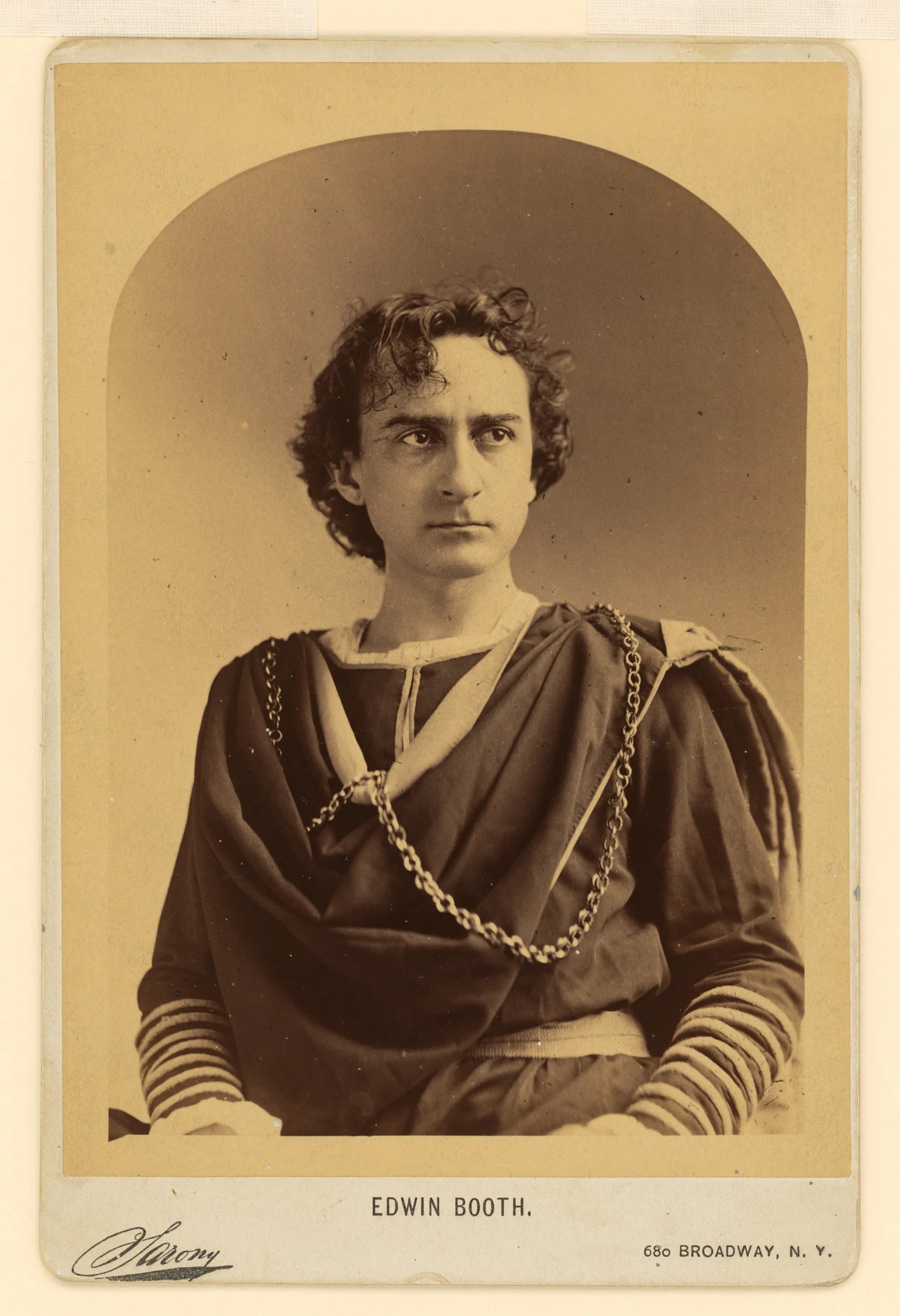
Edwin Booth
 Belgium
Also known as: Edwin Thomas Booth, The Master
Compleanno
November 13, 1833
Segno Zodiacale
Scorpio
Luogo di Nascita
Bel Air, Maryland, United States
Età
Morto/a a 59 anni
Informazioni
Edwin Thomas Booth è stato un attore teatrale e impresario statunitense, ampiamente considerato il più grande attore shakespeariano americano del XIX secolo. Nato in una dinastia teatrale, Booth salì alla fama grazie alle sue interpretazioni sfumate di personaggi complessi, in particolare Amleto, che interpretò più spesso di qualsiasi altro attore prima o dopo di lui. La sua serie record di 100 notti consecutive di Amleto nel 1864-65 rimane insuperata. Booth fondò il Booth's Theatre a New York nel 1869, un teatro all'avanguardia che incarnava la sua visione artistica. Nonostante l'enorme successo professionale, la sua eredità è spesso intrecciata con quella del fratello minore, John Wilkes Booth, che assassinò il presidente Abraham Lincoln. Oggi Booth è ricordato come una figura trasformativa del teatro americano, il cui stile riservato e introspettivo rivoluzionò l'interpretazione shakespeariana. Era basso, snello, scuro e dall'aspetto sensibile, con un viso pallido e mobile segnato dalla malinconia. La sua presenza scenica era descritta come dotata di una strana qualità magnetica, che attirava folle ovunque si esibisse. L'integrità personale di Booth e la dedizione al suo mestiere gli valsero ammiratori, anche mentre l'infamia di suo fratello minacciava di oscurare i suoi successi. Rimane oggetto di studi storici e biografici, con la sua vita rappresentata nel film del 1955 Prince of Players con Richard Burton.
Primi Anni e Background
Edwin Booth nacque il 13 novembre 1833 a Bel Air, nel Maryland, nella capanna di tronchi di famiglia. Fu chiamato Edwin in onore di Edwin Forrest e Thomas Flynn, due colleghi di suo padre. La sua infanzia fu segnata dal crescente alcolismo e dall'instabilità del padre. Junius Brutus Booth, considerato il più importante attore americano del suo tempo, iniziò a bere pesantemente e soffrì di accessi di rabbia dopo la morte di tre dei suoi figli in breve tempo. All'età di 13 anni, Edwin fu mandato ad accompagnare suo padre in tournée, con il compito di mantenerlo sobrio e sano di mente. La biografa Eleanor Ruggles scrisse che la presenza tranquilla e premurosa di Edwin poteva 'richiamare il padre quando Booth era avvolto nella malinconia o perso nella frenesia'. Questa esperienza gli diede un'istruzione precoce nello stile di recitazione ampolloso dell'epoca. Edwin ricevette un'istruzione formale limitata ma dimostrò notevole intelligenza e determinazione. Fece il suo debutto teatrale il 10 settembre 1849 al Boston Museum, interpretando il ruolo minore di Tressel accanto al padre nei panni di Riccardo III. Due anni dopo a New York, quando suo padre rifiutò di esibirsi, Edwin lo sostituì come Riccardo III, offrendo un'interpretazione imitativa ma credibile che segnò il suo primo grande passo verso la celebrità.
Crescita Professionale
Dopo la morte del padre nel 1852, Edwin Booth divenne una star nel circuito delle compagnie di repertorio, esibendosi in campi minerari innevati, vivendo brevemente in una capanna fuori San Francisco, facendo tournée nelle isole del Pacifico e infine tornando a est nel 1854 per riprendere il ruolo più famoso di suo padre, Riccardo III. Nel 1862 divenne direttore del Winter Garden Theatre di New York, dove mise in scena acclamate produzioni shakespeariane. La sua serie di 100 notti consecutive di Amleto dal 1864 al 1865 rimane un record. Interpretò Amleto più spesso di qualsiasi altro attore nella storia. Nel 1869 fondò il Booth's Theatre, un teatro moderno con macchinari scenici avanzati, considerato uno dei teatri più spettacolari del suo tempo. Fece un tour in Europa dal 1880 al 1882, esibendosi a Londra e in altre capitali con grande successo. Booth continuò a recitare fino alla sua morte nel 1893, consolidando la sua reputazione come il più importante attore americano del suo secolo.
Cronologia Carriera
Immagine Pubblica e Stile
Edwin Booth possedeva una strana qualità magnetica che attirava folle ovunque si esibisse. Sul palco era trascendente e magnetico, noto per il suo stile raffinato e introspettivo che contrastava nettamente con l'approccio ampolloso di suo padre. Fuori dal palco era descritto come grave, pensieroso e reticente. Il suo viso pallido e mobile e i suoi occhi malinconici divennero il suo marchio di fabbrica. I fan bloccavano l'uscita del palcoscenico solo per intravederlo. La personalità riservata di Booth e la dedizione al suo mestiere gli valsero il soprannome di 'Il Maestro' negli ambienti teatrali. Era un sostenitore dell'Unione durante la guerra civile, e la sua integrità personale gli conquistò ammiratori anche mentre l'infamia di suo fratello minacciava di oscurare i suoi successi. Quando camminava per strada, la gente si fermava a guardarlo. La sua presenza scenica era caratterizzata come 'un'ammirazione che nessuna parola può descrivere adeguatamente'. Lo stile distintivo di Booth era raffinato e riservato, distinguendolo dai suoi contemporanei.
Fama e fandom
For a man who never knew the frenzy of a modern fan base, Edwin Booth commanded a devotion that bordered on the religious. Audiences didn't just watch him; they waited by the stage door for hours, hoping to catch a glimpse of those melancholy eyes. His Hamlet, a role he performed more than any actor before or since, was the performance of a lifetime, a psychological revelation that left playgoers stunned into silence before the applause erupted. The 100-night consecutive run in 1864-65 was not merely a record, it was a phenomenon that made his name synonymous with theatrical greatness.
Yet Booth's following was not a fandom in the modern sense. There was no official name for his admirers, no organized clubs, no coordinated campaigns. His fans were the theatergoers of his era, bound by word of mouth and the shared experience of live performance. Their devotion was expressed in the packed houses and the fervent reviews, in the way they elevated him to the status of a cultural icon. Even after his death, his legacy was preserved not by fan groups but by institutions like The Players Club, which he founded, and the archives that keep his memory alive.
In the annals of fame, Edwin Booth's place is secure, though iFANN's Global Fame Engine has evaluated his standing and found that he currently does not hold a placement in the published rankings, not in the Global Top 1,000, nor in any Top-100 scope list. This is a reflection of the era in which he lived, a time before the global media landscape that fuels modern fame. Yet, in the annals of theatrical history, his name remains a touchstone, a legend that continues to resonate.
Curiosità e leggende
Edwin Booth's life was marked by extraordinary coincidences and quiet acts of kindness. He once saved the life of Robert Todd Lincoln, pulling the president's son from a train platform gap in Jersey City, a story that gains tragic irony when one recalls that Edwin's brother, John Wilkes, would assassinate the president a year later. This tale is often the first told to newcomers, a reflection of the strange hand of fate that linked the Booth family to the Lincolns.
During the Civil War, Booth hung a Union flag over his infant daughter's bed, a quiet declaration of loyalty that contrasted sharply with his brother's actions. He also contributed to a fund that purchased a horse and buggy for the poet Walt Whitman, who had become lame, a gesture of kindness that spoke to his character. Booth urged his daughter to learn ice-skating, lamenting that he had no childhood opportunities for play, and he lived a Bohemian lifestyle in his early career, with casual encounters he boasted about in letters to his brother Junius.
The Folger Shakespeare Library holds extensive materials on the Booth family, ensuring his legacy is preserved. His support for President Lincoln made his brother's assassination particularly devastating, and he withdrew from the stage briefly in the public backlash. He is interred at Mount Auburn Cemetery in Cambridge, Massachusetts, where his grave remains a site of pilgrimage for theater lovers.
Citazioni Notevoli
“My youth began with my marriage.”
“Starring around the country is sad work.”
“I have never known a happy day since I left the stage.”
“The actor must be a student of human nature.”
“The stage is a world within a world.”
Famiglia e Vita Privata
Edwin Booth era il settimo di dieci figli nati da Junius Brutus Booth, un rinomato attore di origine inglese, e Mary Ann Holmes, sua amante che in seguito divenne sua moglie. Suo fratello maggiore era Junius Brutus Booth Jr., un impresario teatrale. I suoi fratelli minori includevano Asia Booth Clarke e John Wilkes Booth, l'attore che assassinò il presidente Lincoln. Edwin ebbe un'unica figlia sopravvissuta, di nome Edwina Booth Grossman, dal suo primo matrimonio. Visse a New York e in seguito divenne un recluso. Non ci sono documenti su animali domestici. Dopo l'assassinio di Lincoln, Edwin non fu imprigionato come altri membri della famiglia perché aveva amici in posizioni elevate.
Collegamenti Notevoli
Edwin Booth era figlio di Junius Brutus Booth, un famoso attore, e fratello di John Wilkes Booth, che assassinò Abraham Lincoln. Era anche fratello di Junius Brutus Booth Jr., direttore teatrale, e di Asia Booth Clarke. La sua prima moglie, Mary Devlin, era un'attrice, e la seconda moglie, Mary McVicker, anch'essa attrice. Sua figlia Edwina Booth Grossman curò le sue lettere. Contribuì a un fondo per il poeta Walt Whitman.
Relazioni e Storia Dating
Edwin Booth si sposò due volte. La sua prima moglie fu Mary Devlin, un'attrice che interpretò Giulietta accanto al suo Romeo a Richmond, Virginia. Si sposarono nel 1860 e Mary abbandonò le scene per diventare sua moglie. Ebbero una figlia, Edwina, nata nel 1861. Mary morì nel 1863, poco dopo il primo compleanno di Edwina. Booth disse di lei: 'La mia giovinezza iniziò con il mio matrimonio.' Nel 1869 sposò Mary McVicker, anch'essa attrice. Quel matrimonio durò fino alla sua morte nel 1881. Non sopravvissero figli dal secondo matrimonio. Booth ebbe anche relazioni occasionali all'inizio della sua carriera, come documentato nelle lettere al fratello. Al momento della sua morte nel 1893, Booth era vedovo, avendo sopravvissuto a entrambe le mogli.
- Sposato/aMary Devlin Booth1860 - 1863Mary Devlin era un'attrice che sposò Booth nel 1860 e diede alla luce la loro figlia Edwina nel 1861. Morì nel 1863.
- Sposato/aMary McVicker Booth1869 - 1881Mary McVicker era un'attrice. Il matrimonio durò fino alla sua morte nel 1881. Nessun figlio sopravvissuto.
Morte e conseguenze
Morto/a
June 7, 1893 (a 59 anni)
Luogo di morte
New York City
Causa della morte
Apoplexy
The official announcement regarding Edwin Thomas Booth's passing came from his attending physicians, who certified the cause as apoplexy following a sudden collapse at his New York City residence. The celebrated actor, born in 1833, succumbed to what was understood to be a cerebral hemorrhage on June 7, 1893, at the age of fifty-nine. His final days had been marked by a decline in health attributed to chronic heart issues and the physical toll of years spent touring, though he had already retired from active stage management before his last hours.
The theatrical community and the public reacted with immediate and profound mourning, recognizing the loss of the man who had worked tirelessly to restore the family name after the tragedy involving his brother. Tributes poured in from institutions across the United States and Europe, honoring the actor whose record-breaking performances of Hamlet had defined a generation of American theater. Booth's funeral was conducted shortly after his death as a private affair attended by family and close friends, reflecting both the sensitivity of his history and his high standing within the profession.
He was laid to rest at Mount Auburn Cemetery in Cambridge, Massachusetts, where his grave has since become a site of interest for those studying American theater history. Posthumous recognition continued to grow, notably through the dedication of a statue in Gramercy Park, which commemorates his character and his famous rescue of Robert Todd Lincoln. His legacy was further cemented by publications such as an article in The Century Magazine, which helped distinguish his heroic narrative from the infamy of his sibling.
Patrimonio (Valore immobiliare)
$5 Million
Stima del team editoriale di iFANN
iFANN currently estimates the estate of Edwin Booth at approximately $5 million. During his lifetime, Booth earned substantial sums from his tours and theatre management, often commanding thousands of dollars per performance. However, he also spent heavily on his theatrical ventures, particularly Booth's Theatre, which proved a financial burden. After his death in 1893, his estate was managed by his daughter, Edwina Booth Grossman, who compiled and published his letters in 1902. Revenue sources for the estate include royalties from published works, licensing of his name and image for historical publications, and ongoing performances of Shakespearean productions associated with his legacy. The estate has grown modestly over the years through careful management and historical interest. Specific estate valuation figures from his death are not readily available, but his earnings from starring tours and theatre management were significant, though offset by the costs of his ambitious theatrical projects.
Premi e Lodi
View 5 records, honours and achievementsNoto Per
Hamlet
1864 · Hamlet
Richard III
1851 · Richard III
Booth's Theatre
1869 · Founder
Parole chiave
Fonti
Fatti Rapidi
- Professione
- stage actor, theatre manager
- Nato/a
- +1833-11-13
- Luogo di Nascita
- Bel Air, Maryland, United States
- Morto/a
- +1893-06-07
- Luogo di morte
- New York City, New York, United States
- Genere
- Maschio
- Coniuge
- Mary Devlin Booth, Mary McVicker Booth
- Segno Zodiacale
- Scorpio
Dettagli Personali
- Nome Completo
- Edwin Thomas Booth
- Coniuge
- Mary Devlin Booth, Mary McVicker Booth
- Figli
- Edwina Booth Grossman
Domande Frequenti
Per cosa è meglio conosciuto Edwin Booth?
Come reagì Edwin Booth all'uccisione di Lincoln da parte di suo fratello?
Edwin Booth ebbe figli?
Quante volte si sposò Edwin Booth?
Quale teatro costruì Edwin Booth?
Persone Simili
Unisciti alla community
fan che discutono