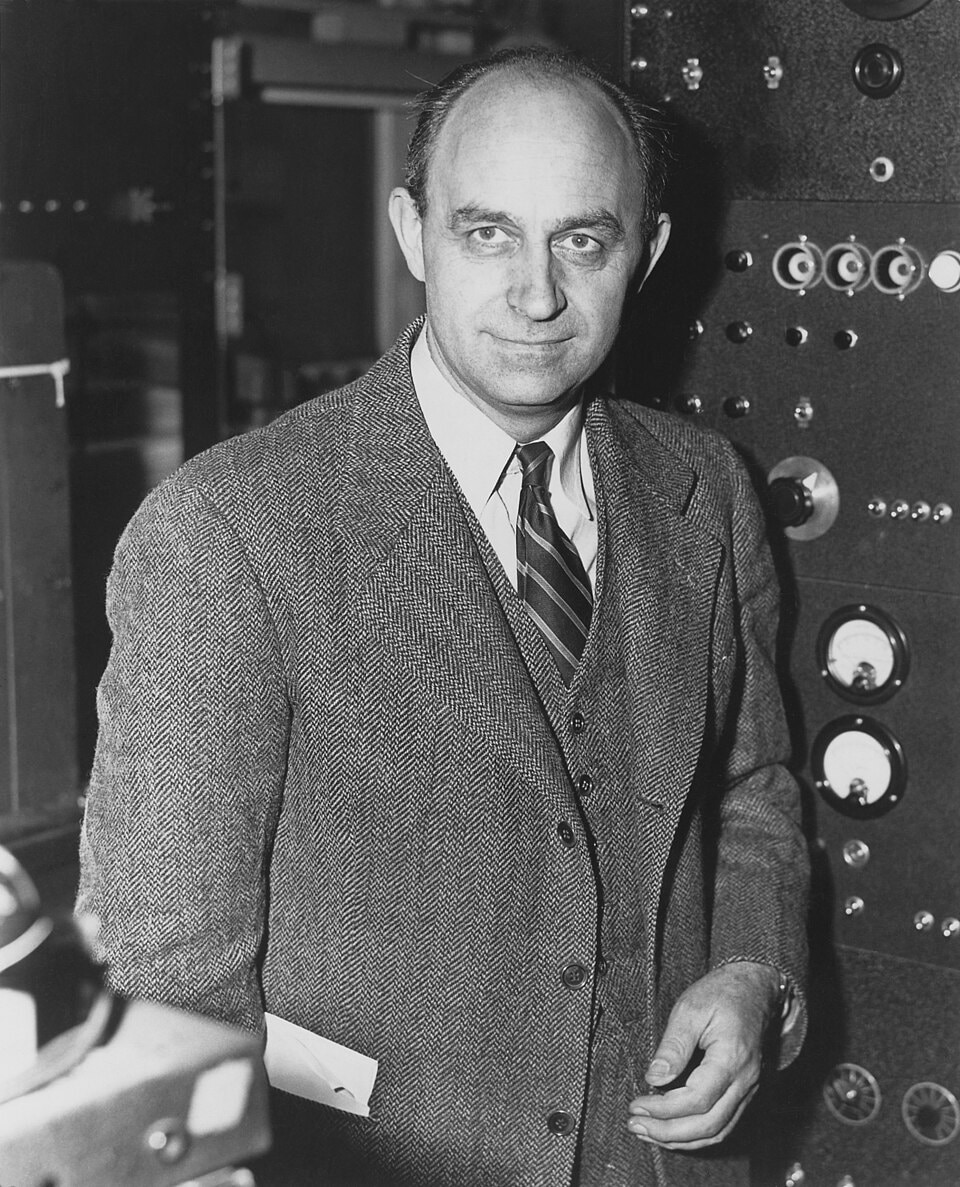
Enrico Fermi
 Italy
Italyphysicist•theoretical physicist•nuclear physicist
Compleanno
September 29, 1901
Segno Zodiacale
Libra
Luogo di Nascita
Rome, Italy
Età
Morto/a a 53 anni
Altezza
5 ft 9 in (1.75 m)
Informazioni
Enrico Fermi was an Italian-American physicist widely regarded as one of the most brilliant scientists of the 20th century. He is best known for building the world's first artificial nuclear reactor, Chicago Pile-1, and for his pivotal role in the Manhattan Project. Fermi won the 1938 Nobel Prize in Physics for his demonstrations of new radioactive elements produced by neutron irradiation and for discovering nuclear reactions caused by slow neutrons. His work laid the foundation for the nuclear age, and he is celebrated for his rare mastery of both theoretical and experimental physics.
Fermi's contributions span multiple fields. He formulated the Fermi-Dirac statistics, which describe particles called fermions, and developed a theory of beta decay that postulated the existence of the neutrino. His discovery that slow neutrons are more effective in nuclear reactions revolutionized nuclear physics. After emigrating to the United States in 1938, he joined the Manhattan Project, where he led the team that achieved the first self-sustaining nuclear chain reaction on December 2, 1942. Today, his legacy is honored through the Fermi National Accelerator Laboratory, the Enrico Fermi Award, and the Fermi Paradox, which stems from a casual question he posed about extraterrestrial life.
Primi Anni e Background
Fermi nacque a Roma da Alberto Fermi, ispettore capo del Ministero delle Comunicazioni, e Ida de Gattis, insegnante. La sua prima infanzia fu segnata dalla tragedia quando suo fratello maggiore Giulio morì improvvisamente per un ascesso alla gola nel 1915. La perdita lo spinse più a fondo negli studi. Scoprì una passione per la fisica e la matematica leggendo vecchi libri da una bancarella del mercato a Campo de' Fiori, imparando da solo concetti complessi. All'età di 14 anni, progettava piccoli motori elettrici e studiava trattati di meccanica analitica.
Fermi trovò un'anima affine nell'amico Enrico Persico, con cui discuteva di problemi di fisica per ore. Dopo essersi distinto negli studi, vinse una borsa di studio per la prestigiosa Scuola Normale Superiore di Pisa. Conseguì la laurea triennale nel 1922 e il dottorato in fisica nel 1923 all'Università di Pisa. La sua tesi di dottorato sulla diffusione dei raggi X dimostrò la sua precoce brillantezza. Un momento cruciale arrivò quando ottenne una cattedra di fisica matematica all'Università di Firenze nel 1924. Poi, nel 1926, sviluppò le leggi statistiche che governano le particelle che obbediscono al principio di esclusione di Pauli, ora note come statistica di Fermi-Dirac, che lo imposero immediatamente come fisico teorico di primo piano. Nello stesso anno, divenne professore ordinario di fisica teorica all'Università di Roma La Sapienza, una posizione creata appositamente per lui.
Crescita Professionale
La carriera di Fermi è una serie di scoperte fondamentali. Nel 1933-34, propose una teoria del decadimento beta che postulava l'esistenza del neutrino e formulò l'interazione di Fermi, descrivendo la forza nucleare debole. Nel 1934, scoprì che bombardare elementi con neutroni lenti è molto più efficace che usare neutroni veloci, portando alla scoperta della radioattività indotta da neutroni. Questo lavoro gli valse il Premio Nobel per la Fisica nel 1938. Usò il denaro del premio per fuggire dall'Italia fascista e trasferirsi negli Stati Uniti.
Nel 1942, all'Università di Chicago, Fermi guidò il team che progettò e costruì Chicago Pile-1, il primo reattore nucleare artificiale al mondo. Il 2 dicembre 1942, raggiunse la prima reazione nucleare a catena autosostenuta. Al Laboratorio di Los Alamos, diresse la Divisione F, lavorando sugli aspetti teorici della bomba termonucleare. Fu presente al test Trinity il 16 luglio 1945, dove stimò famosamente la potenza della bomba lasciando cadere pezzi di carta durante l'onda d'urto. Dopo la guerra, divenne professore all'Istituto di Studi Nucleari dell'Università di Chicago e fece parte del Comitato Consultivo Generale della Commissione per l'Energia Atomica, dove si oppose fermamente allo sviluppo della bomba all'idrogeno. Continuò la ricerca in fisica delle particelle, studiando pioni, muoni e raggi cosmici fino alla sua morte nel 1954.
Cronologia Carriera
Immagine Pubblica e Stile
Fermi è ritratto come il quintessenziale scienziato del XX secolo: intenso, concentrato, con una stempiatura, occhiali e una pipa spesso in bocca. È noto per la sua incredibile chiarezza di pensiero e la sua capacità di risolvere problemi complessi con semplici calcoli. I media e i biografi sottolineano la sua doppia competenza in teoria e sperimentazione, chiamandolo il "papa della fisica". È costantemente descritto come un genio, un brillante risolutore di problemi e un leader calmo e razionale sotto pressione.
Non esiste un fandom formale, ma è venerato da fisici, storici della scienza e studenti di ingegneria. I problemi di Fermi sono un punto fermo dell'insegnamento della fisica e dell'ingegneria, e il Paradosso di Fermi è un argomento importante nella divulgazione scientifica e nella fantascienza. Gli account istituzionali del Fermilab e dei musei pubblicano sulla sua eredità con un tono di riverenza e fascino educativo.
Fama e fandom
Enrico Fermi stands as a towering figure in the annals of science, yet his global fame operates on a different frequency than modern pop icons. As of August 2026, the iFANN Global Fame Engine has evaluated this legendary physicist, but he does not currently hold a placement in the published rankings, meaning no specific ordinal position or score is assigned to him within the top tiers of global celebrity. This absence from the charts reflects his unique status as a historical giant whose influence permeates every physics classroom and laboratory rather than dominating tabloid headlines or social media feeds. While he lacks a formal fanbase with an official name or organized campaigns, the intellectual community reveres him with a devotion that transcends typical fandom. His legacy is sustained by the enduring utility of his theories, which serve as the blueprint for modern technology, and by the cultural mythology surrounding his life. The story of his lunchtime query about extraterrestrial life remains a staple of scientific lore, retold by generations of students and researchers who find wonder in his simple question. Unlike celebrities who rely on public appearances, Fermi's presence is felt through the invisible architecture of his discoveries, creating a silent but profound connection with anyone who understands the universe.
Curiosità e leggende
Enrico Fermi possessed a remarkable ability to estimate quantities using simple calculations, a skill now taught globally as Fermi problems. At the Trinity test, he estimated the bomb's yield to be 10 kilotons of TNT by dropping small pieces of shredded paper and measuring how far they were blown by the shockwave. His estimate was remarkably close to the actual yield of 18.6 kilotons. During a lunch discussion with colleagues in 1950, he famously asked, "But where is everybody?" when discussing the probability of extraterrestrial life. This led to the Fermi Paradox. He is one of the very few physicists who was a world-class master of both theoretical and experimental physics. He learned English by reading scientific journals and listening to the radio, but he always spoke with a strong Italian accent. The element fermium (atomic number 100) is named after him. A central piece of cultural mythology involves the "Fermi Paradox," a question regarding the apparent contradiction between the high probability of extraterrestrial civilizations and the lack of evidence for them. This concept originated from a famous lunch conversation in 1950 at the Los Alamos National Laboratory in New Mexico. Another iconic moment occurred on December 2, 1942, at the University of Chicago, where Fermi led a team to successfully initiate the world's first artificial nuclear chain reaction using Chicago Pile-1. This event is widely cited as the birth of the nuclear age. While not a singular performance event, Fermi's Golden Rule and Fermi-Dirac statistics constitute his enduring intellectual legend, underpinning modern technology including smartphones and particle colliders.
Citazioni Notevoli
“If I could remember the names of all these particles, I would have been a botanist.”
“It is no good to try to stop knowledge from going forward. Ignorance is never better than knowledge.”
“There are two possible outcomes: if the result confirms the hypothesis, then you've made a measurement. If the result is contrary to the hypothesis, then you've made a discovery.”
Famiglia e Vita Privata
Fermi sposò Laura Capon il 19 luglio 1928. Laura era la figlia di un importante ufficiale della marina italiano ebreo. Ebbero due figli: una figlia, Nella (nata nel 1931), e un figlio, Giulio (nato nel 1936), chiamato così in onore del fratello defunto di Fermi. La famiglia fuggì dall'Italia nel 1938 a causa delle leggi razziali del regime fascista che miravano a Laura. Fermi era un uomo di famiglia devoto, anche se il lavoro spesso assorbiva il suo tempo. Morì di cancro allo stomaco il 28 novembre 1954 a Chicago, Illinois.
Collegamenti Notevoli
Fermi collaborò strettamente con J. Robert Oppenheimer, il direttore scientifico del Progetto Manhattan, e in seguito testimoniò a suo favore. Collaborò con Leo Szilard per Chicago Pile-1. Diresse la divisione che lavorava alla bomba termonucleare di Edward Teller, sebbene in seguito si opponesse al suo sviluppo. Sua moglie, Laura Fermi, fu la sua biografa. Sua figlia, Nella Fermi, divenne una storica di spicco.
Relazioni e Storia Dating
Fermi sposò Laura Capon il 19 luglio 1928. Si conobbero tramite amici comuni a Roma, dove Laura era una studentessa di lettere di una famiglia ebrea benestante. Ebbero due figli, Nella e Giulio. Laura fu la sua compagna e biografa, scrivendo Atoms in the Family sulla loro vita. Il matrimonio fu stabile e durò fino alla sua morte il 28 novembre 1954. Nessun'altra relazione romantica pubblica è documentata da fonti storiche credibili. Non ci sono notizie di relazioni extraconiugali, fidanzamenti prima di Laura o flirt di alto profilo. La sua vita fu dedicata quasi esclusivamente al lavoro e alla famiglia.
- Sposato/aLaura Fermi1928 - 1954Si conobbero tramite amici comuni a Roma. Laura era una studentessa di lettere di una famiglia ebrea benestante. Ebbero due figli, Nella e Giulio. Lei fu la sua compagna e biografa.
Morte e conseguenze
Morto/a
November 28, 1954 (a 53 anni)
Luogo di morte
Chicago, Illinois
Causa della morte
Stomach cancer
The scientific community reacted with immediate and profound solemnity to the loss of Enrico Fermi, recognizing him as an architect of the atomic age whose untimely death deprived the world of one of its most brilliant and productive physicists. Tributes poured in from peers and institutions alike, cementing his status as a titan of the twentieth century while Physics Today published a feature titled "Enrico Fermi 1901, 1954" to mark the occasion. The news confirmed that the physicist had passed away at his home in Chicago, Illinois, on November 28, 1954, following a battle with stomach cancer that had been diagnosed in 1953 after surgery for a tumor.
Despite treatment attempts, the condition proved fatal, and his final days were spent recovering from the progression of the disease before he succumbed. His funeral remained a private affair attended by family members and close colleagues from the University of Chicago and the Manhattan Project, reflecting the personal nature of his passing rather than a state-sponsored ceremony. Following the service, his ashes were interred at Forest Home Cemetery in Chicago. Posthumously, Fermi has been honored through numerous dedications and educational initiatives that continue to shape modern physics. The Enrico Fermi Institute was established at the University of Chicago, and the Fermi National Accelerator Laboratory in Batavia, Illinois, bears his name as a premier center for particle research.
The U.S. Department of Energy presents the annual Enrico Fermi Award to recognize outstanding contributions to nuclear science, while a scholarship foundation supports students in the field. His intellectual legacy endures through the Fermi Paradox, which remains a subject of intense discussion and publication decades later.
Patrimonio (Valore immobiliare)
$2 Million
Stima del team editoriale di iFANN
Enrico Fermi was a salaried academic and government scientist who did not amass a significant personal fortune. His net worth at death was modest, and per iFANN's editorial analysis, the current estate value is estimated at $2 Million as of 2026. The estate earns modest royalties from his books, such as Thermodynamics and Nuclear Physics, and from patent rights, though the U.S. government took over most of his nuclear patents in 1944. The Fermi estate is managed by his descendants and is not a commercial enterprise, with no significant annual income stream beyond book royalties and personal property.
Premi vinti (6)
Fermi vinse il Premio Nobel per la Fisica nel 1938 per il suo lavoro sulla radioattività indotta da neutroni. Ricevette anche la Medaglia Hughes (1942), la Medaglia Franklin (1947), il Premio Rumford (1953) e la Medaglia Max Planck (1954). L'Enrico Fermi Award fu istituito in suo onore e lui ne fu il primo destinatario postumo nel 1954.
1938 · Fisica
Demonstrations of new radioactive elements produced by neutron irradiation and discovery of nuclear reactions brought about by slow neutrons
1942 · Fisica
Contributions to the development of the atomic bomb and nuclear physics
Noto Per
Chicago Pile-1 (first nuclear reactor)
1942 · Lead designer
Manhattan Project
1944 · Head of F Division
Nobel Prize in Physics
1938 · Recipient
Fermi-Dirac statistics
1926 · Developer
Beta decay theory (neutrino postulate)
1933 · Developer
Parole chiave
Fatti Rapidi
- Professione
- physicist, theoretical physicist, nuclear physicist
- Nato/a
- +1901-09-29
- Luogo di Nascita
- Rome
- Morto/a
- +1954-11-28
- Luogo di morte
- Chicago
- Genere
- Maschio
- Coniuge
- Laura Fermi
- Segno Zodiacale
- Libra
Dettagli Personali
- Nome Completo
- Enrico Fermi
- Altezza
- 5 ft 9 in (1.75 m)
- Coniuge
- Laura Fermi
- Figli
- Nella Fermi (daughter), Giulio Fermi (son)
- Istruzione
- Scuola Normale Superiore in Pisa (undergraduate and doctorate)
Domande Frequenti
Per cosa è famoso Enrico Fermi?
Come è morto Enrico Fermi?
Cos'è il Paradosso di Fermi?
Enrico Fermi aveva una moglie?
Cos'è l'Enrico Fermi Award?
Persone Simili
Unisciti alla community
fan che discutono