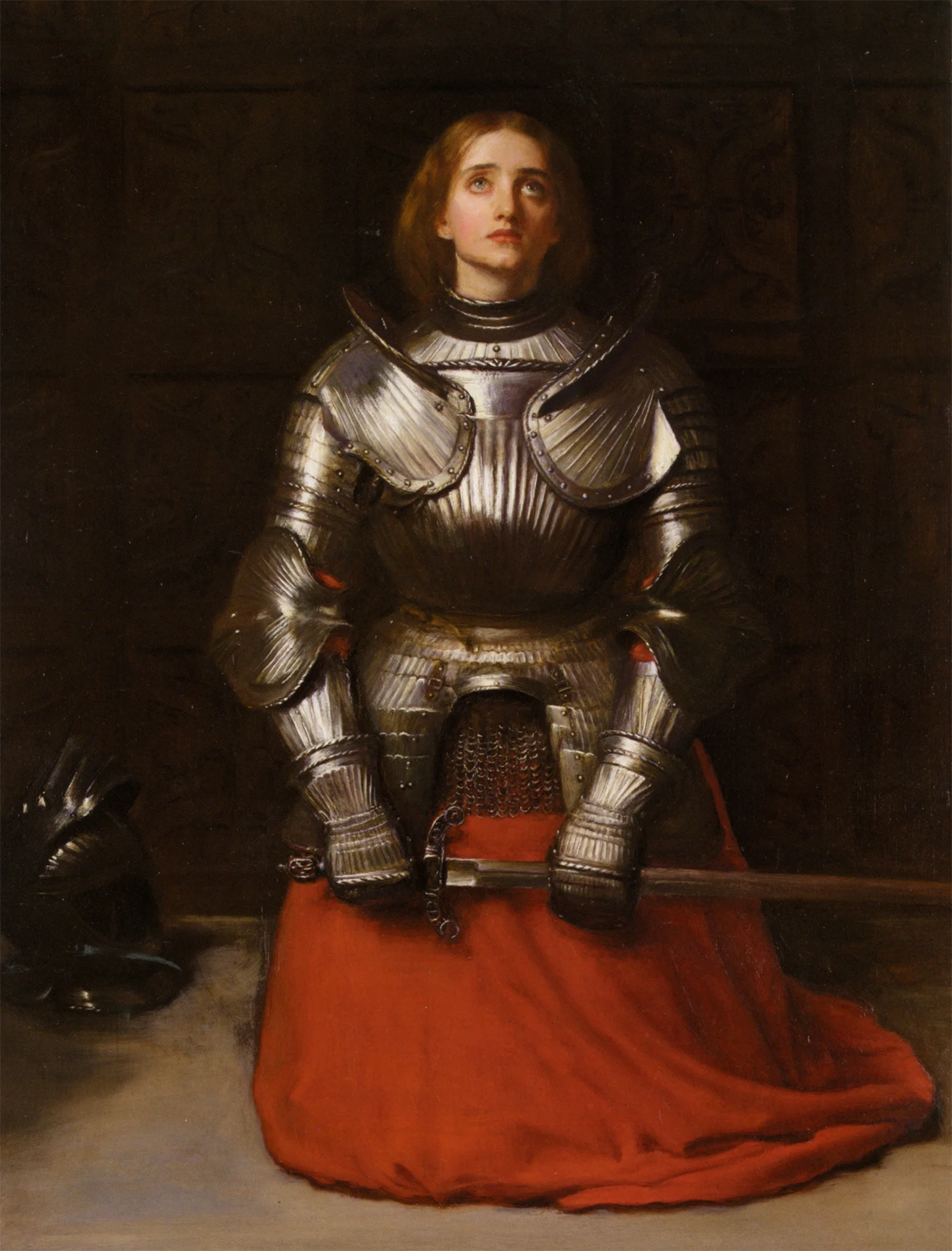
Joan of Arc
 France
military personnel•religious leader
Also known as: The Maid of Orléans, Jeanne d'Arc, Saint Joan of Arc
Compleanno
January 6, 1412
Segno Zodiacale
Capricorn
Luogo di Nascita
Domrémy-la-Pucelle
Età
Morto/a a 19 anni
Altezza
5 ft 0 in (152 cm)
Informazioni
Joan of Arc was a national heroine of France and a canonized Catholic saint, remembered as the teenage peasant girl who helped turn the tide of the Hundred Years' War. Born around 1412 in the village of Domrémy, she claimed to receive visions from saints and the archangel Michael instructing her to drive the English from France and see the disinherited Charles VII crowned king. That conviction, extraordinary in a young woman of no rank, propelled her from rural obscurity to the center of a nation's struggle.
Her legend rests on a stunning few years of action. Granted an audience with Charles and given a role in the army, she helped lift the siege of Orléans and inspired a demoralized French force to a string of victories that opened the road to Reims, where Charles was crowned. Captured by Burgundian forces and handed to the English, she was tried by a church court and burned at the stake in 1431, not yet twenty years old. Decades later her conviction was overturned, and centuries after that she was declared a saint.
Joan endures as one of history's most compelling figures, a symbol of faith, courage, and patriotism whose story has inspired countless retellings in books, films, and art. Her feast day is May 30, and she is the patron saint of soldiers, prisoners, and France.
Primi Anni e Background
Giovanna crebbe a Domrémy, un piccolo villaggio nella regione della Lorena, nel nord-est della Francia, durante la Guerra dei Cent'anni. I suoi genitori, Jacques d'Arc e Isabelle Romée, erano mezzadri che allevavano bestiame e coltivavano campi. Il villaggio si trovava nel Ducato di Bar, la cui gente rimase fedele alla fazione armagnacca pur essendo circondata da territori filo-borgognoni. Nel 1425, Domrémy fu attaccato e il bestiame rubato, indurendo il sentimento locale contro gli inglesi e i loro alleati borgognoni.
Giovanna non imparò mai a leggere o scrivere. Sua madre le insegnò abilità domestiche come cucire e filare, e lei aiutava suo padre nei campi e si occupava degli animali. La famiglia frequentava regolarmente la chiesa e Giovanna ricevette una forte educazione religiosa. Intorno ai 13 anni, iniziò a sperimentare visioni e a sentire voci che credeva divine. Riferì di aver visto San Michele Arcangelo, Santa Caterina e Santa Margherita, che inizialmente le intimarono di essere buona e di andare in chiesa. Col tempo, le voci divennero più urgenti, dicendole che aveva una grande missione: cacciare gli inglesi dalla Francia e vedere il Delfino Carlo incoronato re a Reims.
A circa 16 anni, Giovanna decise di agire. Si avvicinò al comandante locale a Vaucouleurs, Robert de Baudricourt, chiedendo un'escorta per portarla alla Corte Reale. Lui la congedò due volte, ma lei persistette e alla fine ottenne un'udienza con il Delfino a Chinon all'inizio del 1429.
Crescita Professionale
Giovanna arrivò a Chinon nel febbraio 1429 e convinse Carlo VII a permetterle di unirsi allo sforzo bellico. I teologi di Poitiers la esaminarono e non trovarono nulla di male, così le furono fornite un'armatura, uno stendardo con il giglio e i nomi Gesù e Maria, e un cavallo bianco. La sua prima azione importante avvenne all'assedio di Orléans nell'aprile-maggio 1429. Guidando truppe francesi demoralizzate, le ispirò a sollevare l'assedio in nove giorni, un punto di svolta nella guerra. La vittoria le valse il soprannome di La Pulzella d'Orléans.
Dopo Orléans, Giovanna guidò la campagna della Valle della Loira, conquistando Jargeau e vincendo la battaglia di Patay nel giugno 1429. Queste vittorie aprirono la strada a Reims, dove Carlo VII fu incoronato re il 17 luglio 1429, con Giovanna al suo fianco che teneva il suo stendardo. Nel maggio 1430, durante uno scontro a Compiègne, fu disarcionata e catturata dalle forze borgognone, che la vendettero agli inglesi. Fu processata per eresia da un tribunale ecclesiastico a Rouen a partire dal 9 gennaio 1431. Condannata per aver indossato abiti maschili e per aver agito su visioni demoniache, fu bruciata sul rogo il 30 maggio 1431, all'età di 19 anni. Un processo di nullità nel 1456 annullò la condanna, e fu canonizzata nel 1920.
Cronologia Carriera
Immagine Pubblica e Stile
Giovanna è tipicamente raffigurata in armatura con uno stendardo bianco recante il giglio, spesso con i capelli corti e indossando abiti maschili. È ritratta come un simbolo di coraggio, fede, patriottismo e convinzione divina. La sua immagine è stata interpretata in centinaia di film, opere teatrali, libri e opere d'arte, che vanno da martire religiosa a icona femminista a eroina militare. I cattolici la venerano come santa, mentre i nazionalisti francesi la celebrano come un'eroina. Le celebrazioni annuali nel giorno della sua festa, il 30 maggio, includono pellegrinaggi a Domrémy e Rouen, rievocazioni storiche e conferenze accademiche. I resoconti educativi si concentrano sull'accuratezza storica, mentre i resoconti cattolici enfatizzano il suo significato spirituale.
Fama e fandom
Joan of Arc commands a devotion that transcends the modern definition of fandom. There is no organized group calling themselves by a specific name, nor are there fan-funded subway ads or birthday billboards for the 15th-century peasant girl turned military leader. Instead, her following consists of devotees, historians, and cultural admirers who interact with her legacy through religious veneration and academic study. Her story serves as a narrative of resilience against occupation and injustice, inspiring individuals facing oppression to seek moral courage. Communities gather today not to stream a new single, but to reflect on themes of saintly patriotism and divine guidance in theatrical productions and theological discussions. This enduring reverence functions as a form of worship rather than celebrity worship, cementing her status as a symbol of freedom and independence across centuries. The iFANN Global Fame Rankings track this unique blend of historical weight and cultural consumption worldwide. Joan of Arc is currently the 368th most famous person in the world, holding steady from the previous cycle. She ranks as the 20th most famous person in France and stands as the 15th most famous person from France. In Europe, she holds the position of the 92nd most famous person in Europe. Within the pop culture sphere, she is recognized as the 72nd most famous person in Pop.
Curiosità e leggende
Joan dictated her letters to scribes because she could not write herself. Her trial transcript remains one of the most complete medieval documents, preserving extensive eyewitness accounts of her proceedings. She wore men's clothing, a choice that became a central charge during her trial. The French royal family paid a ransom of 10,000 livres after her capture, yet the English refused to release her. Her birthplace, Domrémy, was renamed Domrémy-la-Pucelle in her honor. She correctly predicted the outcome of a military engagement at Orléans, which convinced Charles VII of her divine mission. A sword she claimed was guided by voices was discovered behind the altar of the church of Sainte-Catherine-de-Fierbois. Legends still retell how her presence lifted the siege of Orléans, turning the tide of the Hundred Years' War despite her lack of military training. The story of her martyrdom, where she refused to recant her visions even under threat of death, defines her tragic arc. A posthumous retrial in 1456 declared her innocent, leading to her canonization as a saint in 1920.
Citazioni Notevoli
“I am not afraid; I was born to do this.”
“If I am not, may God put me there; and if I am, may God keep me there.”
“Hold the standard in the battle, and it will touch the king's person. The standard belongs to the king. And for love of the standard, do not let it fall.”
“God has pity on the French. He wishes them to be free.”
“I would rather die than do something which I know to be a sin, or to be against God's will.”
Famiglia e Vita Privata
Giovanna nacque da Jacques d'Arc, un contadino e funzionario del villaggio, e Isabelle Romée, che le fornì un'educazione religiosa. Aveva tre fratelli maggiori, Jean, Pierre e Jacques, e una sorella maggiore di nome Catherine. La famiglia viveva in una modesta casa a Domrémy ed era profondamente cristiana. Giovanna non si sposò mai e non ebbe figli. Fece voto di castità come parte della sua missione divina. Dopo la sua morte, sua madre e i suoi fratelli furono coinvolti nella petizione per il processo di nullità.
Collegamenti Notevoli
La storia di Giovanna è profondamente legata a Carlo VII, il Delfino che lei aiutò ad incoronare. Si oppose a lei il vescovo Pierre Cauchon, che presiedette al suo processo. Robert de Baudricourt, il comandante locale di Vaucouleurs, inizialmente respinse poi approvò la sua missione. Il Duca di Borgogna, Filippo il Buono, le cui forze la catturarono, e Re Enrico VI d'Inghilterra, la cui pretesa lei contrastò, furono avversari chiave. Riferì visioni di San Michele, Santa Caterina e Santa Margherita.
Relazioni e Storia Dating
Giovanna d'Arco non si sposò mai e non ebbe relazioni sentimentali note. I resoconti storici indicano che all'età di circa 16 anni, la sua famiglia organizzò un potenziale matrimonio, ma Giovanna rifiutò e contestò con successo il fidanzamento in tribunale ecclesiastico. Fece un voto di castità come parte della sua missione divina. Non esistono resoconti storici credibili di relazioni romantiche o sessuali. Come santa canonizzata e figura storica, non ha uno stato relazionale attuale.
Morte e conseguenze
Morto/a
May 30, 1431 (a 19 anni)
Luogo di morte
Rouen, Normandy
Causa della morte
Execution by burning at the stake
Immediate mourning was absent in the streets of Rouen, where many viewed her as a traitor or witch rather than a martyr. The public spectacle concluded with her body consumed by flames, leaving only ashes that were cast into the Seine River to prevent veneration as relics. On May 30, 1431, she stood bound to a post in the Old Market Square following a mass at the church of Saint-Sauveur, reciting the name of Jesus as the fire took hold. While some later accounts suggested she may have been strangled before the flames fully consumed her, this remains an unconfirmed detail within the trial transcripts. The legal aftermath transformed her legacy through the Nullification Trial initiated in 1455 by Pope Callixtus III at the request of her mother, Isabelle Romée.
This inquiry annulled the original verdict of heresy seven years after her death, declaring the proceedings procedurally flawed and politically motivated. Her family focused their efforts on justice and the restoration of her honor, which the papal ruling ultimately secured. Centuries later, the Catholic Church canonized her as a saint on May 16, 1920, establishing her feast day on May 30. Modern tributes include annual vigils, memorial murals, and artistic works like the 1928 silent film The Passion of Joan of Arc, cementing her status as a co-patroness of France.
Patrimonio (Valore immobiliare)
$0
Stima del team editoriale di iFANN
Joan of Arc died in 1431 with no personal wealth. Per iFANN's editorial analysis, her net worth is estimated at $0. As a historical and religious figure, she has no living net worth. The Catholic Church manages her legacy through the veneration of saints. No monetary value is assigned to her historical legacy.
Premi vinti (1)
Giovanna d'Arco non ricevette riconoscimenti formali durante la sua vita. Postuma, fu canonizzata come santa dalla Chiesa Cattolica nel 1920 ed è riconosciuta come un'eroina nazionale della Francia.
1920 · Santità
Life and martyrdom
Noto Per
Siege of Orléans
1429 · Military leader
Coronation of Charles VII
1429 · Inspirational figure
Hundred Years' War
1429-1430 · Comandante militare
Parole chiave
Fonti
Fatti Rapidi
- Professione
- military personnel, religious leader
- Nato/a
- January 6, 1412
- Luogo di Nascita
- Domrémy-la-Pucelle
- Morto/a
- May 30, 1431
- Luogo di morte
- Rouen
- Genere
- Femmina
Dettagli Personali
- Nome Completo
- Jehanne d'Arc
- Altezza
- 5 ft 0 in (152 cm)
- Istruzione
- No formal education; could not read or write
Domande Frequenti
Giovanna d'Arco fu davvero bruciata sul rogo?
Giovanna d'Arco sentì davvero delle voci?
Quanti anni aveva Giovanna d'Arco quando morì?
Perché Giovanna d'Arco fu uccisa?
Giovanna d'Arco ha avuto figli?
Persone Simili
Unisciti alla community
fan che discutono