
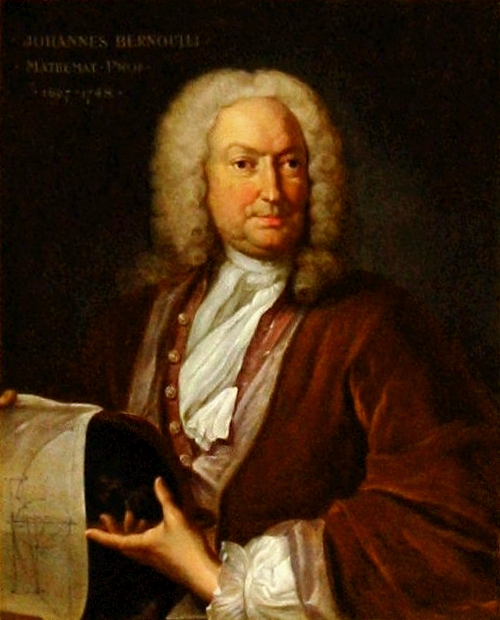
Johann Bernoulli
 Switzerland
mathematician•physicist•physician
Also known as: Jean Bernoulli, John Bernoulli
Compleanno
July 27, 1667
Segno Zodiacale
Sagittarius
Luogo di Nascita
Basel
Età
Morto/a a 80 anni
Informazioni
Johann Bernoulli fu un matematico, fisico e medico svizzero, nato il 27 luglio 1667 a Basilea. Apparteneva alla prominente famiglia Bernoulli, che produsse diverse generazioni di matematici. Johann è noto soprattutto per il suo lavoro fondamentale nel calcolo infinitesimale, nel calcolo delle variazioni e nella fluidodinamica. Formulò il problema della brachistocrona e derivò il principio di Bernoulli, che descrive il comportamento del flusso dei fluidi. La sua corrispondenza con Leibniz contribuì a diffondere il calcolo in tutta Europa. Johann insegnò anche a Leonhard Euler, diventando mentore di uno dei più grandi matematici della storia. Morì il 1° gennaio 1748, all'età di 80 anni.
Primi Anni e Background
Johann nacque in una prospera famiglia di Basilea; suo padre Nicolaus era un farmacista e suo nonno aveva lavorato nel commercio delle spezie. Suo padre sperava che Johann prendesse in mano l'attività di famiglia, ma Johann era attratto dagli studi intellettuali. Si iscrisse all'Università di Basilea per studiare medicina, una professione rispettabile che soddisfaceva i desideri del padre. Mentre studiava medicina, Johann dedicò segretamente tempo alla matematica, imparando il nuovo calcolo differenziale e integrale direttamente dagli scritti di Leibniz e da suo fratello maggiore Jakob, che deteneva una cattedra di matematica all'università. I suoi primi interessi includevano l'applicazione del calcolo differenziale e integrale alla meccanica, all'ottica e alle curve, come la riflessione e la rifrazione della luce e le traiettorie ortogonali. Questi anni formativi lo videro passare dalla medicina alla matematica, portando al suo primo serio lavoro matematico negli anni '90 del 1600.
Crescita Professionale
La svolta di Johann arrivò negli anni '90 del Seicento con il suo lavoro sul problema della brachistocrona, la curva di discesa più veloce sotto gravità, che risolse nel 1696. Questo problema divenne un fondamento del calcolo delle variazioni. Continuò ad applicare il calcolo alla meccanica, all'ottica e alle equazioni differenziali. Nel 1718, pubblicò un trattamento sistematico del calcolo delle variazioni in Histoire de l'Académie Royale des Sciences, stabilendolo come una disciplina coerente. Le sue opere raccolte, Opera Johannis Bernoullii, furono pubblicate in quattro volumi nel 1742. Come insegnante, ha formato Leonhard Euler a Basilea, influenzando profondamente il lavoro successivo di Euler. Ha anche insegnato al Marchese de L'Hôpital, il cui libro di testo sul calcolo differenziale attinse pesantemente alle lezioni di Bernoulli. Gli sforzi di Johann contribuirono a stabilire il calcolo leibniziano come standard in tutta Europa.
Cronologia Carriera
Immagine Pubblica e Stile
Johann Bernoulli è ricordato come uno studioso brillante ma combattivo, intensamente competitivo con suo fratello Jakob. Il suo lavoro pubblicato è tecnico, espresso in latino e nella notazione matematica dell'analisi moderna iniziale. Resoconti moderni enfatizzano il suo ruolo nella diffusione del calcolo leibniziano e nel suo ruolo di mentore di Leonhard Euler. Non esiste un fandom organizzato; l'interesse proviene principalmente da matematici e storici della scienza. I commentatori contemporanei talvolta lo ritraggono umoristicamente, ma ciò riflette la loro voce, non la sua.
Fama e fandom
The Swiss mathematician Johann Bernoulli stands as a towering, albeit distant, figure in the annals of science rather than a contemporary celebrity. In August 2026, the iFANN Global Fame Engine evaluated his enduring legacy and confirmed that he currently holds no placement in the published rankings, meaning he does not appear in the Global Top 1,000 or any specific scope list. This absence from the charts reflects his status as an Enlightenment-era academic whose influence is measured in textbooks and historical texts rather than modern social metrics or fan engagement. Unlike pop icons who command organized followings with official names and ritualistic behaviors, Bernoulli has no documented fandom name. His audience consists exclusively of historians, mathematicians, and students who engage with his work through rigorous study rather than fan campaigns, birthday tributes, or digital communities. There are no fan-funded projects, subway ads, or charity drives dedicated to him, as the concept of a mass public interacting with a deceased scholar did not exist in his time. The few mentions of his birth on July 27, 1667, appearing sporadically on social media, serve merely as educational reminders rather than signs of an active cult following. While modern hobbyist writers sometimes dub him 'the drama queen of mathematics' due to his intense rivalry with his brother Jakob, this label describes a historical personality trait rather than a fan-created identity. His relationship with the public was strictly professional, limited to his role as a professor at the University of Basel and his correspondence with peers. Today, his fame remains static, preserved in the quiet reverence of academia where his contributions to calculus and fluid dynamics continue to shape scientific thought without the noise of a modern fanbase.
Curiosità e leggende
Johann and his brother Jakob were among the first people to learn calculus directly from Leibniz's original writings. Before Leonhard Euler standardized notation, some mathematicians used the letter 'b' instead of 'e' for the base of the natural logarithm, reflecting Johann's early recognition of the constant's unique properties. He is often credited with discovering that e represents the limit of (1 + 1/n)^n as n approaches infinity. His son Daniel Bernoulli later solved the St. Petersburg paradox, illustrating the family's multi-generational influence on probability theory. Modern hobbyist writing has described Johann as 'the drama queen of mathematics' due to his intense rivalry with Jakob. A legendary moment occurred when Johann posed the brachistochrone problem, challenging the greatest minds in Europe to find the curve of fastest descent. Isaac Newton reportedly solved the anonymous challenge overnight, famously stating, 'I recognize the lion by his claw.' Another dark chapter involves the bitter feud between the brothers; after Jakob died, Johann allegedly stole his notes and manuscripts to claim credit for discoveries regarding the law of large numbers. These intellectual conflicts defined his life, creating a legacy of high-stakes mathematical battles rather than crowd-fueled adoration.
Famiglia e Vita Privata
Johann nacque da Nicolaus Bernoulli, un farmacista di Basilea, e da sua moglie. Suo nonno era stato nel commercio delle spezie. Ebbe diversi fratelli, in particolare il fratello maggiore Jakob Bernoulli, un importante matematico. Johann sposò Dorothea Falkner ed ebbero tre figli. Un figlio, Daniel Bernoulli, divenne un famoso matematico e fisico, noto per il principio di Bernoulli e per i lavori in probabilità e idrodinamica. La famiglia Bernoulli ha prodotto molteplici generazioni di matematici, spesso chiamata 'dinastia Bernoulli'.
Collegamenti Notevoli
Johann Bernoulli è strettamente associato a suo fratello Jakob Bernoulli, con cui collaborò e gareggiò. Fu mentore di Leonhard Euler, uno dei più grandi matematici di tutti i tempi. Corrispose anche con Gottfried Wilhelm Leibniz, contribuendo a diffondere il calcolo infinitesimale. Suo figlio Daniel Bernoulli portò avanti la tradizione di famiglia. La famiglia Bernoulli nel suo complesso è sinonimo di matematica moderna primordiale.
Relazioni e Storia Dating
Johann Bernoulli sposò Dorothea Falkner, probabilmente verso la fine degli anni '90 del Seicento. Ebbero tre figli insieme, tra cui il celebre matematico Daniel Bernoulli. Il matrimonio durò fino alla morte di Johann nel 1748. Nessun'altra relazione romantica è documentata nelle fonti storiche.
- Sposato/aDorothea Falkner1697 - 1748Sposato a Basilea; ebbe tre figli tra cui Daniel Bernoulli.
Morte e conseguenze
Morto/a
January 1, 1748 (a 80 anni)
Luogo di morte
Basel, Switzerland
Causa della morte
Natural causes
The final days of Johann Bernoulli unfolded in the quiet academic halls of Basel, where he had spent a lifetime shaping the landscape of European mathematics. On January 1, 1748, the eighty-year-old scholar passed away within the city that had hosted his birth and his career at the University of Basel. Historical records from the era do not preserve a specific medical diagnosis or an autopsy report, reflecting the standard practice for natural deaths among scholars of the eighteenth century rather than any forensic investigation. The immediate reaction came through the dense network of correspondence between mathematicians across the continent, who acknowledged the loss of a central figure in the development of calculus and the calculus of variations.
His funeral was conducted in Basel, attended by family members including his son Daniel and academic colleagues, though no detailed public ceremony was recorded in surviving accounts. Posthumously, his legacy solidified through the publication of his collected works, Opera Johannis Bernoullii, which appeared in four volumes shortly after his death. Tributes manifested as the continued teaching of his methods to students like Leonhard Euler and the enduring application of principles named in his honor. His estate passed to his descendants, notably his son Johann II, who also pursued a distinguished career in mathematics. The mathematical community mourned the passing of a man whose rivalry with Leibniz and mentorship of future giants helped define the scientific age.
Patrimonio (Valore immobiliare)
Johann Bernoulli morì nel 1748, molto prima delle stime moderne del patrimonio. Il suo reddito proveniva da posizioni accademiche e mecenatismo tipici degli studiosi del XVIII secolo. Non esistono documenti finanziari affidabili per stimare la sua ricchezza. La sua eredità intellettuale, tuttavia, è incommensurabile.
Premi e Lodi
View 2 records, honours and achievementsNoto Per
Brachistochrone problem
1696 · Solved
Calculus of variations
1718 · Systematized
Bernoulli's principle
1738 · Derived (via son Daniel)
Parole chiave
Fonti
Fatti Rapidi
- Professione
- mathematician, physicist, physician
- Nato/a
- +1667-07-27
- Luogo di Nascita
- Basel
- Morto/a
- +1748-01-01
- Luogo di morte
- Basel
- Genere
- Maschio
- Coniuge
- Dorothea Falkner
- Segno Zodiacale
- Sagittarius
Dettagli Personali
- Nome Completo
- Johann Bernoulli
- Coniuge
- Dorothea Falkner
- Figli
- Three sons, including Daniel Bernoulli
- Istruzione
- University of Basel (medicine, self-taught in mathematics)
Domande Frequenti
Chi era Johann Bernoulli?
Per cosa è famoso Johann Bernoulli?
Johann Bernoulli vinse premi?
Johann Bernoulli era parente di Jacob Bernoulli?
Quando morì Johann Bernoulli?
Persone Simili
Unisciti alla community
fan che discutono