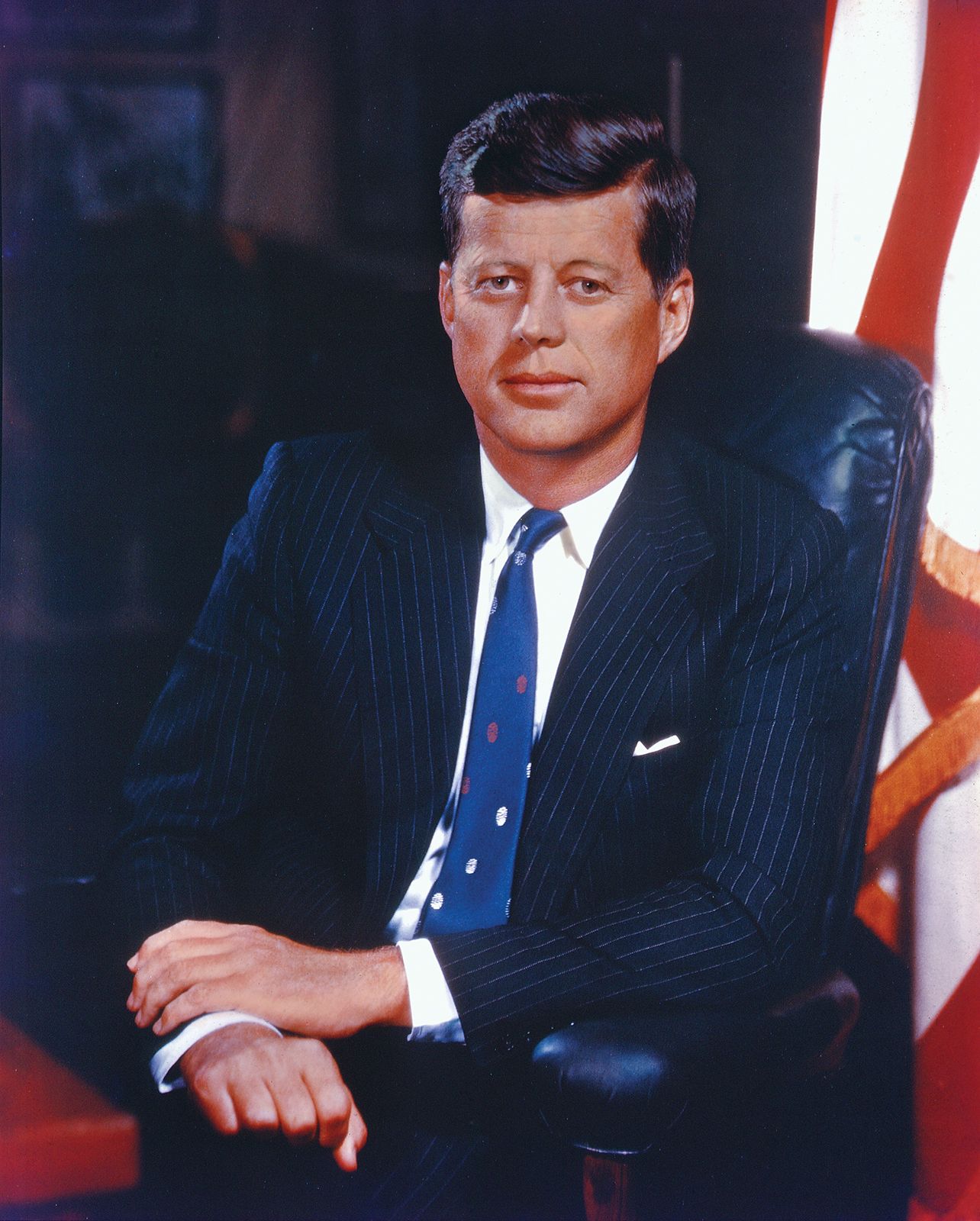
John F. Kennedy
 United States
Politician•35th President of the United States
Also known as: JFK, Jack Kennedy, President Kennedy
Compleanno
May 29, 1917
Segno Zodiacale
Gemini
Luogo di Nascita
Brookline, Massachusetts, United States
Età
Morto/a a 46 anni
Altezza
6 ft 0 in (183 cm)
Informazioni
John Fitzgerald Kennedy è stato un politico statunitense che ha servito come 35º presidente degli Stati Uniti dal 1961 fino al suo assassinio nel 1963. È ampiamente considerato una delle figure più iconiche del XX secolo, noto per il suo carisma, eloquenza e leadership durante la Guerra Fredda. La presidenza di Kennedy ha visto la crisi dei missili di Cuba, la fondazione del Peace Corps e la spinta per la legislazione sui diritti civili. La sua energia giovanile e la visione di una Nuova Frontiera hanno ispirato una generazione. Oggi rimane un simbolo di speranza e progresso, classificandosi costantemente tra i più grandi presidenti statunitensi nei sondaggi storici.
Primi Anni e Background
Nato in una famiglia ricca e politicamente ambiziosa a Brookline, Massachusetts, Kennedy era il secondo di nove figli. Ha frequentato la Choate Rosemary Hall, poi l'Università di Harvard, dove si è laureato cum laude in relazioni internazionali. La sua tesi di laurea, 'Why England Slept', è diventata un bestseller. Dopo l'università, ha prestato servizio nella Marina degli Stati Uniti durante la Seconda Guerra Mondiale, comandando una motosilurante che fu speronata e affondata da un cacciatorpediniere giapponese. Le azioni eroiche di Kennedy nel salvare il suo equipaggio gli valsero la Navy and Marine Corps Medal. Dopo la guerra, lavorò brevemente come giornalista prima di entrare in politica, vincendo un seggio alla Camera dei Rappresentanti degli Stati Uniti nel 1946.
Crescita Professionale
Kennedy ha servito tre mandati alla Camera e due al Senato prima di vincere la presidenza nel 1960, sconfiggendo Richard Nixon in una delle elezioni più serrate della storia statunitense. Il suo discorso inaugurale esortava gli americani a 'non chiederti cosa il tuo paese può fare per te — chiediti cosa puoi fare tu per il tuo paese.' I risultati chiave includono la fondazione del Peace Corps, la gestione riuscita della crisi dei missili di Cuba nel 1962 e la firma del Trattato per la messa al bando limitata dei test nucleari. Ha anche gettato le basi per il Civil Rights Act del 1964. La presidenza di Kennedy fu interrotta dal suo assassinio a Dallas, Texas, il 22 novembre 1963.
Cronologia Carriera
Immagine Pubblica e Stile
Kennedy proiettava un'immagine di vigore giovanile, curiosità intellettuale e raffinatezza elegante. Le sue conferenze stampa erano trasmesse in diretta televisiva, e fu il primo presidente ad abbracciare pienamente il mezzo, guadagnandosi il soprannome di 'il presidente televisivo'. La sua elegante moglie Jacqueline e i loro giovani figli aggiungevano al mistero di Camelot. I media spesso lo ritraevano come un eroe di guerra e un uomo di famiglia, mentre lo sfarzo della sua amministrazione richiamava paragoni con la corte di Re Artù. Il suo assassinio cementò il suo status di martire tragico, e la sua immagine rimane impressa nella memoria americana come simbolo di una promessa perduta.
Fama e fandom
The enduring appeal of John F. Kennedy does not stem from a modern, organized fandom with specific rituals or self-identifying names like those found in pop culture today. Instead, his audience consists of history enthusiasts and citizens who engage with his legacy through national institutions, scholarly works, and the persistent cultural mythology surrounding his brief presidency. There are no fan clubs or grassroots campaigns to keep him alive; rather, the reverence for JFK is expressed through the preservation of his library, the continued operation of vessels bearing his name, and the ongoing political weight his family name carries in American discourse. The Camelot mythos and the tragedy of his assassination have cemented a unique form of collective memory that functions as a secular religion for many, yet it lacks the active, participatory structure of a traditional fanbase. This distinction makes his fame particularly stable and rooted in historical significance rather than transient celebrity trends. His standing remains robust across the globe, reflecting a consistent level of recognition that transcends generations. According to the iFANN Global Fame Rankings, he holds several notable positions: the 79th most famous person in the world, the 15th most famous person in United States, the 43rd most famous person from United States, the 19th most famous person in North America, and the 12th most famous person in Politics. These placements, which have held steady from the previous cycle, underscore his status as a permanent fixture in global consciousness.
Curiosità e leggende
John Fitzgerald Kennedy was the first Catholic president of the United States, a milestone that broke significant religious barriers during his election. He won a Pulitzer Prize for Biography in 1957 for 'Profiles in Courage,' though scholars have long debated the extent of his personal authorship versus that of his staff. Behind the scenes, he managed chronic back pain and Addison's disease, conditions he kept largely hidden from the public eye to maintain an image of vitality. An avid reader with the ability to speed-read up to 1,200 words per minute, he often cited 'Casablanca' as his favorite movie. At home, the family enjoyed a pet pony named Macaroni for their children. Beyond these facts, legends persist about his time in office. The phrase 'Ask not what your country can do for you, ask what you can do for your country' from his 1961 inaugural address remains one of the most quoted lines in American history, defining a generation's sense of civic duty. Another enduring story is the 'Camelot' comparison made by his wife Jacqueline after his death, which framed their White House years as a brief, idealistic era cut short by tragedy. While the assassination in Dallas on November 22, 1963, is a verified historical fact, the emotional intensity described in folklore regarding his popularity is often a retrospective interpretation of the nation's collective trauma rather than spontaneous reactions seen during his lifetime.
Citazioni Notevoli
“Ask not what your country can do for you — ask what you can do for your country.”
“Ich bin ein Berliner.”
“The only thing we have to fear is fear itself.”
“A man may die, nations may rise and fall, but an idea lives on.”
“Forgive your enemies, but never forget their names.”
Famiglia e Vita Privata
Il padre di Kennedy, Joseph P. Kennedy Sr., era un uomo d'affari facoltoso e ambasciatore degli Stati Uniti nel Regno Unito. Sua madre, Rose Fitzgerald Kennedy, era la figlia del sindaco di Boston John F. Fitzgerald. Aveva otto fratelli, tra cui Robert F. Kennedy e Ted Kennedy, entrambi politici di spicco. Nel 1953, sposò Jacqueline Lee Bouvier, una sofisticata e intelligente socialite. Ebbero tre figli: Caroline, John Jr. e Patrick, che morì due giorni dopo la nascita. La famiglia viveva alla Casa Bianca, che Jacqueline restaurò e ridecorò famosamente. I Kennedy avevano anche un cane pastore tedesco di nome Pushinka, un regalo del premier sovietico Nikita Khrushchev.
Collegamenti Notevoli
John F. Kennedy è strettamente associato a suo fratello Robert F. Kennedy, che ha servito come suo Procuratore Generale, e a suo fratello Ted Kennedy, che è diventato un senatore di lunga data. Ha anche avuto un rapporto complesso con il direttore dell'FBI J. Edgar Hoover e il premier sovietico Nikita Khrushchev. Sua moglie Jacqueline Kennedy Onassis rimane una figura iconica a pieno titolo.
Relazioni e Storia Dating
John F. Kennedy sposò Jacqueline Lee Bouvier il 12 settembre 1953 a Newport, Rhode Island. La coppia ebbe quattro figli, ma solo due sopravvissero fino all'età adulta: Caroline (nata nel 1957) e John Jr. (nato nel 1960). Una figlia, Arabella, nacque morta nel 1956, e il figlio Patrick morì due giorni dopo la nascita nel 1963. Il matrimonio di Kennedy fu pubblicamente ritratto come una favola romantica, ma fu segnato dalle sue numerose relazioni extraconiugali, incluse presunte storie con Marilyn Monroe, Judith Exner e altri. Nonostante le infedeltà, Jacqueline rimase pubblicamente di supporto. Dopo l'assassinio di Kennedy, sposò il magnate della navigazione greco Aristotle Onassis nel 1968. Al 2026, Kennedy è deceduto, e il suo matrimonio con Jacqueline terminò con la sua morte.
- Sposato/aJacqueline Kennedy Onassis1953 - 1963Sposato dal 1953 fino al suo assassinio; ebbero quattro figli, di cui due sopravvissuti all'infanzia.
Morte e conseguenze
Morto/a
November 22, 1963 (a 46 anni)
Luogo di morte
Dallas, Texas
Causa della morte
Gunshot wound to the head
The news of the president's death sparked immediate, spontaneous mourning across the globe, with crowds gathering outside the White House and at Parkland Memorial Hospital in Dallas. World leaders responded swiftly; UK Prime Minister Harold Macmillan and French President Charles de Gaulle ordered flags flown at half-staff, while a moment of silence was observed nationwide on November 22. This collective grief marked a profound shift in American political culture, often cited as the end of post-war optimism. The official cause of death was established as a gunshot wound to the head resulting in massive destruction of the brain and skull, confirmed by doctors who declared him dead at 1:00 PM CST after failed resuscitation attempts.
He had been shot earlier that day around 12:30 PM CST during a motorcade through Dealey Plaza, with his final reported words varying between witness accounts as 'They're going to kill us' or 'Oh no, they're going to shoot me.' The investigation began immediately with the arrest of Lee Harvey Oswald, who was later killed by Jack Ruby before he could face trial. The Warren Commission concluded in September 1964 that Oswald acted alone, though the House Select Committee on Assassinations later suggested a high probability of conspiracy involving multiple shooters. A private religious service was held at St.
Matthew's Cathedral on November 24, followed by a public funeral procession from the Capitol Rotunda to the Washington National Cathedral where millions watched. Kennedy was buried at Arlington National Cemetery near the Tomb of the Unknowns, where Jacqueline Kennedy lit the Eternal Flame. Posthumous honors included the establishment of the John F. Kennedy Presidential Library and Museum in 1979 and the awarding of the Presidential Medal of Freedom, while his estate transitioned to family management to support educational initiatives.
Patrimonio (Valore immobiliare)
$100 Million
Stima del team editoriale di iFANN
As of 2026, research by the iFANN Editorial Team puts John F. Kennedy's net worth at the time of his death in 1963 at $100 Million. The bulk of this wealth originated from a family trust established by his father, Joseph P. Kennedy Sr., who built a fortune through stocks, real estate, and liquor distribution. During his tenure as president, Kennedy earned an annual salary of $100,000. His estate continued to generate income from book royalties, including ongoing sales of 'Profiles in Courage' and other writings. The Kennedy family trust, managed by his surviving siblings and later descendants, has grown significantly over the decades. Assets include real estate holdings in Massachusetts and New York, as well as investment portfolios. In 2026, the estate's value is estimated at over $100 Million, though the bulk of the Kennedy family fortune is held in trusts that benefit multiple heirs.
Premi vinti (3)
John F. Kennedy ha ricevuto numerosi premi, in particolare il Premio Pulitzer per la Biografia nel 1957 per 『Profiles in Courage』. Gli è stata conferita postuma la Medaglia Presidenziale della Libertà nel 1963. Ha anche guadagnato la Medaglia della Marina e del Corpo dei Marines per il suo eroismo nella Seconda Guerra Mondiale.
1957 · Biografia
Profiles in Courage
1963 · Onorificenza civile
Posthumous award
Noto Per
Presidency of the United States
1961 · 35th President
Cuban Missile Crisis
1962 · Commander-in-Chief
Profiles in Courage
1956 · Author
Parole chiave
Fatti Rapidi
- Full Name
- John Fitzgerald Kennedy
- Nato/a
- May 29, 1917, Brookline, Massachusetts
- Morto/a
- November 22, 1963, Dallas, Texas
- Political Party
- Democratic
- Vice President
- Lyndon B. Johnson
Dettagli Personali
- Nome Completo
- John Fitzgerald Kennedy
- Altezza
- 6 ft 0 in (183 cm)
- Coniuge
- Jacqueline Kennedy Onassis
- Figli
- Caroline Kennedy, John F. Kennedy Jr., Patrick Bouvier Kennedy (died shortly after birth)
- Istruzione
- Harvard University (BA), Stanford Graduate School of Business (audited)
Domande Frequenti
Quanti anni aveva John F. Kennedy quando morì?
Qual è il patrimonio di John F. Kennedy nel 2026?
Con chi era sposato John F. Kennedy?
Per cosa è più famoso John F. Kennedy?
Perché John F. Kennedy è considerato un grande presidente?
Persone Simili
Unisciti alla community
fan che discutono