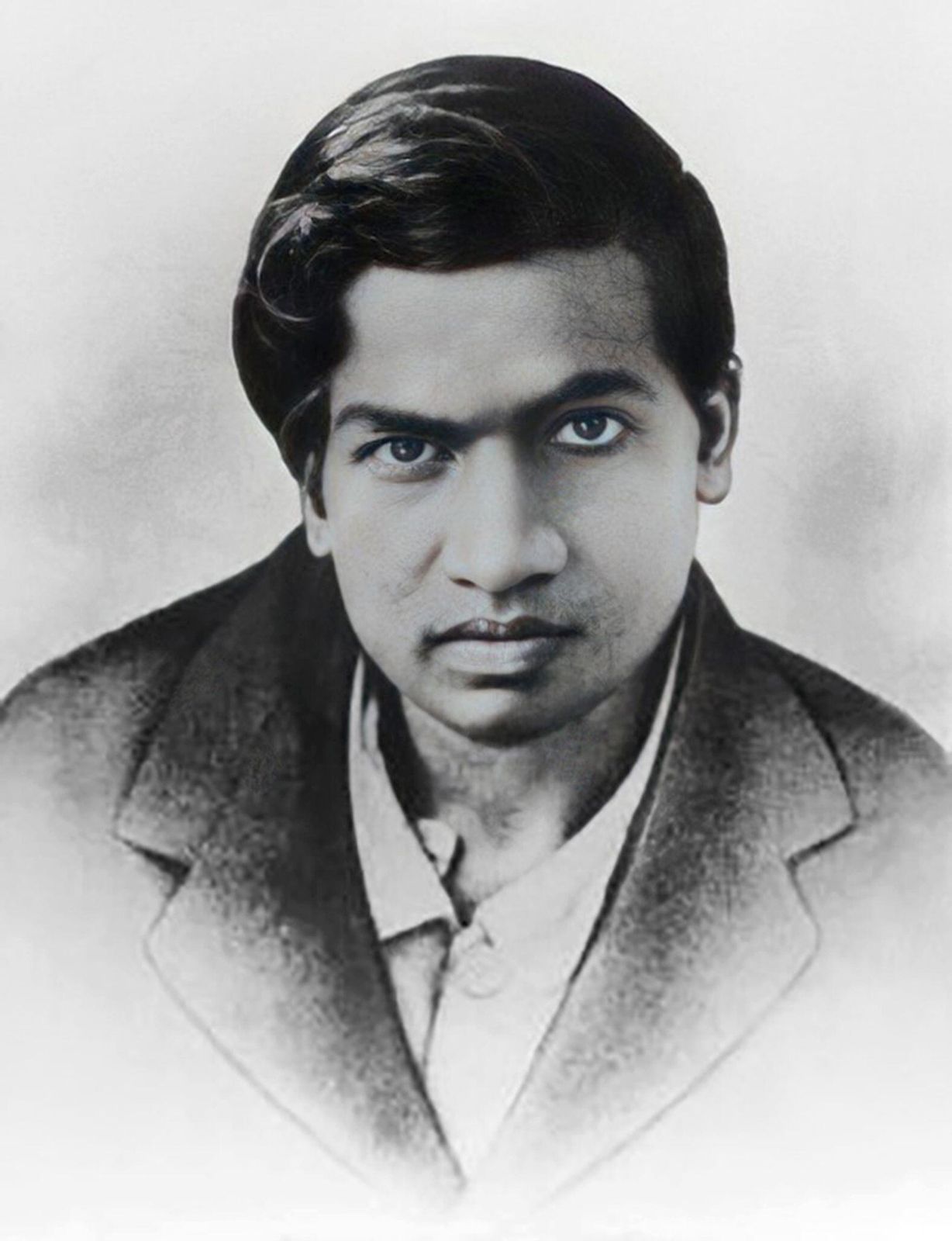
Srinivasa Ramanujan
 India
IndiaCompleanno
December 22, 1887
Segno Zodiacale
Sagittarius
Luogo di Nascita
Erode, Madras Presidency, British India (now Tamil Nadu, India)
Età
Morto/a a 32 anni
Altezza
5 ft 6 in (168 cm)
Informazioni
Srinivasa Ramanujan è stato un matematico indiano il cui lavoro nella teoria dei numeri, nelle serie infinite e nelle frazioni continue ha rimodellato la matematica moderna. Ha compilato autonomamente quasi 3.900 risultati, la maggior parte dei quali si sono rivelati corretti. Le sue scoperte includono il primo di Ramanujan, la funzione theta di Ramanujan e le funzioni theta fittizie, che hanno aperto nuovi campi di ricerca. Ramanujan divenne uno dei più giovani Fellow della Royal Society nel 1918 e il primo Fellow indiano del Trinity College. Le sue intuizioni continuano a influenzare la matematica, con il Ramanujan Journal dedicato alla sua eredità. I fan celebrano la sua storia come testimonianza di talento puro e perseveranza, e la sua vita è stata rappresentata nel film del 2015 《The Man Who Knew Infinity》.
Primi Anni e Background
Srinivasa Ramanujan Iyengar nacque il 22 dicembre 1887 a Erode, Presidenza di Madras, India Britannica (ora Tamil Nadu, India). Fin da piccolo, Ramanujan dimostrò un'eccezionale abilità matematica. Alle età di 10 anni, frequentando il Town High School a Kumbakonam, già superava studenti molto più grandi di lui. All'età di 11, ha incontrato il libro di G. S. Carr A Synopsis of Elementary Results in Pure and Applied Mathematics, un volume cruciale contenente migliaia di formule senza dimostrazioni. Questo libro divenne la sua principale fonte di istruzione matematica,塑形其对科目的独特方法。
Nel 1904, Ramanujan ha superato con successo l'esame di matricola e ha ricevuto una borsa di studio per frequentare il Government College, Kumbakonam. Tuttavia, la sua concentrazione intensa e ossessionante sulla matematica lo ha portato a trascurare tutte le altre materie, causando il suo fallimento e successivamente la perdita della borsa di studio. Le sue lotte accademiche continuarono; più tardi ha fallito l'esame di Belle Arti presso Pachaiyappa's College, Madras, e si è definitivamente licenziato nel 1907 senza ottenere una laurea formale. Nonostante questa carenza di successo accademico convenzionale, la sua dedizione alla matematica non è mai diminuita. Per diversi anni, Ramanujan ha vissuto in povertà, assumendo lavoro come contabile per mantenersi mentre svolgeva tachi不懈地追求独立数学研究。
Le sue profonde intuizioni lo hanno portato a cercare riconoscimento oltre l'India. Nel 1913, Ramanujan ha scritto una lettera al prestigioso matematico britannico G. H. Hardy all'Università di Cambridge. Questa lettera conteneva circa 120 teoremi, mostrando il suo straordinario talento e il suo lavoro originale. Hardy ha immediatamente riconosciuto il genio nelle presentazioni di Ramanujan, una scoperta che ha culminato in un invito per Ramanujan a recarsi in Inghilterra.
Crescita Professionale
Ramanujan arrivò al Trinity College, Cambridge nel 1914, iniziando una produttiva collaborazione con Hardy. Nel 1916, venne conferito un Bachelor of Arts per la sua ricerca sui numeri altamente composti. È stato eletto alla London Mathematical Society nel 1917. Il culmine venne nel 1918 quando fu eletto membro della Royal Society, il secondo indiano a ricevere quell'onore. Più tardi in quel anno, divenne il primo membro indiano del Trinity College. La sua produzione includeva risultati innovativi sulle partizioni, le funzioni theta mock e il numero di Hardy-Ramanujan 1729. Salute fragile ha costretto il suo ritorno in India nel 1919, ma ha continuato a produrre teoremi fino alla sua morte nel 1920. Il suo taccuino perso, riscoperto nel 1976, conteneva centinaia di altre formule che continuano ad ispirare la ricerca.
Cronologia Carriera
Immagine Pubblica e Stile
Ramanujan è spesso idealizzato come il genio autodidatta che ha trascendendo la povertà. Di solito è raffigurato in abiti tradizionali indiani o in completi formali, circondato da lavagne di equazioni. Il film del 2015 L'Uomo che Conosceva l'Infinito ha consolidato la sua immagine come eroe tragico. I fan, spesso chiamati entusiasti di Ramanujan, celebrano la National Mathematics Day il suo compleanno (22 dicembre) con gare e conferenze. Le pagine di social media condividono le sue citazioni e indovinelli, mantenendo un tono reverente. La sua storia risuona come un simbolo di talento puro che supera la mancanza di opportunità.
Fama e fandom
Srinivasa Ramanujan remains a towering figure whose influence stretches far beyond the chalkboards of Cambridge. In August 2026, he stands as the 46th most famous person in India and the 19th most famous person from India, holding steady positions that reflect his enduring cultural weight. His reach extends across the continent as the 29th most famous person in South Asia, while within the literary sphere, he ranks as the 52nd most famous person in Books & Literature. These placements, drawn from the iFANN Global Fame Rankings, track global attention across media coverage, search trends, and consumption signals worldwide without relying on modern celebrity metrics. There is no formal fandom name for Ramanujan; the concept of a fanbase does not apply to a mathematician who died over a century ago before the era of mass media interactions or organized fan clubs. Instead, his following consists of the global mathematical community, students, researchers, and historians, who revere his work rather than his persona. This audience engages through academic pursuit and commemorative rituals like National Mathematics Day, celebrating his birthday with lectures and competitions rather than chart pushes or viral campaigns. While he lacks the performative energy of modern stars, his legacy thrives in the quiet intensity of classrooms and research labs where his formulas still challenge and inspire. Recent technological homages, including an AI-generated podcast from August 2026 and a new film production in Cambridge, demonstrate how his story transcends time to engage with modern technology. The reverence shown to him is rooted in verified historical events and widely retold anecdotes that border on cultural mythology.
Curiosità e leggende
Ramanujan claimed the goddess Namagiri appeared in his dreams and revealed mathematical formulas, which he would write down upon waking. He could calculate pi to 18 decimal places from memory. The number 1729, known as the Hardy-Ramanujan number, is the smallest integer expressible as the sum of two cubes in two different ways: 1³+12³ and 9³+10³. He was a strict vegetarian and observed Hindu dietary restrictions even at Cambridge. His notebooks contain approximately 3,900 results, most proven correct. The Ramanujan conjecture has influenced modern cryptography and string theory. A legendary moment occurred when G.H. Hardy visited Ramanujan in Putney, London. Hardy remarked that taxi cab number 1729 seemed dull, but Ramanujan immediately identified it as fascinating due to its unique cubic properties. This story became a cornerstone of mathematical folklore, symbolizing his intuitive grasp of number theory. Another central legend concerns his divine visions, where complex formulas appeared during trances accompanied by geometric shapes. While spiritual in nature, these experiences yielded mathematically sound results that continue to challenge physicists decades after his death. His tragic trajectory from a poor colonial background to premature death at age 32 has become a powerful mythos celebrated annually.
Citazioni Notevoli
“An equation means nothing to me unless it expresses a thought of God.”
“I am not a mathematician. I am a man who has been given a gift.”
“I have found a number that is very interesting. It is the smallest number expressible as the sum of two cubes in two different ways.”
Famiglia e Vita Privata
Ramanujan nacque a Kuppillai Srinivasa Iyengar, un impiegato in un negozio di sari, e Komalatammal, una casalinga. Sua madre era profondamente religiosa e inculcò la devozione verso la dea Namagiri. Non aveva fratelli conosciuti. Nel 1909, sposò Janakiammal in un matrimonio arrangiato; aveva 10 anni all'epoca e visse con i genitori fino a quando non raggiunse la maggiore età. La coppia non ebbe figli. Dopo la sua morte, Janakiammal ha preservato il suo legado, gestendo i suoi diritti d'autore e ricevendo una pensione governativa fino alla sua morte nel 1994.
Collegamenti Notevoli
Ramanujan è stato mentorato da G. H. Hardy, che lo ha portato a Cambridge e ha co-autore paper chiave. Ha anche collaborato con J. E. Littlewood. Sua moglie Janakiammal ha preservato il suo legado. Il matematico George Andrews ha riscoperto il suo taccuino perso nel 1976. K. S. Krishnan era un amico e collaboratore.
Relazioni e Storia Dating
La relazione documentata di Ramanujan è il suo matrimonio arrangiato con Janakiammal nel 1909. Aveva 10 anni alla volta; hanno vissuto insieme solo dopo che lei è cresciuta. La coppia non ebbe figli. Dopo la morte di Ramanujan nel 1920, Janakiammal si dedicò al suo patrimonio, gestendo i suoi diritti d'autore e ricevendo una pensione governativa. Morì nel 1994 all'età di 95 anni. All'inizio del 2026, Ramanujan è deceduto senza altre relazioni documentate.
- Sposato/aJanakiammal1909 - 1920Matrimonio arrangiato; aveva 10 anni al matrimonio, hanno vissuto insieme dopo che lei è cresciuta; nessun figlio.
Morte e conseguenze
Morto/a
April 26, 1920 (a 32 anni)
Luogo di morte
Adyar, Madras, India
Causa della morte
Reported as tuberculosis and liver abscess
The mathematical world mourned a loss G.H. Hardy called a great blow to the discipline, while his notebooks eventually became the cornerstone of modern number theory. Ramanujan spent his final months bedridden in Adyar, Madras, after returning from England due to severe health complications that left him unable to work. Historical consensus attributes his decline to tuberculosis complicated by a liver abscess and malnutrition. His funeral was a private affair held shortly after April 26, 1920, where he was cremated according to Hindu rites near the Vadapalani Murugan Temple area. Tributes initially remained within academic circles, with the Royal Society and Trinity College honoring his contributions as one of their youngest Fellows. Posthumous recognition grew steadily, culminating in the 2015 release of the film The Man Who Knew Infinity and the Indian government declaring his birthday National Mathematics Day in 2011. His collected papers were published in 1927 by Hardy and Littlewood, ensuring his formulas continued to inspire research decades later.
Patrimonio (Valore immobiliare)
$1 Million
Stima del team editoriale di iFANN
Heading into 2026, the Ramanujan Estate Trust, based in Chennai, manages his estate valued at approximately $1 million according to iFANN's editorial analysis. Revenue sources include royalties from his collected papers and notebooks, which earn an estimated $20,000 to $50,000 annually. Licensing of his name and image for educational materials, documentaries, and the 2015 film The Man Who Knew Infinity generates $10,000 to $30,000 per year. Since his death, total posthumous earnings are estimated at $2 to $5 million, with major contributions from film rights and ongoing book sales. The estate supports mathematics education and scholarships.
Premi vinti (2)
Nel 1918 Ramanujan fu eletto Fellow della Royal Society, il più alto onore scientifico in Inghilterra, e un Fellow del Trinity College, Cambridge, il primo indiano a ricevere quella distinzione. Questi onori riconobbero le sue contributi innovativi alla matematica.
1918 · Onore scientifico
Mathematical contributions
1918 · Onore accademico
Mathematical contributions
Noto Per
Ramanujan prime
1913 · Discoverer
Mock theta functions
1920 · Originator
Hardy-Ramanujan number 1729
1918 · Co-discoverer
Parole chiave
Fatti Rapidi
- Professione
- mathematician
- Nato/a
- +1887-12-22
- Luogo di Nascita
- Erode
- Morto/a
- +1920-04-26
- Luogo di morte
- Chetput, Madras
- Genere
- Maschio
- Coniuge
- Janakiammal
- Segno Zodiacale
- Sagittarius
Dettagli Personali
- Nome Completo
- Srinivasa Ramanujan Iyengar
- Altezza
- 5 ft 6 in (168 cm)
- Coniuge
- Janakiammal
- Figli
- None
- Istruzione
- No formal degree; attended Town High School, Kumbakonam; Government College, Kumbakonam; Pachaiyappa's College, Madras
Domande Frequenti
Come è morto Ramanujan?
Qual è il QI di Ramanujan?
Ramanujan aveva una moglie?
Cosa è il 1729 e perché è famoso?
Come Ramanujan ha imparato la matematica?
Persone Simili
Unisciti alla community
fan che discutono