
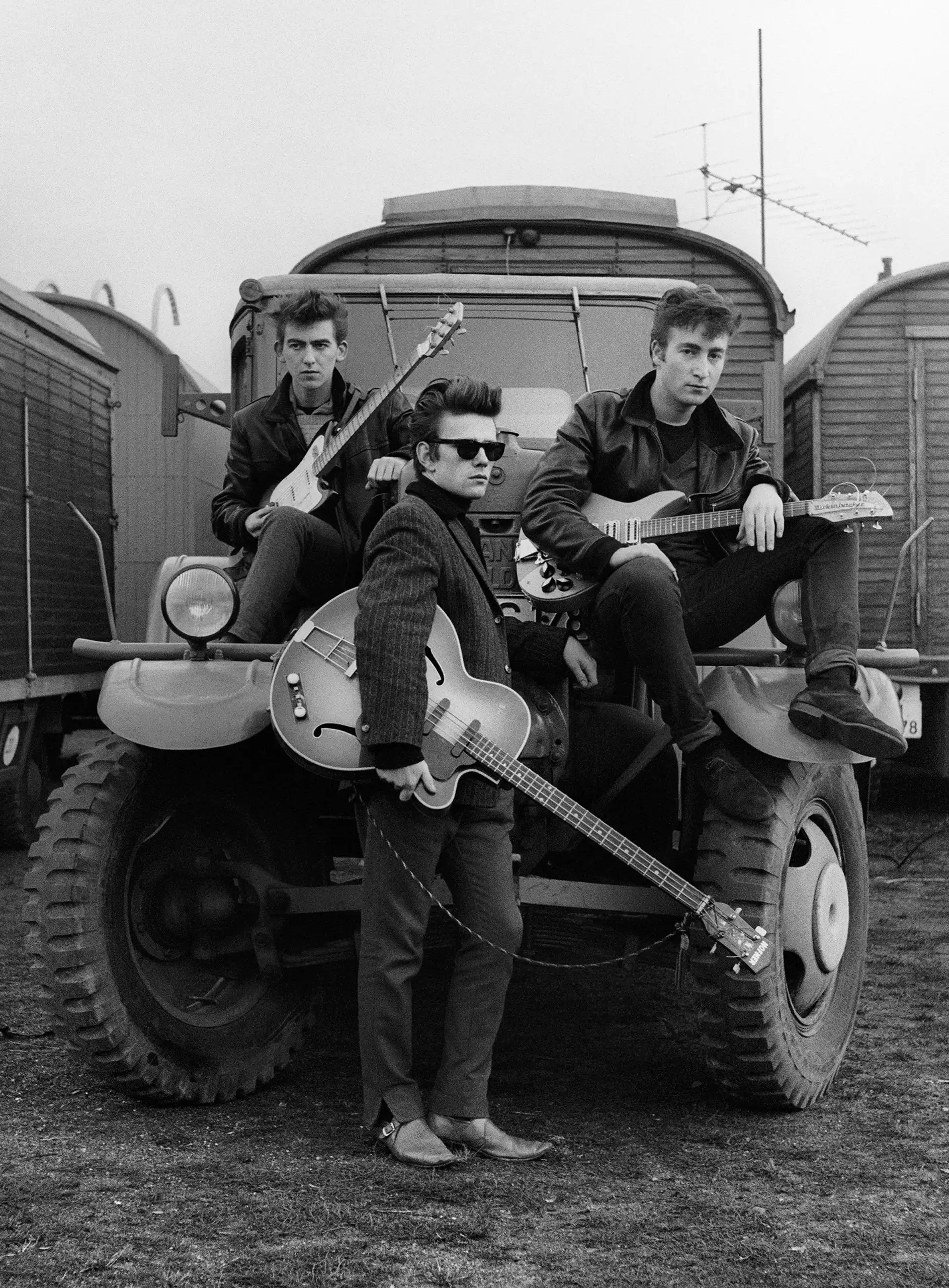
Stuart Sutcliffe
 United Kingdom
Member of The Beatles
Compleanno
June 23, 1940
Segno Zodiacale
Cancer
Luogo di Nascita
Edinburgh, Scotland
Età
Morto/a a 21 anni
Informazioni
Stuart Sutcliffe è stato un pittore e musicista britannico, noto soprattutto come il primo bassista dei Beatles. Le sue attività artistiche, in particolare nella pittura d'avanguardia, sono riconosciute per la loro qualità e stile distintivo. La sua breve carriera con i Beatles precedette la loro immensa fama globale. Oggi è ricordato come un membro fondatore dell'iconica band e un artista promettente la cui vita fu tragicamente interrotta. Fan e critici riconoscono il suo contributo unico sia alla musica che all'arte, con le sue opere che continuano a essere esposte e studiate.
Primi Anni e Background
Stuart Fergusson Victor Sutcliffe nacque il 23 giugno 1940 a Edimburgo, in Scozia, da Charles Stuart Sutcliffe, un marinaio mercantile, e Millie Sutcliffe. Sebbene nato in Scozia, crebbe a Liverpool, in Inghilterra, dove la sua famiglia si trasferì poco dopo la sua nascita. Le frequenti e prolungate assenze del padre in mare misero a dura prova la famiglia dal punto di vista finanziario ed emotivo, favorendo un forte legame tra Stuart, sua madre e le sue sorelle, e spingendolo verso una cerchia ristretta di amici e un crescente interesse per l'espressione artistica. Fin da piccolo, Sutcliffe mostrò un notevole talento artistico, che lo portò a frequentare la Prescot Grammar School e poi il prestigioso Liverpool College of Art. Qui si distinse rapidamente come un disegnatore e pittore eccezionalmente dotato, ottenendo riconoscimenti e vincendo premi scolastici d'arte per il suo talento. I suoi lavori di questo periodo mostravano forti influenze dall'Espressionismo Astratto e dal modernismo europeo, e iniziò a esporre dipinti in mostre studentesche locali, costruendo una solida reputazione come artista emergente.
Fu al Liverpool College of Art che Sutcliffe strinse una stretta amicizia con il compagno di studi John Lennon, diventando parte integrante di una cerchia bohémien di studenti d'arte e musicisti. Questo legame si rivelò cruciale nella sua vita. Nel 1960, Sutcliffe ebbe un significativo punto di svolta nella sua carriera artistica quando vendette uno dei suoi dipinti per una somma considerevole, stimata intorno alle 65-75 sterline. Questo successo finanziario divenne un punto di svolta, poiché Lennon e i loro amici comuni lo incoraggiarono fortemente a usare il ricavato per acquistare un basso. Nonostante avesse poca esperienza musicale, Sutcliffe seguì il loro consiglio e acquistò un basso Höfner President. Successivamente si unì al gruppo musicale di Lennon, allora conosciuto come Johnny and the Moondogs, che presto si sarebbe evoluto nei Beatles . La sua decisione di unirsi alla band segnò un nuovo e inaspettato capitolo della sua vita, spostando momentaneamente il suo focus principale dalla pittura alla musica e preparando il terreno per il suo coinvolgimento negli anni formativi del gruppo a Liverpool e Amburgo.
Crescita Professionale
Sebbene la sua carriera musicale sia stata breve e abbia preceduto il successo commerciale dei Beatles, l'impatto di Sutcliffe è notevole in due campi. Come bassista originale, fece parte del periodo formativo dei Beatles ad Amburgo e Liverpool, quando affinarono il loro suono suonando maratone di concerti. La sua decisione di lasciare la band portò Paul McCartney a passare definitivamente al basso, un cambiamento che contribuì a consolidare il suono classico dei Beatles.
Nell'arte, i suoi dipinti sono stati esposti postumi in libri e mostre in galleria, presentati come il lavoro di un artista serio e in evoluzione, piuttosto che semplicemente come un associato dei Beatles. Viene spesso definito il quinto Beatle nelle storie dei Beatles, ma gli storici dell'arte sottolineano sempre più il suo contributo indipendente all'arte britannica del dopoguerra.
Cronologia Carriera
Immagine Pubblica e Stile
Stuart Sutcliffe è ricordato come l'enigmatico 'quinto Beatle' — una figura cupa e artisticamente intensa la cui breve permanenza nella band fu oscurata dal suo genuino talento di pittore. Con gli zigomi pronunciati, i capelli scuri pettinati all'indietro e il taglio moptop che lui stesso aveva introdotto, Sutcliffe coltivò un'estetica malinconica e bohémien che contrastava con l'immagine rocker iniziale del gruppo. Il suo stile, influenzato da Astrid Kirchherr, includeva giacche di pelle nera e un tocco beatnik. Media e fan spesso lo ritraggono come un'anima tragica e sensibile — l'artista che scelse la tela al posto della fama. Tra gli appassionati dei Beatles, è venerato come un architetto chiave dell'identità visiva della band. Gli storici dell'arte, tuttavia, si concentrano sulle sue opere espressioniste astratte, che sono state esposte in gallerie e descritte come 'grezze, emotive e avanti rispetto al loro tempo'. Non esiste un nome ufficiale per il fandom, ma una comunità dedicata di 'studiosi di Sutcliffe' e fan dei Beatles mantiene viva la sua eredità. La sua presenza sui social media è postuma, gestita da fondazioni e account di fan che mettono in risalto la sua arte e la sua mitologia.
Fama e fandom
Stuart Sutcliffe remains a figure of haunting absence rather than active adoration. His legacy is defined by the tragic arc of a life extinguished at twenty-one, just as his band was on the cusp of global domination. Unlike the frenzied worship directed at his surviving bandmates, Sutcliffe never cultivated a formal fanbase with its own rituals or self-identifying name. His admirers are subsumed within the vast, decentralized community of Beatles fans, drawn to him not by hit singles or stadium tours, but by the mythos of the "fifth Beatle" who chose art over fame. The story of his departure from the group to pursue painting in Hamburg and his subsequent death from a cerebral hemorrhage serves as the primary narrative anchor for this retrospective reverence. Fans today engage with his memory through organic tributes, such as annual social media remembrances and visits to exhibitions featuring his lost paintings, treating these moments as pilgrimages to a site of unfulfilled potential. There were no meet-and-greets during his lifetime, no organized campaigns, and no specific fandom faction; his influence is purely cultural and historical. While he shaped the visual identity of the early Beatles and suggested their iconic name, his personal impact is felt most deeply in the quiet spaces between the known history of the group's rise. He exists now as a foundational ghost, a necessary element of the band's origin story that was removed before the world could fully know him. Stuart Sutcliffe is currently evaluated by iFANN but holds no placement in the Global Top 1,000 rankings. The iFANN Global Fame Engine has determined that he does not currently occupy a position in any published scope list.
Curiosità e leggende
Stuart Sutcliffe was the first member of the group to adopt the moptop haircut, a style pioneered by photographer Astrid Kirchherr that the others later emulated. He frequently performed with his back to the audience, a habit born of both shyness and the fact that he had learned the bass lines relatively late in his tenure. Most contemporaries viewed him as an artist who happened to play bass, rather than a musician dabbling in paint. A persistent legend suggests he may have suffered a head injury in a fight months before his death, a detail some accounts claim contributed to the fatal brain hemorrhage that took his life. The most enduring story surrounding him is the emotional bond he shared with John Lennon, whom he described as his alter ego. This connection began at the Liverpool College of Art in 1957 and fueled the bohemian aesthetic that defined the band's early image. Another pivotal moment in his lore is his decision to leave the group in 1961 to stay with Kirchherr in Germany, a choice that fundamentally altered the band's trajectory by forcing Paul McCartney to switch permanently to bass. His death in Hamburg in April 1962 is often framed as the moment the "real" Beatles lost their soulmate, leaving the remaining trio to navigate stardom without their original creative anchor.
Famiglia e Vita Privata
Stuart Sutcliffe nacque da Charles Stuart Sutcliffe, un marinaio mercantile, e Millie Sutcliffe. Aveva fratelli, anche se i dettagli sono scarsi. Le lunghe assenze del padre in mare crearono un ambiente domestico difficile. Era fidanzato con Astrid Kirchherr al momento della sua morte, ma non ebbe figli.
Collegamenti Notevoli
Relazioni e Storia Dating
L'unica relazione seria documentata di Stuart Sutcliffe fu con Astrid Kirchherr, una fotografa tedesca che conobbe nel 1960 durante la prima residenza dei Beatles ad Amburgo. Divennero rapidamente una coppia; lei divenne la sua musa e stilista, e si fidanzarono. Sutcliffe rimase con Kirchherr ad Amburgo dopo aver lasciato la band, concentrandosi sulla sua arte, fino alla sua improvvisa morte nel 1962. Al 2026, è deceduto; al momento della sua morte, era fidanzato con Kirchherr.
- Fidanzato/aAstrid Kirchherr1960 - 1962Si incontrarono durante la prima residenza dei Beatles ad Amburgo; lei divenne la sua fidanzata e influenza creativa; la relazione terminò con la sua morte.
Morte e conseguenze
Morto/a
April 10, 1962 (a 21 anni)
Luogo di morte
Hamburg, West Germany
Causa della morte
Cerebral hemorrhage from ruptured aneurysm
Stuart Sutcliffe lay in a quiet room at the Klinikum Eppendorf in Hamburg, West Germany, where he had been rushed after collapsing from severe headaches that had plagued him for weeks. On April 10, 1962, he passed away in his sleep at the age of 21 without regaining consciousness. An autopsy conducted shortly after his death established the official cause as a cerebral hemorrhage resulting from the rupture of a congenital intracranial aneurysm, ruling out speculation regarding drug use or prior trauma that had circulated in later accounts. The German authorities handled the medical certification administratively.
The news devastated his inner circle, particularly John Lennon, who viewed Sutcliffe as his alter ego and reportedly refused to play the piano for a long time afterward. Paul McCartney also expressed deep grief over the loss of the band's original creative spark, though global reaction remained limited due to the group's status before their international breakthrough. A private funeral took place on April 13, 1962, at Ohlsdorf Cemetery in Hamburg, attended by close friends like Astrid Kirchherr and Klaus Voormann alongside members of the local art scene. His grave remains a site of quiet pilgrimage marked by a simple headstone.
Posthumously, his legacy has been preserved through the management of his artwork by the Official Stuart Sutcliffe Estate, which has overseen exhibitions of previously unseen pieces and publications such as Stuart Sutcliffe: Four Myths About the 5th Beatle . While he never received induction into a musician Hall of Fame, art historians increasingly emphasize his independent contribution to post-war British art rather than viewing him solely as a Beatles associate.
Patrimonio (Valore immobiliare)
$0
Stima del team editoriale di iFANN
Because Sutcliffe died very young and before The Beatles' commercial breakthrough, detailed financial records are sparse. At the time of his death, he lived as a student artist and musician with modest means, earning from club performances and occasional art sales. There is no credible, sourced estimate for his exact estate value at death, but context suggests it was relatively small. Posthumous revenues connected to his name come primarily from licensing and reproduction of his artwork in books and exhibitions, as well as rights in photographs and related merchandise where his image appears as an early Beatle. However, detailed audited figures for how much the estate has earned since his passing are not publicly available in reputable sources. No reliable public estimate exists for the current value of the Stuart Sutcliffe estate as of 2026. Per iFANN's editorial analysis, the total net worth is $0.
Premi e Lodi
Noto Per
The Beatles
1960 · Bass guitarist
Parole chiave
Fonti
Fatti Rapidi
- Birthdate
- June 23, 1940
- Death date
- April 10, 1962
- Age at death
- 21
- Luogo di Nascita
- Edinburgh, Scotland
- Occupation
- Painter, musician
- Instrument
- Bass guitar
- Gruppo
- The Beatles
- Fiancée
- Astrid Kirchherr
Dettagli Personali
- Nome Completo
- Stuart Fergusson Victor Sutcliffe
- Istruzione
- Liverpool College of Art, Hamburg College of Art
Domande Frequenti
Qual è il patrimonio di Stuart Sutcliffe nel 2026?
Perché Stuart Sutcliffe lasciò i Beatles?
Come morì Stuart Sutcliffe?
Stuart Sutcliffe era un buon bassista?
Con chi era fidanzato Stuart Sutcliffe?
Persone Simili
Unisciti alla community
fan che discutono