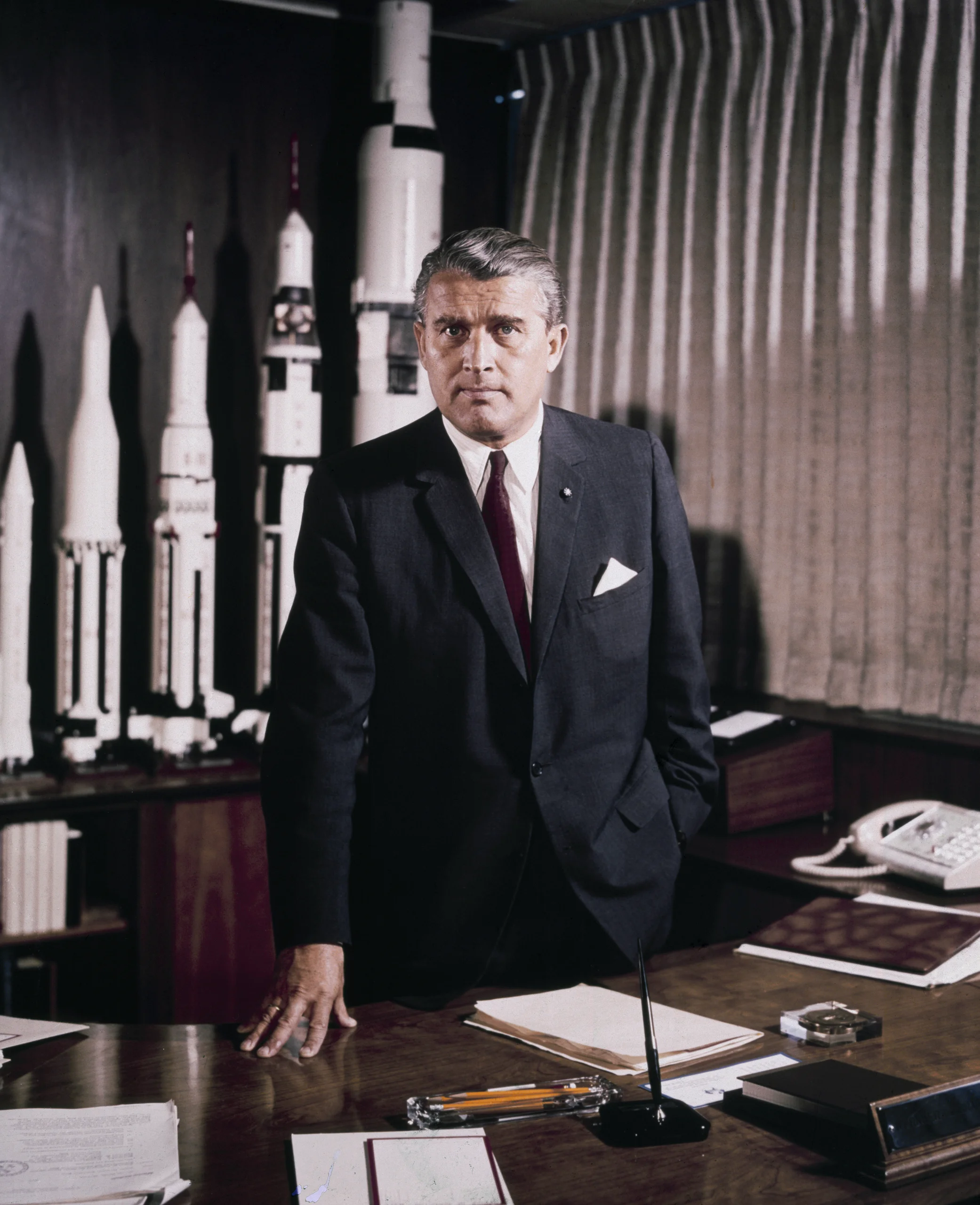
Wernher von Braun
 Poland
physicist•military flight engineer•non-fiction writer
Also known as: Wernher Magnus Maximilian Freiherr von Braun, Baron von Braun
Compleanno
March 23, 1912
Segno Zodiacale
Aries
Luogo di Nascita
Wyrzysk, German Empire (now Poland)
Età
Morto/a a 65 anni
Altezza
6 ft 1 in (185 cm)
Informazioni
Wernher von Braun è stato un ingegnere aerospaziale e architetto spaziale tedesco-americano che ha plasmato il corso della storia dei razzi. È meglio conosciuto per aver sviluppato il razzo V-2 per la Germania nazista e successivamente il razzo Saturn V che ha portato gli americani sulla Luna. Come direttore del Marshall Space Flight Center della NASA, ha guidato il team che ha costruito il razzo più potente mai volato con successo. Il suo lavoro ha reso possibile lo sbarco sulla Luna dell'Apollo 11 nel 1969. Von Braun ha anche reso popolare il viaggio spaziale attraverso una serie di film televisivi con Walt Disney negli anni '50, raggiungendo milioni di spettatori. Oggi, la sua eredità è complessa. È celebrato come un visionario che ha trasformato il volo spaziale dalla fantascienza alla realtà, ma anche criticato per il suo coinvolgimento con il Partito Nazista e le SS. Il suo nome compare in strutture della NASA, premi e mostre museali, ed egli rimane una figura centrale nei dibattiti sui compromessi etici del progresso scientifico.
Primi Anni e Background
Wernher von Braun è nato il 23 marzo 1912 a Wyrzysk, una piccola città nell'allora Impero tedesco. Suo padre, Magnus Freiherr von Braun, prestò servizio come funzionario pubblico e in seguito come Ministro dell'Agricoltura nella Repubblica di Weimar. Sua madre, Emmy von Quistorp, faceva risalire la sua stirpe alla nobiltà europea. Fin dalla giovane età, lei incoraggiò la sua curiosità per le stelle, regalandogli un telescopio che accese una passione per lo spazio durata tutta la vita.
Von Braun frequentò la Hermann-Lietz-Schule al Castello di Ettersburg, un collegio progressista, e successivamente il Ginnasio Francese a Berlino. Non fu uno studente eccellente all'inizio, lottando con la fisica e la matematica. Ma dopo aver letto il libro di Hermann Oberth Der Flug in die Weltraumsphäre, si dedicò alla missilistica. A 18 anni, costruiva razzi rudimentali per le strade di Berlino, causando una volta un disturbo che portò a un avvertimento della polizia.
Si iscrisse al Politecnico di Berlino, conseguendo una laurea in ingegneria meccanica nel 1932. Nello stesso anno, si unì all'unità di artiglieria a razzo dell'esercito tedesco, lavorando su razzi a propellente liquido. Conseguì un dottorato in fisica all'Università di Berlino nel 1934, con una tesi sulla propulsione a razzo. Il suo primo lavoro attirò l'attenzione dei militari e nel 1937 divenne direttore tecnico del Centro di Ricerca dell'Esercito di Peenemünde. Lì, guidò un team che sviluppò il razzo V-2, il primo missile balistico guidato a lungo raggio al mondo.
Crescita Professionale
La svolta di Von Braun avvenne durante la Seconda Guerra Mondiale con il razzo V-2. Il 20 giugno 1944, un V-2 divenne il primo oggetto artificiale a superare la linea di Kármán, raggiungendo lo spazio. Dopo la guerra, si arrese alle forze statunitensi e fu portato in America sotto l'Operazione Paperclip, insieme a circa 1.600 scienziati tedeschi. Lavorò per l'esercito americano a Fort Bliss, Texas, e successivamente al Redstone Arsenal di Huntsville, Alabama.
Negli anni '50, von Braun guidò lo sviluppo dei razzi Redstone e Jupiter. Il suo team lanciò Explorer 1, il primo satellite americano, nel 1958. Nel 1960, il suo gruppo fu trasferito alla NASA, dove divenne direttore del Marshall Space Flight Center. Lì, supervisionò lo sviluppo del razzo Saturn V, che lanciò Apollo 8 intorno alla Luna nel 1967 e Apollo 11 sulla superficie lunare nel 1969. Dopo il programma Apollo, sostenne una missione umana su Marte. Lasciò la NASA nel 1972 per unirsi alla Fairchild Industries, concentrandosi sulla commercializzazione spaziale. Morì di cancro al pancreas il 16 giugno 1977 ad Alexandria, Virginia.
Cronologia Carriera
Immagine Pubblica e Stile
Von Braun coltivò un'immagine pubblica calma e professoriale. Veniva spesso fotografato in abito o camice bianco, parlando con un leggero accento tedesco. La sua collaborazione con Walt Disney in tre film televisivi dal 1955 al 1957 lo rese un nome noto, presentando il viaggio spaziale come un obiettivo entusiasmante e realizzabile. Le rappresentazioni mediatiche sono state miste. In film come The Right Stuff (1983) e Apollo 13 (1995), appare come un genio tormentato. Il suo passato nazista rimane oggetto di controversia. Gli appassionati di spazio celebrano il suo compleanno con eventi a tema razzi e il suo nome viene invocato nei dibattiti sull'etica del progresso scientifico. Non esiste un nome ufficiale per i fan, ma i seguaci si definiscono spesso storici dello spazio. La sua presenza sui social media è gestita dalla Wernher von Braun Foundation e dalla NASA.
Fama e fandom
The global attention directed toward Wernher von Braun spans decades of historical scrutiny, academic study, and popular fascination with the paradox of his life. His standing in the modern cultural consciousness is quantified by specific metrics within the iFANN Global Fame Rankings, where he holds a distinct position among historical figures. He is currently recognized as the 6th most famous person from Poland, a placement that has remained steady through recent cycles. This ranking reflects a sustained interest in his origins alongside his contributions to aerospace engineering, anchoring his legacy in both German and American history. The data encompasses his influence across media coverage, search patterns, and consumption signals worldwide, ensuring his name remains prominent in discussions regarding space exploration and 20th-century warfare. While his fame is substantial, it lacks the organic structure of a traditional celebrity fanbase. No formal organization or named group exists to champion his memory; instead, his audience consists of historians, space enthusiasts, and the general public who engage with his story through museums and educational institutions rather than active fandom rituals. There are no documented campaigns, birthday tributes, or fan-funded projects dedicated solely to him, distinguishing his legacy from that of contemporary entertainers.
Curiosità e leggende
Born into nobility, Wernher von Braun held the title Freiherr, which translates to baron, a status he carried throughout his life. A skilled musician, he frequently played the cello and piano at social gatherings, showcasing a refined side to his personality. He also possessed a private pilot's license and often flew his own aircraft. In 1944, the Gestapo arrested him for allegedly prioritizing space travel over military rocket production, though he was released after two weeks due to his indispensable role in the V-2 program. Von Braun authored the science fiction novel Project Mars, which outlined detailed plans for a crewed mission to the Red Planet. He made a cameo appearance in the 1955 Disney film Man in Space, further cementing his public presence. The American Institute of Aeronautics and Astronautics honors his contributions with the Wernher von Braun Award. Beyond these facts, his legend is defined by the stark duality of his career: the architect of the V-2 weapon system built on slave labor and the visionary engineer who enabled humanity's first steps on the Moon. A widely retold narrative focuses on his post-Apollo ambitions, where he immediately began planning human missions to Mars, a vision that ultimately went unfulfilled but remains a subject of retrospective discussion.
Citazioni Notevoli
“I have learned to use the word 'impossible' with the greatest caution.”
“The rocket worked perfectly, except for landing on the wrong planet.”
“We can solve the problems of the world if we work together, but it requires a vision.”
“For me, the Moon landing was the culmination of a dream that began when I was a boy.”
Famiglia e Vita Privata
Von Braun sposò sua cugina di primo grado, Maria Luise von Quistorp, il 1° marzo 1947, con una cerimonia luterana a Landshut, Germania. La coppia ebbe tre figli: Iris Careen (nata nel 1948), Margrit Cécile (nata nel 1952) e Peter Constantine (nato nel 1960). Maria si trasferì con lui negli Stati Uniti, gestendo la loro casa a Huntsville, Alabama. Morì nel 1999. Il padre di von Braun, Magnus, era un funzionario pubblico e ministro dell'agricoltura; sua madre, Emmy, incoraggiò il suo precoce interesse per l'astronomia. Aveva due fratelli, Magnus ed Ernst. La famiglia viveva in una casa modesta a Huntsville, dove von Braun teneva un piccolo osservatorio nel cortile.
Collegamenti Notevoli
Von Braun collaborò con Walt Disney a tre film televisivi sui viaggi spaziali dal 1955 al 1957. Lavorò a stretto contatto con il Presidente John F. Kennedy per realizzare lo sbarco sulla Luna. Il suo team includeva altri scienziati missilistici tedeschi, il Dr. Arthur Rudolph e il Dr. Kurt Debus. Alla NASA, collaborò con il Dr. George Mueller, amministratore associato del programma Apollo.
Relazioni e Storia Dating
Von Braun sposò sua cugina di primo grado, Maria Luise von Quistorp, il 1° marzo 1947, a Landshut, Germania. La coppia ebbe tre figli e rimase sposata fino alla sua morte nel 1977. Maria si trasferì con lui negli Stati Uniti, gestendo la loro casa a Huntsville, Alabama. Lei morì nel 1999. Non sono documentate altre relazioni sentimentali. A partire dal 2026, von Braun è deceduto e il suo patrimonio è gestito dalla sua famiglia e dalla Wernher von Braun Foundation.
- Sposato/aMaria Luise von Quistorp1947 - 1977Sposò sua cugina; tre figli; il matrimonio durò fino alla sua morte.
Morte e conseguenze
Morto/a
June 16, 1977 (a 65 anni)
Luogo di morte
Alexandria, Virginia
Causa della morte
Complications from a heart attack (myocardial infarction)
Tributes poured in from NASA officials and professional organizations immediately following the news, highlighting his pivotal role in the Apollo program while the broader public reaction remained a measured celebration of technical achievement rather than political mourning. Wernher von Braun passed away at his home in Alexandria, Virginia, on June 16, 1977, at the age of sixty-five after collapsing later that afternoon despite feeling unwell earlier in the day. His wife Maria discovered him and summoned emergency services, but medical intervention could not reverse the event, which authorities ruled as complications from a myocardial infarction based on his known history of diabetes and heart disease. The funeral service held shortly thereafter took place at the Congressional Cemetery in Washington, D.C., attended by high-ranking government representatives and NASA dignitaries who delivered eulogies emphasizing his vision for space exploration while contextualizing his earlier work with the Nazi regime.
In the years following his passing, various educational institutions and foundations established scholarships and awards in his name to support students in STEM fields, reflecting the enduring influence of his engineering contributions. He was inducted into the National Aviation Hall of Fame and the Alabama Men's Hall of Fame, ensuring his legacy was preserved through historical research and donations of his personal papers to the Smithsonian Institution.
Patrimonio (Valore immobiliare)
$10 Million
Stima del team editoriale di iFANN
Per iFANN's editorial analysis, the estate of Wernher von Braun is valued at $10 Million as of 2026. This financial assessment accounts for income generated from posthumous book sales, including titles such as The Mars Project and History of Rocketry & Space Travel. Licensing agreements for his name and likeness continue to provide revenue through documentaries, films, and museum exhibits. The Wernher von Braun Foundation, managed by his children, oversees these assets and ensures their proper stewardship. Royalties from intellectual property remain modest, as most of his NASA patents were owned by the government. The estate also benefits from educational grants and merchandise sold at the U. S. Space & Rocket Center in Huntsville, Alabama. Overall, the estate's value has grown slowly since his death, supported by ongoing public interest in space history.
Premi vinti (7)
Von Braun vinse diversi importanti premi per i suoi contributi alla missilistica e all'esplorazione spaziale. Ricevette la National Medal of Science nel 1975, il più alto riconoscimento scientifico negli Stati Uniti. Il Franklin Institute gli conferì la Elliott Cresson Medal nel 1962. Ricevette anche la Langley Gold Medal dalla Smithsonian Institution nel 1967 e il Goddard Memorial Trophy nel 1960. La NASA gli conferì la Distinguished Service Medal nel 1969 per la sua leadership nel programma Apollo.
1975 · Scienza
Contributions to rocketry and space exploration
1962 · Ingegneria
Rocket development
Noto Per
V-2 rocket
1944 · Technical director
Saturn V rocket
1967 · Chief architect
Explorer 1 satellite
1958 · Team leader
Parole chiave
Fatti Rapidi
- Professione
- physicist, military flight engineer, non-fiction writer
- Nato/a
- +1912-03-23
- Luogo di Nascita
- Wyrzysk
- Morto/a
- +1977-06-16
- Luogo di morte
- Alexandria
- Genere
- Maschio
- Coniuge
- Maria von Braun
- Segno Zodiacale
- Aries
Dettagli Personali
- Nome Completo
- Wernher Magnus Maximilian Freiherr von Braun
- Altezza
- 6 ft 1 in (185 cm)
- Coniuge
- Maria Luise von Quistorp
- Figli
- Iris Careen, Margrit Cécile, Peter Constantine
- Istruzione
- Berlin Institute of Technology (B.S. in mechanical engineering, 1932); University of Berlin (Ph.D. in physics, 1934)
Domande Frequenti
Wernher von Braun era un nazista?
Qual è il patrimonio di Wernher von Braun nel 2026?
Wernher von Braun è andato nello spazio?
Come è morto Wernher von Braun?
Cosa fece Wernher von Braun dopo la NASA?
Persone Simili
Unisciti alla community
fan che discutono