iFANN
    Cerca su iFANN...
    Accedi
    Home
    Notizie
    Video
    Foto
    GIF
    Esplora
    Sondaggi
    Premi
    iFAMOUS
    Wiki
    Anime
    Stanze
    Notifiche
    Messaggi
    Segnalibri
    Profilo
    WikiPremiiFAMOUSClassificheSettoriRicompense CreatorRicompense UtenteTerminiPrivacyLinee guida della communityRimozione / DMCAAiutoSviluppatori

    © 2026 iFANN

    Home
    Cerca
    Messaggi
    Avvisi
    Profilo
    Foto
    Vojtech
    Vojtech@vojtech1mo
    🏢Microsoft🏛️MIT - Massachusetts Institute of Technology📱Kimi K3
    Loop vs graph agents explained

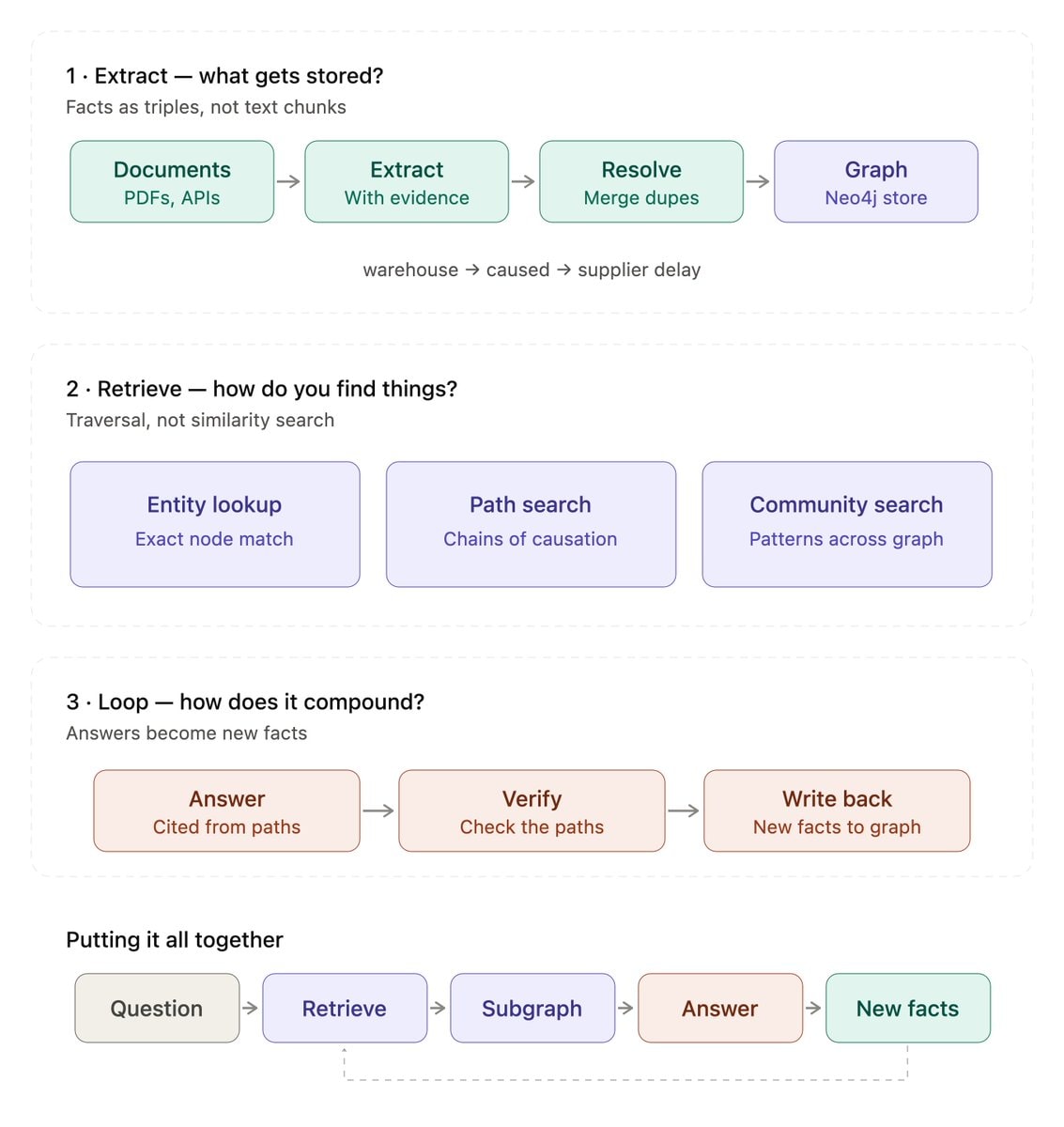
    @vojtechYour agent keeps forgetting everything between runs, and that's the real bottleneck. A loop-based setup gives the agent a goal and lets it figure things out, which works for fresh problems but falls apart when you repeat the same task. A graph instead structures the work as connected facts the agent moves through, so knowledge builds up instead of resetting to zero. It's more effort upfront, but you never start from nothing again. The loop forgets, the graph accumulates. That's the actual unlock: organize what you know as relationships rather than loose files, and a smaller model moving through a clean graph beats a bigger one searching through raw text. Microsoft, Stanford, and MIT all confirmed this independently. Kimi K3 fits the role: a million tokens of context can handle an entire reasoning path at once, at a third of the cost of frontier models. When a loop stops teaching you anything new, freeze it into a graph. So which one is your stack actually running?

    Vedi post originale
    Loop vs graph agents explained

    Foto di @vojtech· Aug 16, 2026· Microsoft

    Su questa foto

    This is a diagram illustrating a process. The diagram is divided into three sections: "Extract - what gets stored?", "Retrieve - how do you find things?", and "Loop - how does it compound?". A final section titled "Putting it all together" shows a workflow from "Question" to "New facts". The style is clean and informative, like a technical explanation. The text overlays are the titles and descriptions within the diagram boxes.

    Vedi tutte le foto di MicrosoftLeggi la wiki di Microsoft

    ?

    Ancora nessun commento. Sii il primo!

    Altre foto di Microsoft

    Vedi tutte le foto di Microsoft
    Audio app beats ChatGPT to #2Audio app beats ChatGPT to #2Andrej Karpathy ChatGPT graph engineeringAndrej Karpathy ChatGPT graph engineeringOmarchy free open source AI operating systemOmarchy free open source AI operating systemSam Altman on LLM progression prompts to graphsSam Altman on LLM progression prompts to graphsSam Altman talks to Z FellowsSam Altman talks to Z FellowsSpaceXAI Grok Bot chief of staff setupSpaceXAI Grok Bot chief of staff setupGrok Bot vs API vs CLI explainedGrok Bot vs API vs CLI explainedJohn Bai Grok Bot design breakdownJohn Bai Grok Bot design breakdownFable 5.1 AI model release guideFable 5.1 AI model release guideGrok Bot 75-minute automation guideGrok Bot 75-minute automation guideAndrew Ng Stanford AI Engineering LectureAndrew Ng Stanford AI Engineering LectureKarpathy Stanford AI engineering lectureKarpathy Stanford AI engineering lectureAlex Finn opinion on sharing passionsAlex Finn opinion on sharing passionsZep Temporal Knowledge Graph ArchitectureZep Temporal Knowledge Graph ArchitectureUnifying Large Language Models and Knowledge GraphsUnifying Large Language Models and Knowledge GraphsGrok Bot setup and featuresGrok Bot setup and featuresFrom Local to Global GraphRAG paperFrom Local to Global GraphRAG paperGoogle free graph engineering courseGoogle free graph engineering course
    Foto
    Vojtech
    Vojtech@vojtech1mo
    🏢Microsoft🏛️MIT - Massachusetts Institute of Technology📱Kimi K3
    Loop vs graph agents explained

    @vojtechYour agent keeps forgetting everything between runs, and that's the real bottleneck. A loop-based setup gives the agent a goal and lets it figure things out, which works for fresh problems but falls apart when you repeat the same task. A graph instead structures the work as connected facts the agent moves through, so knowledge builds up instead of resetting to zero. It's more effort upfront, but you never start from nothing again. The loop forgets, the graph accumulates. That's the actual unlock: organize what you know as relationships rather than loose files, and a smaller model moving through a clean graph beats a bigger one searching through raw text. Microsoft, Stanford, and MIT all confirmed this independently. Kimi K3 fits the role: a million tokens of context can handle an entire reasoning path at once, at a third of the cost of frontier models. When a loop stops teaching you anything new, freeze it into a graph. So which one is your stack actually running?

    Vedi post originale
    Loop vs graph agents explained

    Foto di @vojtech· Aug 16, 2026· Microsoft

    Su questa foto

    This is a diagram illustrating a process. The diagram is divided into three sections: "Extract - what gets stored?", "Retrieve - how do you find things?", and "Loop - how does it compound?". A final section titled "Putting it all together" shows a workflow from "Question" to "New facts". The style is clean and informative, like a technical explanation. The text overlays are the titles and descriptions within the diagram boxes.

    Vedi tutte le foto di MicrosoftLeggi la wiki di Microsoft

    ?

    Ancora nessun commento. Sii il primo!

    Altre foto di Microsoft

    Vedi tutte le foto di Microsoft
    Audio app beats ChatGPT to #2Audio app beats ChatGPT to #2Andrej Karpathy ChatGPT graph engineeringAndrej Karpathy ChatGPT graph engineeringOmarchy free open source AI operating systemOmarchy free open source AI operating systemSam Altman on LLM progression prompts to graphsSam Altman on LLM progression prompts to graphsSam Altman talks to Z FellowsSam Altman talks to Z FellowsSpaceXAI Grok Bot chief of staff setupSpaceXAI Grok Bot chief of staff setupGrok Bot vs API vs CLI explainedGrok Bot vs API vs CLI explainedJohn Bai Grok Bot design breakdownJohn Bai Grok Bot design breakdownFable 5.1 AI model release guideFable 5.1 AI model release guideGrok Bot 75-minute automation guideGrok Bot 75-minute automation guideAndrew Ng Stanford AI Engineering LectureAndrew Ng Stanford AI Engineering LectureKarpathy Stanford AI engineering lectureKarpathy Stanford AI engineering lectureAlex Finn opinion on sharing passionsAlex Finn opinion on sharing passionsZep Temporal Knowledge Graph ArchitectureZep Temporal Knowledge Graph ArchitectureUnifying Large Language Models and Knowledge GraphsUnifying Large Language Models and Knowledge GraphsGrok Bot setup and featuresGrok Bot setup and featuresFrom Local to Global GraphRAG paperFrom Local to Global GraphRAG paperGoogle free graph engineering courseGoogle free graph engineering course