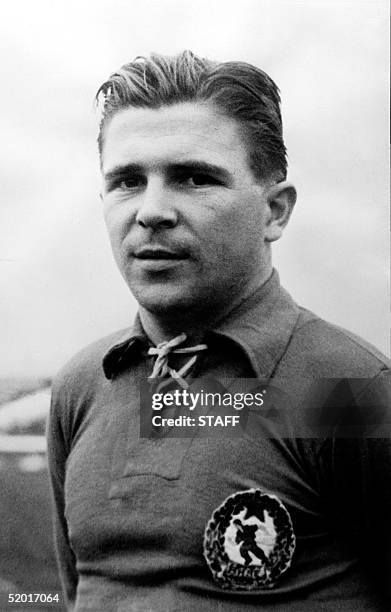
Ferenc Puskás
 Hungary
association football player•association football coach
Also known as: Galloping Major
Compleanno
April 1, 1927
Segno Zodiacale
Aries
Luogo di Nascita
Budapest, Hungary
Età
Died at 79
Altezza
5 ft 7 in (170 cm)
Informazioni
Ferenc Puskás è stato un calciatore e allenatore ungherese, ampiamente considerato uno dei più grandi giocatori di tutti i tempi e la prima superstar internazionale dello sport. Attaccante dal sinistro devastante, è il miglior assistman europeo di tutti i tempi nel calcio internazionale con 53 assist. Soprannominato il "Maggiore Marciante", fu riconosciuto nel 1995 come il miglior marcatore della massima serie del XX secolo dall'IFFHS. Con 802 gol in 792 partite ufficiali, si colloca al settimo posto nella classifica dei marcatori di tutti i tempi. La sua eredità include il FIFA Puskás Award, introdotto nel 2009 per il gol più bello dell'anno. È stato inserito nel FIFA 100 nel 2004 e nominato miglior giocatore ungherese degli ultimi 50 anni nel 2003. Il suo stile di gioco era potente e diretto, con una capacità innata di segnare da quasi qualsiasi angolazione. Dopo la sua morte, la sua eredità è mantenuta dalla Fondazione Puskás, che gestisce account sui social media condividendo filmati storici e aggiornamenti sul Puskás Award. La Puskás Arena di Budapest continua a ospitare grandi partite e concerti. Una nuova serie documentaria "The Mighty Magyars" è in produzione, con filmati d'archivio. Il governo ungherese ha annunciato l'espansione del Museo Puskás, che dovrebbe aprire nel 2027, centenario della sua nascita.
Primi Anni e Background
Puskás nacque Ferenc Purczeld il 1° aprile 1927 a Budapest, Ungheria. Suo padre, Ferenc Puskás Sr., era un ex calciatore che giocò per il Kispest AC e allenò suo figlio fin da giovane. Cresciuto nel distretto di Kispest, un'area operaia di Budapest, giocava a calcio costantemente per strada e nei campi. A 12 anni entrò nella squadra giovanile del Kispest AC, il club locale. La sua naturale capacità di segnare fu subito evidente. Esordì in prima squadra per il Kispest a soli 16 anni nel 1943. Nel 1947 cambiò il suo cognome in Puskás e ottenne la prima convocazione in nazionale ungherese. Nel 1948 era il miglior marcatore europeo con 50 gol in campionato in una singola stagione. Parlava ungherese, spagnolo e un po' di tedesco. Morì il 17 novembre 2006 a Budapest all'età di 79 anni. Il suo funerale fu un evento nazionale.
Crescita Professionale
Puskás fu capitano della nazionale ungherese conosciuta come i Mighty Magyars, portandoli all'oro olimpico nel 1952 e alla finale dei Mondiali del 1954, dove persero 3–2 contro la Germania Ovest nel Miracolo di Berna. Segnò in finale nonostante una frattura scomposta. Dopo la rivoluzione ungherese del 1956, disertò e fu squalificato per due anni dalla UEFA. Nel 1958, a 31 anni, firmò per il Real Madrid. Lì segnò 242 gol in 262 partite, vincendo tre Coppe dei Campioni (1959, 1960, 1966) e cinque campionati spagnoli consecutivi (1961–1965). Nella finale di Coppa dei Campioni del 1960 segnò quattro gol nella vittoria per 7–3 sull'Eintracht Francoforte, un record che resiste ancora. Vinse quattro Trofei Pichichi come capocannoniere della Liga (1960, 1961, 1963, 1964). Vinse anche quattro campionati ungheresi (1950, 1952, 1954, 1955) e la Coppa d'Ungheria nel 1952 con il Budapest Honvéd. Dopo il ritiro da giocatore nel 1966, allenò il Panathinaikos portandolo alla finale di Coppa dei Campioni del 1971, vincendo il campionato greco nel 1972, e in seguito allenò l'AEK Atene e la nazionale ungherese. Nel 2002, il Népstadion di Budapest fu ribattezzato Puskás Ferenc Stadion in suo onore. Divenne ambasciatore FIFA/SOS Charity nel 1998.
Cronologia Carriera
Immagine Pubblica e Stile
Puskás era un attaccante robusto, dal petto ampio, con un sinistro devastante e un incredibile senso della posizione. I media lo ritraevano come un genio umile e un eroe tragico dei Mondiali del 1954. I tifosi lo ricordano come il cuore dei Mighty Magyars e un simbolo dell'orgoglio calcistico ungherese. I tifosi ungheresi si riuniscono ogni anno il 1° aprile alla statua di Puskás vicino alla Puskás Arena per onorare il suo compleanno. Documentari e biopic continuano a celebrare la sua vita, ritraendolo come una figura più grande della vita che ha superato le avversità. Apparve su molteplici copertine di France Football e World Soccer durante i suoi anni al Real Madrid. Il tono dei contenuti nei documentari è nostalgico ed eroico. La voce della fondazione sui social media è riverente e storica. Citazioni notevoli includono: "Sono ungherese. Sono nato a Budapest. Morirò ungherese. Ma la Spagna mi ha dato una seconda vita."
Fama e fandom
While Ferenc Puskás does not command a single, formally named collective like the "Puskas Army," his reverence is institutionalized through the global supporters of Real Madrid and the Hungarian national team. Fans often identify simply as admirers of the "Mighty Magyars" or devotees of the "Galloping Major," gathering annually on April 1 near the Puskás statue in Budapest to honor his legacy. This devotion manifests in high-profile tributes rather than grassroots campaigns; in August 2026, Real Madrid honored him before a match against Ferencváros with Roberto Carlos in a ceremonial role, while a significant event in Budapest reinforced the city as a pilgrimage site for his followers. His family remains central to this narrative, highlighted when his great-granddaughter Ane Puskás appeared at the 2026 Champions League final venue, underscoring an enduring personal bond felt by the fanbase. A Danish novel published in 2025 further immortalizes his story for new generations.
In the realm of global recognition, Ferenc Puskás maintains a formidable position within historical rankings. He is currently the 4th most famous person from Hungary, a standing that has held steady since the previous measurement cycle. These placements reflect a vast scope of attention tracked across media coverage, search activity, and cultural consumption signals worldwide. The iFANN Global Fame Rankings confirm his status as a figure whose influence transcends the sport itself, anchoring him firmly in the pantheon of international icons.
Curiosità e leggende
Puskás was known as the "Galloping Major" because he held the rank of major in the Hungarian Army while playing for the army club Budapest Honvéd. Despite his fame, he never won the Ballon d'Or, as the award was only open to European players in a single calendar year during his prime. After retiring, he struggled with alcoholism but later recovered and became a FIFA ambassador. His left foot was famously powerful; he scored a goal from the halfway line in a 1954 match against West Germany. He was 5 feet 7 inches (170 cm) tall. The greatest team he ever played against, in his view, was the Brazil of 1954. He scored a hat-trick in the 1962 European Cup final, which Real Madrid lost 5–3 to Benfica. In 1955, he was top scorer in the Hungarian League for the fourth time. He was ranked among the top 10 players of the 20th century by France Football.
A widely retold legend concerns the "Match of the Century" on November 25, 1953, at Wembley Stadium, where Hungary defeated England 6–3. In this performance, Puskás scored two goals, shocking a nation that had never lost at home to a foreign team. Reports describe the crowd's stunned reaction and the subsequent disruption of English football supremacy as a moment that fundamentally altered the perception of international sport. Another mythologized aspect is his tenure at Real Madrid from 1958 to 1967, where he scored 242 goals in 262 games, a statistic that remains a cornerstone of the club's history.
Citazioni Notevoli
“I didn't want to be a soldier. I wanted to be a footballer. But the army gave me the chance to play for Honvéd, so I became a major.”
“The greatest team I ever played against was the Brazil of 1954. They were magical. But we beat them 4–2.”
“Football is a simple game. You pass the ball, you move, you shoot. I just did it better than most.”
“I am Hungarian. I was born in Budapest. I will die Hungarian. But Spain gave me a second life.”
“The 1954 final is the biggest regret of my life. I was not fully fit. I should not have played.”
Famiglia e Vita Privata
Puskás era figlio di Ferenc Puskás Sr., un ex calciatore che giocò per il Kispest AC. Suo padre fu il suo primo allenatore e una grande influenza. Non aveva fratelli menzionati nelle fonti. Nel 1950 sposò Erzsébet Hunyadvári, che conobbe a Budapest alla fine degli anni '40. Lei lo seguì in esilio in Spagna e lo sostenne per tutta la carriera. La coppia non ebbe figli. Rimasero sposati fino alla morte di lui nel 2006. Puskás visse a Madrid durante i suoi anni da calciatore e in seguito tornò a Budapest. Possedeva una casa in entrambe le città. Sua moglie fu la sua costante compagna, e non ci sono documenti di altri partner romantici. Gli fu diagnosticato il morbo di Alzheimer nei primi anni 2000 e ne soffrì fino alla morte.
Collegamenti Notevoli
Puskás formò un leggendario tandem d'attacco con Alfredo Di Stéfano al Real Madrid. Giocò anche al fianco di Francisco Gento e fu allenato da Luis Carniglia. In nazionale ungherese, fu compagno di squadra di Nándor Hidegkuti, Sándor Kocsis e József Bozsik. Suo padre, Ferenc Puskás Sr., fu il suo primo allenatore. Affrontò Just Fontaine in partite internazionali e in seguito allenò il Panathīnaïkos contro l'Ajax nella finale della Coppa dei Campioni.
Relazioni e Storia Dating
Puskás sposò Erzsébet Hunyadvári nel 1950. Si incontrarono a Budapest alla fine degli anni '40 e restarono insieme per 56 anni fino alla morte di lui nel 2006. Lei lo seguì in esilio in Spagna e fu un costante sostegno durante la sua carriera. La coppia non ebbe figli. Non sono registrate altre relazioni pubbliche o flirt di alto profilo in fonti attendibili. A partire dal 2026, Puskás è deceduto; fu sposato con Erzsébet Hunyadvári fino alla sua morte.
- Sposato/aErzsébet Hunyadvári1950 - 2006Si incontrarono a Budapest alla fine degli anni '40 e stettero insieme per 56 anni. Lei lo seguì in esilio in Spagna. Nessun figlio.
Morte e conseguenze
Morto/a
November 17, 2006 (a 79 anni)
Luogo di morte
Sconosciuto
Causa della morte
Sconosciuto
Patrimonio (Valore immobiliare)
$2.4 Million
Stima del team editoriale di iFANN
Ferenc Puskás, the legendary Hungarian footballer and Real Madrid star, carried an estimated net worth of $2.4 million at the time of his death in 2006. Per iFANN's editorial analysis, this figure reflects wealth accumulated primarily through his successful playing career, including his tenure at Real Madrid where he secured multiple European Cups and La Liga titles, alongside his later managerial roles. Puskás also generated income from endorsements and public appearances, though specific financial details from his era remain limited. As of 2026, his legacy endures as one of the greatest in football history.
Premi vinti (25)
Puskás vinse l'oro olimpico nel 1952, tre Coppe dei Campioni (1959, 1960, 1966) e cinque titoli di La Liga con il Real Madrid. Vinse quattro Trofei Pichichi e fu capocannoniere del campionato ungherese per quattro volte. Ricevette il UEFA Jubilee Award come miglior giocatore ungherese degli ultimi 50 anni nel 2003 e fu inserito nel FIFA 100 nel 2004. Il FIFA Puskás Award fu creato in suo onore nel 2009.
1952 · Calcio
Hungary national team
1966 · Club
Real Madrid
1960 · Club
Real Madrid
1959 · Club
Real Madrid
Noto Per
Real Madrid
1958 · Forward
Hungary national team
1947 · Captain and forward
1954 World Cup
1954 · Captain
Parole chiave
Fatti Rapidi
Dettagli Personali
- Nome Completo
- Ferenc Purczeld
- Altezza
- 5 ft 7 in (170 cm)
- Coniuge
- Erzsébet Hunyadvári
Domande Frequenti
Quanti gol ha segnato Ferenc Puskás in carriera?
Ferenc Puskás era sposato? Aveva figli?
Cos'è il FIFA Puskás Award?
Perché Ferenc Puskás lasciò l'Ungheria?
Qual era il patrimonio di Ferenc Puskás al momento della morte?
Unisciti alla community
fan che discutono