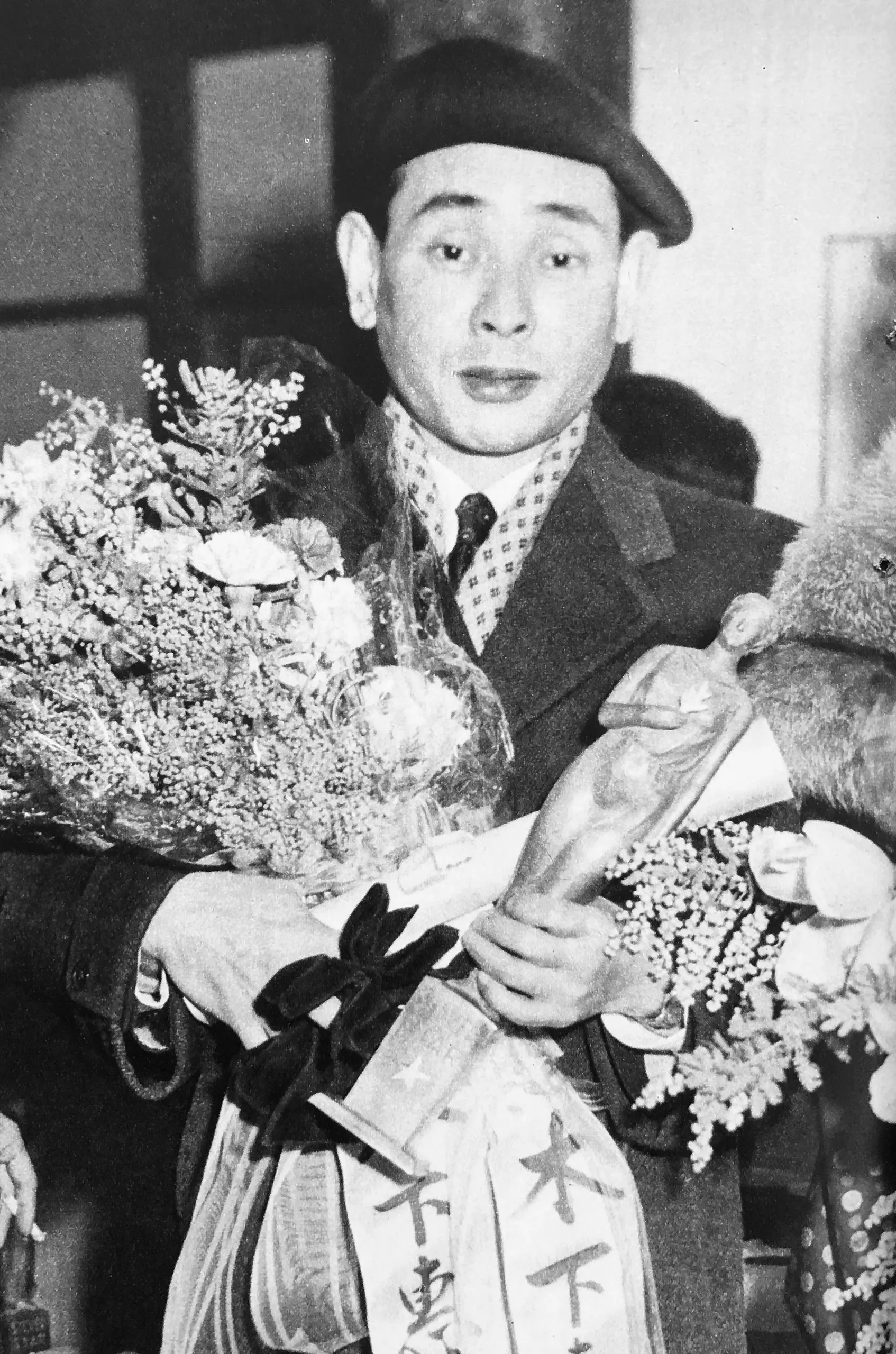
Keisuke Kinoshita
 Japan
Japanfilm director•screenwriter•film producer
Compleanno
December 5, 1912
Segno Zodiacale
Sagittarius
Luogo di Nascita
Hamamatsu, Shizuoka Prefecture, Japan
Età
Morto/a a 86 anni
Altezza
5 ft 6 in (168 cm)
Informazioni
Keisuke Kinoshita è stato un regista e sceneggiatore giapponese il cui lavoro ha profondamente risuonato con il pubblico nazionale dagli anni '40 agli anni '60. Sebbene meno conosciuto a livello internazionale di Akira Kurosawa o Yasujiro Ozu, Kinoshita era un nome familiare in Giappone, celebrato per la sua narrazione umanista e l'audacia tecnica. I suoi film spesso mescolavano sentimentalismo e sperimentazione visiva, dal primo film giapponese a colori, Carmen Comes Home (1951), al The Ballad of Narayama (1958) ispirato al kabuki. La sua opera più amata, Twenty-Four Eyes (1954), rimane un pilastro del cinema giapponese, vincendo un Golden Globe per il miglior film straniero. In una carriera durata oltre quattro decenni, Kinoshita ha diretto 48 film, molti dei quali continuano a essere proiettati in retrospettive e restaurati per le nuove generazioni. Morì nel 1998 all'età di 86 anni, lasciando un'eredità come regista che ha catturato la vita emotiva della gente comune giapponese con grazia e sincerità.
Primi Anni e Background
Kinoshita è cresciuto a Hamamatsu, una città nota per i suoi opifici tessili e fabbriche di pianoforti, dove suo padre gestiva un negozio di tessuti per kimono. La morte del padre quando Kinoshita era ancora giovane lasciò la famiglia in condizioni modeste, e sua madre lo allevò insieme ai suoi fratelli da sola. Questa esperienza di sacrificio materno sarebbe poi diventata un tema ricorrente nei suoi film. Frequentò la Hamamatsu Middle School, dove sviluppò una passione per il cinema guardando film occidentali e giapponesi nei teatri locali. Dopo il diploma, si trasferì a Tokyo nel 1933 e si unì alla Shochiku, uno dei principali studi cinematografici giapponesi, come addetto allo sviluppo in laboratorio. Era la posizione più bassa nella scala produttiva, ma Kinoshita si fece strada fino a diventare assistente alla macchina da presa e poi assistente alla regia. Apprese il mestiere sotto registi affermati, in particolare Yasujiro Ozu e Keigo Kimura. Nel 1943, dopo un decennio di apprendistato, la Shochiku lo promosse a regista, e realizzò il suo film d'esordio Port of Flowers, un dramma umanistico ambientato in una città portuale. Il film ebbe un modesto successo e stabilì la sua reputazione per una narrazione radicata nella vita quotidiana.
Crescita Professionale
Il successo di Kinoshita arrivò nel 1951 con Carmen Comes Home, il primo film a colori giapponese, che utilizzava il processo sperimentale Fujicolor. Il film era una commedia drammatica su una ragazza di campagna che diventa una spogliarellista a Tokyo e torna al suo villaggio natale, e fu un successo sia commerciale che di critica. Tre anni dopo, diresse Twenty-Four Eyes, un epico strappalacrime che segue un'insegnante e i suoi dodici studenti dal 1928 fino al dopoguerra. Il film vinse il Golden Globe per il miglior film straniero e il Mainichi Film Award per il miglior film, e rimane la sua opera più famosa. Nel 1958, Kinoshita pubblicò The Ballad of Narayama, un adattamento stilizzato di una fiaba popolare su un'anziana donna portata su una montagna per morire. Il film utilizzava set artificiali, fondali dipinti e luci teatrali ispirate al kabuki, e vinse un altro Golden Globe per il miglior film straniero. Durante tutti gli anni '60, continuò a dirigere prolificamente, con film come The River Fuefuki (1960) e The Scent of Incense (1964). Nel 1967, passò alla televisione, dirigendo diversi drammi acclamati. Il suo ultimo film fu il TV movie The River of Life (1986).
Cronologia Carriera
Immagine Pubblica e Stile
In Giappone, Kinoshita è venerato come un tesoro nazionale, spesso chiamato il regista del popolo perché i suoi film piacevano a un pubblico di massa. I critici descrivono il suo stile come umanista e sentimentale, con temi ricorrenti dell'amore materno, l'impatto della guerra sulla gente comune e il passare del tempo. Era noto per la sua audace sperimentazione visiva, inclusi l'uso del colore, set stilizzati e design ispirato al kabuki. I critici occidentali a volte lo paragonano a Douglas Sirk per il suo approccio melodrammatico. I fan organizzano proiezioni annuali di Twenty-Four Eyes il 3 marzo, il Girls' Day in Giappone, e retrospettive del suo lavoro attirano regolarmente folle ai festival cinematografici di tutto il mondo. La sua presenza sui social media è gestita da gruppi di fan e dagli account ufficiali dello studio Shochiku.
Fama e fandom
Keisuke Kinoshita commands a legacy defined not by the fervor of modern idol worship, but by the enduring reverence of film scholars and cinephiles who study the golden age of Japanese cinema. Unlike contemporary stars with organized fan clubs bearing specific monikers, his audience consists of historians and general enthusiasts who engage with his work through institutional channels like The Criterion Collection and museum retrospectives rather than grassroots campaigns or social media rituals. His cultural footprint remains anchored in the global appreciation for post-war humanism and technical innovation, with commemorative tributes appearing sporadically on significant anniversaries of his birth. While no formal fandom name exists to unify these disparate groups, the collective memory of his films serves as a unifying thread for those dedicated to preserving cinematic history. This quiet, academic devotion stands in stark contrast to the chaotic adoration seen in pop culture, reflecting a relationship built on artistic merit rather than celebrity spectacle. Despite his profound impact on domestic audiences and international recognition from peers like Akira Kurosawa, iFANN's Global Fame Engine has evaluated this person, but they do not currently hold a placement in the published rankings (Global Top 1,000 or a Top-100 scope list). Consequently, no numerical ranking or score is assigned to his current global fame status within the system.
Curiosità e leggende
Keisuke Kinoshita directed Japan's first color film, Carmen Comes Home (1951), utilizing Fujicolor technology that produced such vivid hues it reportedly caused eye strain for some viewers. His 1944 film The Army contained subtle anti-war messages that drew the ire of military censors during production. He served as a mentor to Masaki Kobayashi, who worked under him as an assistant director on The Morning of the Osone Family. Among his own body of work, Kinoshita held She Was Like a Wild Chrysanthemum (1955) as his personal favorite. He consistently turned down offers to direct in Hollywood, preferring to remain at Shochiku studio throughout his career. His final words, according to his wife, expressed a desire to make one more film before passing. A notable piece of industry lore involves Akira Kurosawa naming Kinoshita as his favorite Japanese director, a reflection of his standing among peers. His 1958 adaptation of The Ballad of Narayama sparked intense cultural discourse regarding ancient folklore and social customs, often cited for its kabuki-inspired design and controversial themes. These elements combine to form a legacy where the films themselves are the primary ritual for fans, rather than organized fan events.
Citazioni Notevoli
“I wanted to make films that would make people cry, but also make them think.”
“The war took everything from us, but it could not take away our humanity.”
“I never wanted to go to Hollywood. My stories are Japanese stories.”
“A film should be like a poem: concise, beautiful, and full of feeling.”
“My mother was the strongest person I ever knew. I put her into every film.”
Famiglia e Vita Privata
Il padre di Kinoshita morì quando lui era giovane, lasciando sua madre a crescerlo insieme ai suoi fratelli da sola. Sposò l'attrice Yoshiko Kuga nel 1956; lei aveva 25 anni e lui 43 all'epoca. La coppia non ebbe figli. Kuga recitò in diversi suoi film, tra cui The Ballad of Narayama. Dopo la morte di Kinoshita, Kuga divenne la principale custode della sua eredità, supervisionando restauri e festival cinematografici. Ha parlato in interviste della sua devozione al lavoro e della loro tranquilla vita domestica a Tokyo.
Collegamenti Notevoli
Kinoshita lavorò a stretto contatto con l'attrice Hideko Takamine, che recitò in diversi suoi film tra cui Twenty-Four Eyes e She Was Like a Wild Chrysanthemum. Collaborò anche con il compositore Chuji Kinoshita (nessuna parentela) e lo sceneggiatore Kogo Noda. Come mentore, influenzò il regista Masaki Kobayashi, che iniziò la sua carriera come assistente alla regia di Kinoshita.
Relazioni e Storia Dating
Kinoshita sposò l'attrice Yoshiko Kuga nel 1956. Si incontrarono quando Kuga fu scritturata per il suo film The Ballad of Narayama (1958), anche se si sposarono due anni prima dell'uscita. Kuga aveva 25 anni, Kinoshita 43. La coppia non ebbe figli e rimase sposata fino alla morte di Kinoshita nel 1998. In seguito, Kuga lo descrisse come un marito devoto che dava priorità al lavoro ma era profondamente affettuoso. Dopo la sua morte, divenne la principale custode della sua eredità. Non sono documentate altre relazioni sentimentali in fonti attendibili.
- Sposato/aYoshiko Kuga1956 - 1998Si incontrarono quando Kuga fu scritturata per The Ballad of Narayama; rimasero sposati fino alla morte di Kinoshita.
Morte e conseguenze
Morto/a
December 30, 1998 (a 86 anni)
Luogo di morte
Sconosciuto
Causa della morte
Sconosciuto
The Cannes Film Festival honored the late director by selecting The Ballad of Narayama for its Cannes Classics program in 2012, a retrospective gesture acknowledging his contribution to cinema long after his passing. The Criterion Collection further sustained this appreciation with an Eclipse Series dedicated to Kinoshita and World War II in 2014, while a comprehensive critical volume titled The Cinema of Kinoshita Keisuke: Films of Joy and Sorrow appeared in August 2025. A biographical film named Dawn of a Filmmaker: The Keisuke Kinoshita Story, starring Ryo Kase and directed by Keiichi Hara, served as a major cultural commemoration during the early 2010s. These posthumous releases maintained the visibility of his fifty feature films, which spanned from 1943 to 1988, ensuring his legacy remained active within global archives.
Keisuke Kinoshita passed away on December 30, 1998, at the age of eighty-six. Available records do not specify the exact location where he died, nor do they provide an official statement regarding the cause of death or details concerning his final days. His widow, actress Yoshiko Kuga, managed the estate following his death, overseeing restorations and film festivals while preserving their quiet domestic history in Tokyo., institutions continued to recognize his work through curated screenings and publications. The Keisuke Kinoshita Memorial Museum in Hamamatsu City stands as a physical tribute to his life, though the specific arrangements of his funeral, including whether it was held there or how his remains were interred, remain unrecorded in the historical data.
Patrimonio (Valore immobiliare)
$5.5 Million
Stima del team editoriale di iFANN
Per iFANN's editorial analysis, the estate of Keisuke Kinoshita is valued at $5.5 Million as of 2026. During his lifetime, Kinoshita earned a salary as a contract director at Shochiku, estimated at ¥1-2 million per film in the 1950s and 1960s. After his death, his widow Yoshiko Kuga managed the estate, which generates revenue from film restorations, DVD and Blu-ray sales by distributors such as the Criterion Collection, television broadcasts in Japan, and screening fees from film festival retrospectives. A major retrospective at the Museum of Modern Art in New York in 2023 and ongoing restorations by Shochiku and the National Film Archive of Japan have boosted licensing income. The estate does not include significant real estate or business ventures, as Kinoshita focused entirely on his film career.
Premi vinti (18)
Kinoshita ha vinto due Golden Globe Awards per il miglior film straniero, per Twenty-Four Eyes (1955) e The Ballad of Narayama (1959). Ha anche ricevuto numerosi Mainichi Film Awards, tra cui miglior film e miglior regista per The Morning of the Osone Family, Twenty-Four Eyes, She Was Like a Wild Chrysanthemum e The Ballad of Narayama. Ha vinto Blue Ribbon Awards per miglior film e miglior regista sia per Twenty-Four Eyes che per The Ballad of Narayama.
1959 · Miglior Film Straniero
The Ballad of Narayama
1955 · Miglior Film Straniero
Twenty-Four Eyes
1958 · Miglior film
The Ballad of Narayama
1958 · Miglior regista
The Ballad of Narayama
1955 · Miglior film
She Was Like a Wild Chrysanthemum
1955 · Miglior regista
She Was Like a Wild Chrysanthemum
1954 · Miglior film
Twenty-Four Eyes
1954 · Miglior regista
Twenty-Four Eyes
1951 · Miglior regista
Carmen Comes Home
1947 · Miglior film
The Morning of the Osone Family
Noto Per
Twenty-Four Eyes
1954 · Regista
The Ballad of Narayama
1958 · Regista
Carmen Comes Home
1951 · Regista
She Was Like a Wild Chrysanthemum
1955 · Regista
A Japanese Tragedy
1953 · Regista
Parole chiave
Fatti Rapidi
- Professione
- film director, screenwriter, film producer
- Nato/a
- December 5, 1912
- Luogo di Nascita
- Hamamatsu, Shizuoka, Japan
- Morto/a
- December 30, 1998
- Luogo di morte
- Tokyo, Japan
- Genere
- Maschio
- Segno Zodiacale
- Sagittarius
- Altezza
- 5 ft 6 in (168 cm)
- Coniuge
- Yoshiko Kuga (m. 1956)
- Children
- None
- Education
- Hamamatsu Middle School
Dettagli Personali
- Nome Completo
- Keisuke Kinoshita
- Altezza
- 5 ft 6 in (168 cm)
- Coniuge
- Yoshiko Kuga
- Istruzione
- Hamamatsu Middle School
Filmografia
48
Totale
43
Film
5
TV
Domande Frequenti
Quanti anni aveva Keisuke Kinoshita quando morì?
Per cosa è più conosciuto Keisuke Kinoshita?
Keisuke Kinoshita ha vinto qualche premio?
Keisuke Kinoshita era sposato?
Quanti film ha diretto Keisuke Kinoshita?
Social Media
Unisciti alla community
fan che discutono