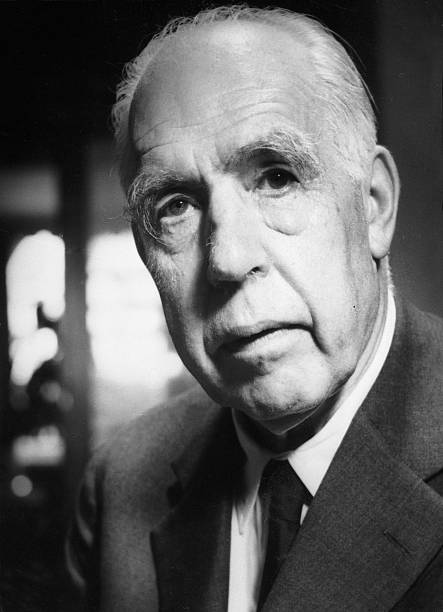
Niels Bohr
 Denmark
university teacher•nuclear physicist•philosopher of science
Compleanno
October 7, 1885
Segno Zodiacale
Libra
Luogo di Nascita
Copenhagen, Denmark
Età
Morto/a a 77 anni
Altezza
5 ft 10 in (178 cm)
Informazioni
Niels Bohr è stato un fisico teorico e filosofo della scienza danese che ha ridefinito la nostra comprensione dell'atomo. È famoso soprattutto per il modello atomico di Bohr, che proponeva che gli elettroni orbitano attorno al nucleo in livelli energetici discreti. Il suo lavoro fondamentale sulla struttura atomica e la teoria quantistica gli valse il Premio Nobel per la Fisica nel 1922. Bohr introdusse anche il principio di complementarità, influenzando sia la fisica che la filosofia. Fondò l'Istituto di Fisica Teorica dell'Università di Copenaghen, oggi chiamato Istituto Niels Bohr, dove fece da mentore a una generazione di fisici. Predisse l'elemento afnio e l'elemento sintetico bohrio fu chiamato in suo onore. Dopo la seconda guerra mondiale, Bohr sostenne il controllo internazionale delle armi nucleari e contribuì alla fondazione del CERN. La sua eredità continua a ispirare fisici e filosofi in tutto il mondo.
Primi Anni e Background
Niels Henrik David Bohr nacque il 7 ottobre 1885 a Copenaghen, in Danimarca, in una casa piena di curiosità intellettuale e discorsi scientifici. Suo padre, Christian Bohr, era un illustre professore di fisiologia all'Università di Copenaghen, mentre sua madre, Ellen Adler Bohr, proveniva da un'importante e ricca famiglia ebraica di banchieri. Questo vivace ambiente domestico fece sì che il giovane Niels fosse esposto a sofisticate discussioni scientifiche fin dalla tenera età, spesso accompagnando il padre alle riunioni dell'Accademia Reale Danese. Frequentò la Gammelholm Latin School, dove la sua naturale predisposizione per la fisica e la matematica divenne rapidamente evidente. Sebbene eccellesse in queste materie rigorose, dimostrando un precoce talento per il pensiero analitico, pare che trovasse la scrittura di saggi un'impresa più ardua.
Nel 1903, Bohr si iscrisse all'Università di Copenaghen, intraprendendo una carriera accademica rapida e illustre. Conseguì la laurea triennale nel 1907, seguita dalla laurea magistrale nel 1909, e infine completò il dottorato nel 1911. La sua tesi di dottorato, che esplorava la complessa teoria elettronica dei metalli, fu riconosciuta come innovativa negli ambienti accademici. Tuttavia, la sua presentazione in una densa prosa danese fece sì che ricevesse un'attenzione immediata limitata sulla scena internazionale, ritardando un più ampio riconoscimento delle sue intuizioni innovative.
Un periodo cruciale per i futuri contributi di Bohr iniziò poco dopo il completamento del dottorato. Nel 1911, si recò a Cambridge, in Inghilterra, per proseguire le sue ricerche presso il rinomato Laboratorio Cavendish sotto la guida di J.J. Thomson, lo scopritore dell'elettrone. Questa prima collaborazione, tuttavia, si rivelò improduttiva per Bohr. Imperterrito, fece una mossa cruciale nel 1912, trasferendosi a Manchester per lavorare con Ernest Rutherford. Fu sotto Rutherford, il cui rivoluzionario modello nucleare dell'atomo aveva recentemente proposto un nucleo piccolo e denso orbitato da elettroni, che Bohr trovò il terreno fertile per le sue stesse idee rivoluzionarie. Il modello atomico di Rutherford divenne la struttura fondamentale su cui Bohr avrebbe costruito le sue rivoluzionarie teorie sulla struttura atomica e la meccanica quantistica .
Crescita Professionale
Nel 1913, Bohr pubblicò la sua trilogia fondamentale di articoli sulla struttura atomica, proponendo che gli elettroni orbitano attorno al nucleo in livelli energetici quantizzati. Questo modello di Bohr spiegò con successo lo spettro dell'idrogeno e gli valse un immediato riconoscimento internazionale. Nel 1916, fu nominato Professore di Fisica Teorica all'Università di Copenaghen. Quattro anni dopo, fondò l'Istituto di Fisica Teorica, che divenne un hub globale per la meccanica quantistica, attirando giovani fisici da tutto il mondo.
Bohr ricevette il Premio Nobel per la Fisica nel 1922 all'età di 37 anni. Nel 1927, introdusse il principio di complementarità alla Conferenza di Como, una pietra miliare dell'Interpretazione di Copenaghen della meccanica quantistica. Durante gli anni '30, sviluppò il modello a goccia del nucleo atomico, che in seguito aiutò a spiegare la fissione nucleare. Nel 1943, dopo essere fuggito dalla Danimarca occupata dai nazisti, Bohr si unì al Progetto Manhattan a Los Alamos. Sebbene abbia lavorato alla bomba atomica, dopo la guerra sostenne costantemente il controllo internazionale delle armi nucleari. Contribuì a fondare il CERN nel 1954 e divenne il primo presidente dell'Istituto Nordico di Fisica Teorica nel 1957.
Cronologia Carriera
Immagine Pubblica e Stile
Bohr era noto per la sua pipa, il suo comportamento riflessivo e il suo stile di insegnamento gentile e socratico. Parlava con voce sommessa e deliberata ed era descritto come infinitamente paziente con gli studenti. Nelle rappresentazioni mediatiche, è costantemente mostrato come la saggia figura paterna della meccanica quantistica, diplomatico, profondamente filosofico e umanitario. I suoi dibattiti con Albert Einstein sulla meccanica quantistica sono leggendari, con la battuta di Einstein "Dio non gioca a dadi" rivolta all'interpretazione probabilistica di Bohr. Il fandom di Bohr è principalmente accademico, composto da fisici, storici della scienza e appassionati di filosofia. Le annuali Niels Bohr Lectures all'Istituto Niels Bohr sono un evento importante, e i dibattiti Bohr-Einstein rimangono un argomento popolare per simposi e conferenze pubbliche.
Fama e fandom
Niels Bohr commands a legacy defined not by the chaotic adoration of pop culture, but by the enduring reverence of the scientific community and historians. While he lacks an organized fanbase with official monikers or ritualistic campaigns, his intellectual influence persists through academic institutions like the Niels Bohr Institute and the global study of quantum mechanics. The stories that surround him are those of verified historical milestones rather than viral moments; the debates with Albert Einstein remain the central pillar of his mythology, recently reignited by experimental confirmations in 2025 and 2026 that validated his probabilistic interpretations decades after his death. His status as a figure of immense historical weight is quantified by the iFANN Global Fame Rankings. Within this framework, he holds a steady position as the 10th most famous person from Denmark, a ranking anchored in his national significance. Furthermore, his standing within the broader historical landscape places him as the 23rd most famous person in Classical studies, reflecting the timeless nature of his contributions to physics and philosophy. These placements underscore his transition from a contemporary scientist to a foundational figure in human history.
Curiosità e leggende
Niels Bohr's first scientific paper on water jets secured the Royal Danish Academy's gold medal in 1907. During his dramatic escape from occupied Denmark in 1943, he nearly perished when the oxygen system failed on the Mosquito bomber transporting him to Britain; he passed out and survived only because the pilot descended to a lower altitude. He designed his own coat of arms featuring the yin-yang symbol accompanied by the motto "Contraria sunt complementa" (Opposites are complementary). The Danish government granted him an honorary residence at Carlsberg Mansion, a privilege traditionally reserved for the nation's most distinguished citizens. Beyond these facts, the scientific community often recounts the legendary series of debates between Bohr and Albert Einstein from 1927 to 1935, where Einstein famously declared that God does not play dice against Bohr's Copenhagen Interpretation. This rivalry was so pivotal that recent experiments in late 2025 and early 2026 by Chinese scientists have been cited as finally validating Bohr's position over Einstein's objections. Another recurring anecdote involves his brother Harald Bohr, an Olympic gold medalist in football, highlighting the athletic prowess of the Bohr family alongside their scientific genius.
Citazioni Notevoli
“An expert is a person who has made all the mistakes that can be made in a very narrow field.”
“The opposite of a correct statement is a false statement. But the opposite of a profound truth may well be another profound truth.”
“We are all agreed that your theory is crazy. The question that divides us is whether it is crazy enough to have a chance of being correct.”
“Never express yourself more clearly than you are able to think.”
“Everything we call real is made of things that cannot be regarded as real.”
Famiglia e Vita Privata
Bohr nacque da Christian Bohr, professore di fisiologia all'Università di Copenaghen, e Ellen Adler Bohr, che proveniva da una ricca famiglia ebraica di banchieri. Aveva un fratello minore, Harald Bohr, che divenne un illustre matematico e calciatore olimpionico. Bohr sposò Margrethe Nørlund il 1° agosto 1912. Ebbero sei figli: Christian (morto in un incidente in barca all'età di 18 anni), Harald (morto infante), Hans (medico), Erik (ingegnere chimico), Aage (premio Nobel per la fisica) ed Ernest (avvocato). La famiglia visse nella residenza onoraria di Carlsberg Mansion a Copenaghen dal 1932 in poi. La famiglia di Bohr includeva sua moglie e i suoi figli, ed era noto per essere un padre devoto nonostante il suo intenso programma di lavoro.
Collegamenti Notevoli
I collaboratori più stretti di Bohr includevano Ernest Rutherford, che lo ha guidato a Manchester; Werner Heisenberg, suo studente e poi collega; e Albert Einstein, con cui ha avuto famosi dibattiti decennali sulla meccanica quantistica. Ha anche lavorato a stretto contatto con Max Born, Wolfgang Pauli, Oskar Klein, Hans Kramers, George de Hevesy, John Wheeler e James Franck. Suo figlio Aage Bohr ha vinto il Premio Nobel per la Fisica nel 1975.
Relazioni e Storia Dating
Bohr sposò Margrethe Nørlund il 1º agosto 1912 in una cerimonia civile. Era la sorella del matematico Niels Erik Nørlund. Margrethe fu la compagna per tutta la vita, confidente e partner intellettuale di Bohr; batteva a macchina i suoi manoscritti, lo accompagnava alle conferenze e gestiva la loro casa. Ebbero sei figli: Christian (morto in un incidente in barca a 18 anni), Harald (morto in fasce), Hans, Erik, Aage (che vinse il Premio Nobel per la Fisica nel 1975) ed Ernest. Il matrimonio durò 50 anni fino alla morte di Bohr nel 1962. Non sono state credibilmente riportate altre relazioni romantiche documentate pubblicamente. La sua corrispondenza personale e le biografie descrivono costantemente un matrimonio devoto e monogamo.
- Sposato/aMargrethe Nørlund1912 - 1962Compagna per tutta la vita e partner intellettuale; batteva a macchina i suoi manoscritti e gestiva la casa.
Morte e conseguenze
Morto/a
November 18, 1962 (a 77 anni)
Luogo di morte
Copenhagen, Denmark
Causa della morte
Heart failure due to coronary artery disease
Tributes poured in from world leaders and the global scientific community following the passing of Niels Bohr, with King Frederik IX presiding over a state funeral that drew high-ranking Danish officials and leading physicists from around the world. Albert Einstein, who had died just three months prior, was among the prominent scientists whose loss was noted alongside Bohr's, while Werner Heisenberg and Enrico Fermi issued formal statements honoring his contributions to quantum mechanics and atomic theory. The scientific community observed moments of silence and saw an immediate surge in academic citations and reprints of his work, reflecting the profound impact of his death on international physics. Bohr passed away peacefully in his sleep at his home at Blegdamsvej 17 in Copenhagen on November 18, 1962, at the age of 77.
His final days followed a gradual decline in health after a heart attack earlier that year, culminating in his last public appearance in late October when he delivered a speech at the opening of the new Niels Bohr Institute building despite his deteriorating condition. The official cause of death was determined to be heart failure resulting from long-standing coronary artery disease by his personal physician, who attended him during his final days. The funeral service took place five days later on November 23, 1962, at the Church of Our Lady in Copenhagen before burial at the Assistens Cemetery in the Nørrebro district. Eulogies emphasized his role as a mentor to the generation of physicists who shaped modern physics, featuring traditional church hymns appropriate for a state funeral of his stature.
Posthumous honors included the establishment of the Niels Bohr Medal by the International Union of Pure and Applied Physics in 1963 and the naming of element Bohrium in his honor by the IUPAC in 1997. His legacy remains anchored by the continued operation of the Niels Bohr Institute as a premier research center and the preservation of his papers and correspondence within the Niels Bohr Library & Archives and the Royal Danish Academy of Sciences. The family estate was handled privately, ensuring the maintenance of his intellectual property rights and archival holdings managed by the institute.
Patrimonio (Valore immobiliare)
$5 Million
Stima del team editoriale di iFANN
Niels Bohr died in 1962, and per iFANN's editorial analysis, his estate is valued at approximately $5 million as of 2026. This figure reflects intellectual property rights, book royalties, and archival holdings managed by the Bohr family through the Niels Bohr Archive and the Niels Bohr Institute. Bohr lived modestly as a university professor and Nobel laureate. He donated much of his Nobel Prize money to scientific causes and refugee relief. His collected works, published in multiple volumes, continue to generate royalties. The Niels Bohr Institute receives ongoing funding and donations in his honor. The estate's primary revenue sources include licensing of his image and name for educational materials, research grants to the Niels Bohr Archive, and steady book royalties from his philosophical and scientific writings.
Premi vinti (8)
Bohr vinse il Premio Nobel per la Fisica nel 1922 per le sue indagini sulla struttura atomica. Ricevette anche la Medaglia Hughes (1921), la Medaglia Matteucci (1923), la Medaglia Franklin (1926), la Medaglia Max Planck (1930), la Medaglia Copley (1938) e il primo Premio Atoms for Peace (1957). Fu insignito dell'Ordine dell'Elefante, la più alta onorificenza reale danese, nel 1947.
1957 · Pace
1947 · Ordine Reale
Noto Per
Bohr Model of the Atom
1913 · Developer
Principle of Complementarity
1927 · Formulator
Copenhagen Interpretation
1927 · Co-founder
Liquid-Drop Model of the Nucleus
1936 · Developer
Manhattan Project
1943 · Contributor
Parole chiave
Fonti
Fatti Rapidi
Dettagli Personali
- Nome Completo
- Niels Henrik David Bohr
- Altezza
- 5 ft 10 in (178 cm)
- Coniuge
- Margrethe Bohr
- Figli
- 6 sons: Christian, Harald, Hans, Erik, Aage, Ernest
- Istruzione
- University of Copenhagen (B.A. 1907, M.A. 1909, Ph.D. 1911)
Domande Frequenti
Per cosa è famoso Niels Bohr?
Niels Bohr ha lavorato alla bomba atomica?
Quanti anni aveva Niels Bohr quando morì?
Niels Bohr aveva figli?
Qual era il QI di Niels Bohr?
Persone Simili
Unisciti alla community
fan che discutono