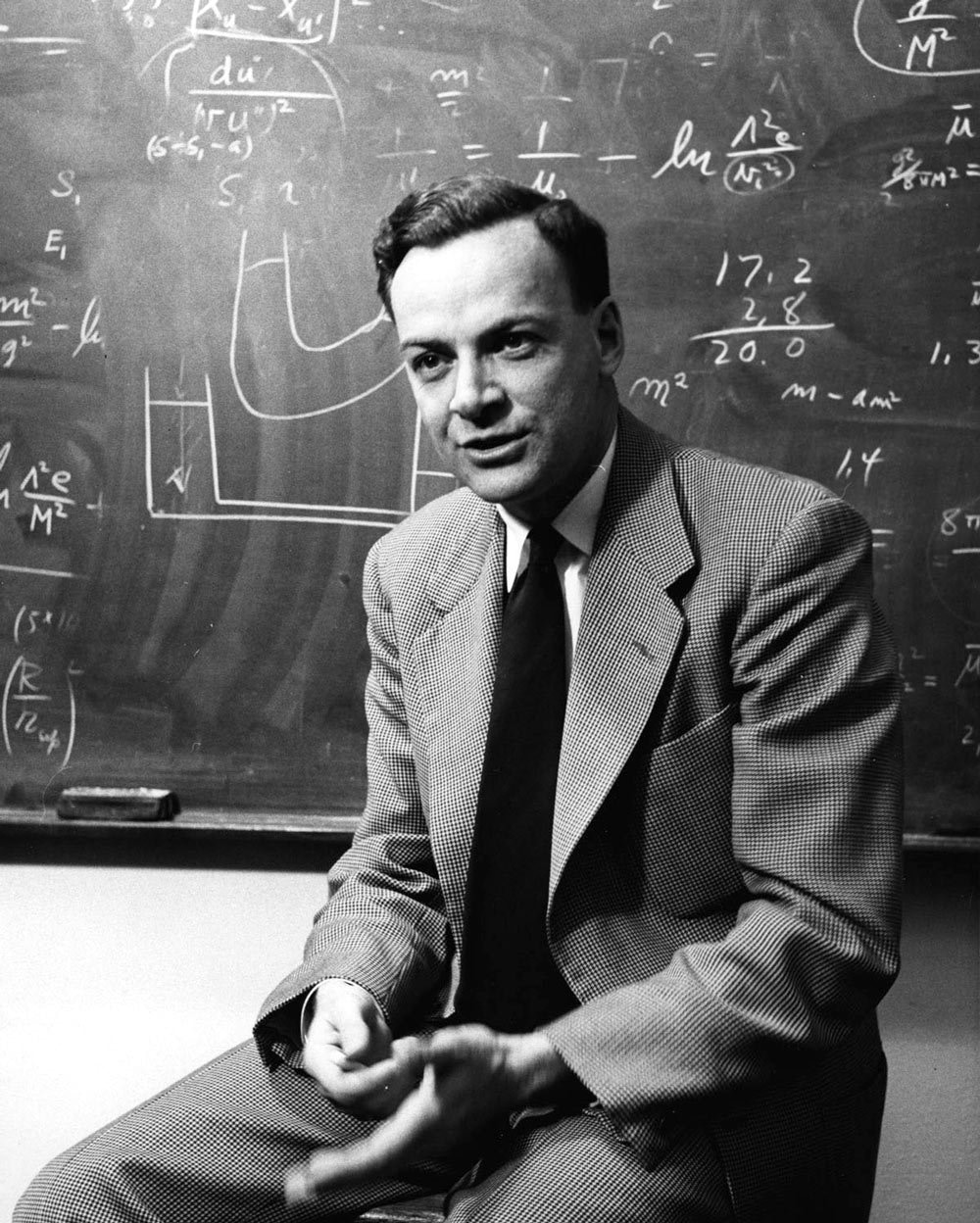
Richard Feynman
 United States
physicist•quantum physicist•inventor
Compleanno
May 11, 1918
Segno Zodiacale
Taurus
Luogo di Nascita
Far Rockaway, Queens, New York City, USA
Età
Died at 69
Altezza
5 ft 8 in (173 cm)
Informazioni
Richard Feynman è stato un fisico teorico statunitense considerato uno degli scienziati più brillanti e influenti del ventesimo secolo, celebrato tanto per la sua personalità irrefrenabile quanto per il suo lavoro. Ha condiviso un Premio Nobel per i suoi contributi all'elettrodinamica quantistica, la teoria che descrive come luce e materia interagiscono, e il suo elegante metodo pittorico per rappresentare le interazioni tra particelle, noto come diagrammi di Feynman, è diventato uno strumento indispensabile usato dai fisici di tutto il mondo. Il suo lavoro ha ridefinito il modo in cui il mondo subatomico viene compreso e calcolato.
La portata di Feynman è stata straordinaria, toccando la superfluidità, la fisica del nucleo atomico e idee pionieristiche sull'informatica quantistica e la nanotecnologia. Ha partecipato giovanissimo al Progetto Manhattan e in seguito ha raggiunto un pubblico più vasto grazie al suo talento di insegnante e comunicatore; i suoi celebri corsi e le sue memorie argute e irriverenti hanno introdotto generazioni alla gioia del pensiero scientifico. Pochi scienziati hanno trasmesso con altrettanto successo il piacere della curiosità.
È diventato un nome familiare negli ultimi anni della sua vita come membro della commissione che indagò sul disastro dello space shuttle Challenger, dove dimostrò in modo memorabile il cedimento di una guarnizione cruciale con un semplice bicchiere di acqua ghiacciata. Giocoso, iconoclasta e infinitamente curioso, ha incarnato la scienza come avventura. Richard Feynman rimane un'icona amata della fisica e del piacere intellettuale.
Primi Anni e Background
Feynman è cresciuto a Far Rockaway, nel Queens, in una famiglia ebraica di origine russa e polacca. Suo padre Melville, un venditore di uniformi, lo incoraggiava a mettere tutto in discussione e a pensare in modo critico. Sua madre Lucille gli ha trasmesso il senso dell'umorismo. Da ragazzo, allestì un laboratorio in casa, riparava radio per i vicini e imparò da solo il calcolo infinitesimale. Frequentò la Far Rockaway High School, dove le sue abilità matematiche si distinsero.
Al MIT, Feynman iniziò con la matematica ma passò alla fisica. Nell'ultimo anno, vinse la Putnam Mathematical Competition, il più importante concorso universitario di matematica negli Stati Uniti. La sua tesi sviluppò un nuovo metodo per calcolare le forze molecolari. Nel 1939, si trasferì a Princeton per gli studi di dottorato sotto John Wheeler. Al suo primo seminario parteciparono Albert Einstein, Wolfgang Pauli e John von Neumann. Conseguì il dottorato nel 1942, con una tesi sul principio di minima azione in meccanica quantistica.
Crescita Professionale
Feynman fu reclutato per il Progetto Manhattan direttamente da Princeton. A Los Alamos, divenne il più giovane capogruppo della divisione teorica, lavorando direttamente sotto Hans Bethe. Insieme idearono la formula di Bethe-Feynman per calcolare la resa della bomba nucleare. Gestì anche il primitivo sistema di calcolo del progetto e assistette al test Trinity nel luglio 1945.
Dopo la guerra, insegnò alla Cornell e poi si trasferì al Caltech nel 1950. Nel 1948, pubblicò la formulazione dell'integrale di percorso della meccanica quantistica e introdusse i diagrammi di Feynman, che rivoluzionarono la fisica delle particelle. La sua conferenza del 1959 There's Plenty of Room at the Bottom è considerata il fondamento intellettuale della nanotecnologia. Dal 1961 al 1964, tenne le lezioni universitarie che divennero The Feynman Lectures on Physics, ancora oggi un classico. Nel 1965, condivise il Premio Nobel per la Fisica per il suo lavoro sull'elettrodinamica quantistica.
Negli anni '80, si dedicò alla scrittura per il grande pubblico. La sua autobiografia Surely You're Joking, Mr. Feynman! (1985) divenne un bestseller. Nel 1986, fece parte della Commissione Rogers che indagò sul disastro del Challenger, dimostrando in modo celebre il cedimento dell'O-ring con un bicchiere di acqua ghiacciata. Morì di cancro addominale nel 1988.
Cronologia Carriera
Immagine Pubblica e Stile
Feynman coltivava la personalità di un genio giocoso e irriverente. Si vestiva in modo informale, spesso in camicia, e raramente si vedeva senza un sorriso malizioso. Le sue lezioni erano leggendarie per chiarezza ed entusiasmo, usando analogie quotidiane per spiegare fisica profonda. Si rifiutava di prendere l'autorità sul serio, il che lo faceva amare da studenti e pubblico. Le rappresentazioni mediatiche evidenziano costantemente la sua combinazione di intelligenza pura, curiosità infantile e umorismo iconoclasta. I suoi libri sono colloquiali e pieni di aneddoti. I fan, spesso chiamati appassionati di Feynman, celebrano il suo compleanno l'11 maggio condividendo citazioni e clip delle sue lezioni. La sua tecnica Feynman per l'apprendimento è ampiamente adottata dagli studenti.
Fama e fandom
Richard Feynman's legacy endures not through a cohesive cult of personality or organized fan clubs, but through the quiet reverence of academics, students, and science enthusiasts who keep his spirit alive via textbooks and memoirs. Unlike modern icons with dedicated armies tracking every move, his admirers are scattered across lecture halls and bookstores, united by a shared appreciation for his iconoclastic approach to physics and his refusal to accept authority without evidence. There is no formal moniker for this global audience, nor are there documented rituals like birthday billboards or fan-funded campaigns; instead, the fandom exists in the continued sales of *Surely You're Joking, Mr. Feynman!* and the enduring relevance of his lectures. While recent analyses have revisited his anecdotes about beating abacus champions or solving the "restaurant dilemma," these moments remain part of scientific folklore rather than drivers of a digital movement. His influence is characterized by deep admiration for his ability to explain complex concepts simply, a trait that transcends generations without requiring social media engagement. Despite his massive cultural footprint, iFANN's Global Fame Engine has evaluated this person, but they do not currently hold a placement in the published rankings (Global Top 1,000 or a Top-100 scope list).
Curiosità e leggende
During his time at Los Alamos, Feynman taught himself to crack safes, leaving notes inside colleagues' cabinets as pranks. He played bongo drums at parties and even performed with a ballet company. He often did physics calculations at strip clubs, claiming the atmosphere helped him concentrate. He drove a beat-up van decorated with Feynman diagrams. His lifelong dream of visiting Tannu Tuva, a tiny Siberian republic, was never fulfilled but became the subject of the book *Tuva or Bust!*. He reportedly scored 125 on an IQ test in school, but biographers dismiss that as unreliable. His blackboard at the time of his death read: What I cannot create, I do not understand. Legends surrounding him include his impromptu demonstration during the Challenger disaster investigation, where he placed O-ring material in ice water to prove its loss of elasticity in cold temperatures. A persistent story involves his work on the "silly sprinkler" problem, which physicists recently solved in July 2026, settling decades of debate. Another tale recounts his victory over an abacus champion in mental arithmetic, a feat often cited in comparisons between human intuition and AI reasoning.
Citazioni Notevoli
“I think I can safely say that nobody understands quantum mechanics.”
“What I cannot create, I do not understand.”
“The first principle is that you must not fool yourself, and you are the easiest person to fool.”
“There's plenty of room at the bottom.”
“Physics is like sex: sure, it may give some practical results, but that's not why we do it.”
“I'm smart enough to know that I'm dumb.”
“The problem is not to find the answer, it's to face the answer.”
Famiglia e Vita Privata
Il padre di Feynman, Melville, nacque a Minsk e lavorava come venditore di uniformi. Sua madre, Lucille Phillips, era una casalinga. Aveva un fratello minore, Henry, morto infante, e una sorella, Joan, che divenne fisica. Feynman sposò la sua fidanzata del liceo, Arline Greenbaum, nel 1942, nonostante la diagnosi di tubercolosi. Lei morì nel 1945. Ebbe un breve matrimonio con Mary Louise Bell all'inizio degli anni '50, che finì con un divorzio. Nel 1960, sposò Gweneth Howarth, un'inglese. Ebbero un figlio, Carl (nato nel 1962), e una figlia adottiva, Michelle. La famiglia viveva ad Altadena, in California. Gweneth gli sopravvisse.
Collegamenti Notevoli
Feynman lavorò a stretto contatto con Hans Bethe a Los Alamos e alla Cornell, co-sviluppando la formula di Bethe-Feynman. Il suo supervisore di dottorato fu John Wheeler. Condivise il Premio Nobel del 1965 con Julian Schwinger e Sin-Itiro Tomonaga. Al Caltech, fu collega di Murray Gell-Mann. Co-autore di The Feynman Lectures on Physics con Robert B. Leighton e Matthew Sands. Le sue memorie successive furono scritte con Ralph Leighton.
Relazioni e Storia Dating
Feynman sposò la sua fidanzata del liceo Arline Greenbaum nel 1942, sapendo che aveva la tubercolosi. Lei morì nel 1945 mentre lui era a Los Alamos. In seguito sposò Mary Louise Bell all'inizio degli anni '50, ma il matrimonio finì rapidamente con un divorzio. Nel 1960, sposò Gweneth Howarth, un'inglese conosciuta in Svizzera. Ebbero un figlio, Carl, e una figlia adottiva, Michelle. Feynman rimase sposato con Gweneth fino alla sua morte nel 1988. Al 2026, è deceduto, essendo sposato con Gweneth al momento della sua scomparsa.
- Sposato/aArline Greenbaum1942 - 1945Sposato nonostante la sua tubercolosi; morì mentre lui lavorava al Progetto Manhattan.
- Divorziato/aMary Louise Bell1952 - 1956Breve matrimonio che finì con un divorzio.
- Sposato/aGweneth Howarth1960 - 1988Sposato nel 1960; ebbe due figli; rimase insieme a lei fino alla morte.
Morte e conseguenze
Morto/a
February 15, 1988 (a 69 anni)
Luogo di morte
Los Angeles, California, USA
Causa della morte
Retroperitoneal fibrosis leading to kidney failure
Nobel laureates Julian Schwinger and Shin'ichirō Tomonaga issued statements honoring the brilliance and iconoclastic nature of their colleague as news of his passing spread through the global scientific community. Caltech and Cornell University held memorial services while former students organized gatherings to celebrate a life that reshaped how the subatomic world is understood. The public reaction triggered an immediate surge in sales for his books, particularly Surely You're Joking, Mr. Feynman! and The Character of Physical Law, which saw renewed interest among readers worldwide. Feynman passed away at his home in Elysian Park, Los Angeles, California, on February 15, 1988, at the age of 69. In his final days, he suffered from severe pain and declining health due to tumor-like growths associated with retroperitoneal fibrosis, a rare condition where scar tissue forms around blood vessels and organs.
This ruling was established based on a medical diagnosis confirmed by his family and attending physicians. His last public appearance prior to this illness occurred in early 1987, though he remained active in writing and correspondence until his condition forced him into bed. A private funeral ceremony was held shortly after his death, with details regarding the specific location of burial or cremation kept confidential by his family. Posthumous releases and honors have since solidified his legacy, including the release of the documentary Tales of the Quantum in 2014 and his induction into the National Inventors Hall of Fame in 1999. The Richard P. Feynman Foundation was established to promote science education, offering scholarships and grants.
Patrimonio (Valore immobiliare)
$8 Million
Stima del team editoriale di iFANN
iFANN currently estimates Richard Feynman's estate value at $8 Million. During his life, he earned a modest income as a Caltech professor, with a salary estimated at $30,000 to $50,000 per year in the 1960s through 1980s. His Nobel Prize in 1965 came with about $55,000 in prize money, which he shared. The bulk of his wealth came from book royalties. The Feynman Lectures on Physics remains a standard textbook worldwide, generating steady income. His memoirs *Surely You're Joking, Mr. Feynman!* and *What Do You Care What Other People Think?* continue to sell. The estate, managed by his children Carl and Michelle, also earns from licensing his name and image for documentaries, merchandise, and educational materials. The Feynman Lectures have been adapted into digital formats, adding to ongoing revenue. He had no major business ventures or real estate investments of note.
Premi vinti (5)
Feynman vinse il Premio Nobel per la Fisica nel 1965 per il suo lavoro sull'elettrodinamica quantistica. Ricevette il Premio E. O. Lawrence nel 1962, il Premio Albert Einstein nel 1954, la Medaglia Oersted nel 1972 e la Medaglia Nazionale della Scienza nel 1979. Fu eletto alla National Academy of Sciences e come Membro Straniero della Royal Society.
1965 · Fisica
Quantum Electrodynamics
1979 · Scienza
Theoretical Physics
Noto Per
Quantum Electrodynamics
1965 · Nobel Prize
Feynman Diagrams
1948 · Inventor
The Feynman Lectures on Physics
1963 · Author
Manhattan Project
1943 · Group Leader
Challenger Investigation
1986 · Commission Member
Parole chiave
Fonti
Fatti Rapidi
- Professione
- physicist, quantum physicist, inventor
- Nato/a
- +1918-05-11
- Luogo di Nascita
- Far Rockaway, Queens, New York City, USA
- Morto/a
- +1988-02-15
- Luogo di morte
- Los Angeles, California, USA
- Genere
- Maschio
- Coniuge
- Gweneth Howarth
- Segno Zodiacale
- Taurus
- Altezza
- 5 ft 8 in (173 cm)
- Education
- MIT (SB, 1939); Princeton (Ph.D., 1942)
Dettagli Personali
- Nome Completo
- Richard Phillips Feynman
- Altezza
- 5 ft 8 in (173 cm)
- Coniuge
- Gweneth Howarth
- Figli
- 2 (Carl, Michelle)
- Istruzione
- Massachusetts Institute of Technology (SB, 1939); Princeton University (Ph.D., 1942)
Domande Frequenti
Come è morto Richard Feynman?
Qual è il patrimonio di Richard Feynman nel 2026?
Richard Feynman ha avuto figli?
Qual era il QI di Richard Feynman?
Perché Richard Feynman ha messo un anello di gomma in acqua ghiacciata?
Social Media
Unisciti alla community
fan che discutono